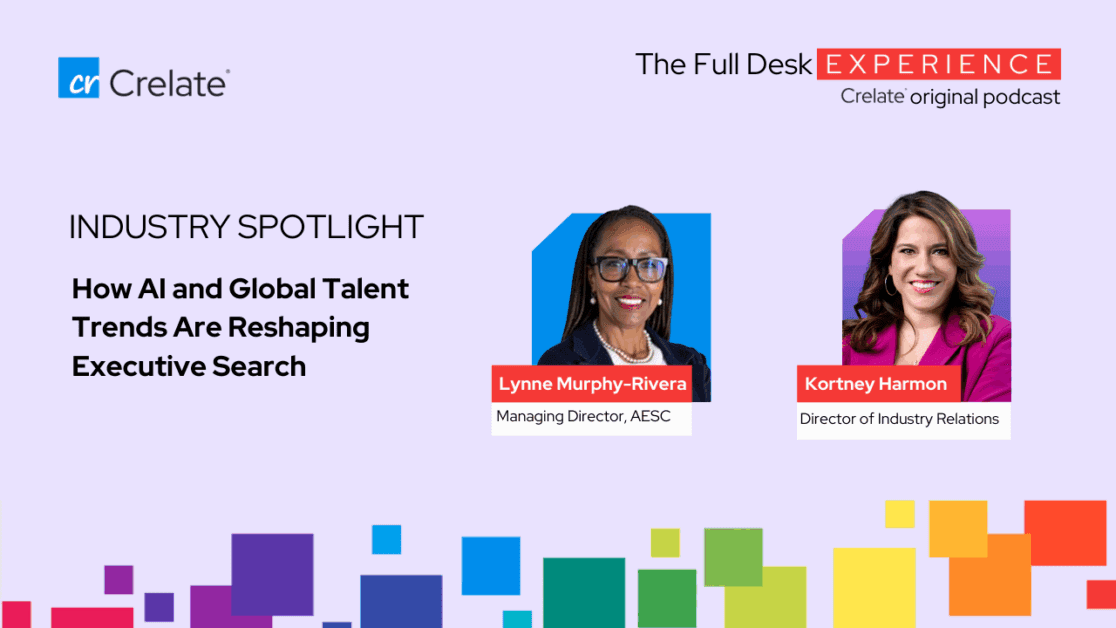
How AI and Global Talent Trends Are Reshaping Executive Search with Lynne Murphy-Rivera, Managing Director- AESC
Show notes
CEO turnover is accelerating—so how are boards, leaders, and search firms adapting while maintaining the judgment that high-stakes decisions demand? In this Industry Spotlight, Kortney Harmon sits down with Lynne Murphy-Rivera, Managing Director of the Americas at AESC, to unpack how AI, demographic shifts, and rising performance expectations are reshaping the future of executive search. Lynne shares on-the-ground insights from global member firms, revealing how today’s volatility is redefining leadership, governance, and the work of retained search.
Key insights you can’t miss:
• Why CEO transitions are at an all-time high—and why boards expect results faster
• How AI is transforming research, oversight, and the need for clearer judgment
• What a five-generation workforce means for leadership pipelines and succession
• How “chaos moments” at the top create strategic opportunities for retained search firms
This episode shows how executive search can lead through uncertainty by combining AI-driven efficiency with the human judgment that defines great leadership advisory. Tune in and discover how executive search is not just keeping pace with change, but helping shape the future of strategic leadership.
________________
Follow Lynne M LinkedIn: LinkedIn: Lynne
AESC Website: https://www.aesc.org/
Follow Crelate on LinkedIn: Crelate
Want to learn more about Crelate? Book a demo here
Subscribe to our newsletter: The Full Desk Experience
Transcription
Lynne Murphy-Rivera [00:00:00]:
Is too much oversight threatening? What could be amazing insights and amazing aha moments that you would find in AI? I have personally found those aha moments with AI just putting a question out there and then going through the journey of they’re asking you questions like, do you want me to include this or should I include that? If you have a board that says don’t use AI at all because it is too risky, and let’s wait until we see what other companies are doing. You’re already behind and you’ve already missed the innovation moment.
Kortney Harmon [00:00:35]:
Hi, I’m Kortney Harmon, Director of Industry Relations at Crelate. This is the Industry Spotlight, a series of the Full desk experience, a Crelate original podcast.
Kortney Harmon [00:00:47]:
In this series, we will talk with top leaders and influencers who are shaping the talent industry, shining a light on popular trends, the latest news and the stories that laid the groundwork for their success. Welcome back to another episode of the Full Desk Experience Industry Spotlight.
Lynne Murphy-Rivera [00:01:08]:
Welcome back to another episode of the Full Desk Experience where we explore strategic recruiting in a post AI world. Today is no different. We’re going to be going beyond traditional talent acquisition to really talk what’s happening at the very top of organizations, the C suite, the boards, and more. And I’m so excited for our guest today, Lynn Murphy Rivera. She is the Managing Directors of the Americas for the association of Executive Search and Leadership Consultants. So that’s a mouthful. That’s A, E, S, C. For those of you who don’t know.
Lynne Murphy-Rivera [00:01:43]:
Did I say, Did I miss anything there?
Lynne Murphy-Rivera [00:01:45]:
Yeah, this is why I put the logo behind me so that. Just in case you. Yeah, it’s. It’s totally fine. You, you were. You hit it right out.
Lynne Murphy-Rivera [00:01:52]:
The pull part, I love it. And for those who aren’t aware, AESC is a global executive search association that really represents premier firms across six continents. And Lynn really sits at that intersection directing the Americas, and she really has a keen insight for the intersection of executive search, for governance, leadership, consulting. And she has a really unique vantage point of how organizations are really navigating and they’re thinking and how they’re coming to business. So, Lynn, thank you so much for spending time to chat with me today and be with me. So I’m so excited.
Lynne Murphy-Rivera [00:02:28]:
Kortney, thank you so much for the invitation. I’ve been looking forward to this. I think since we started talking, I wanted to be on your podcast and we’re very happy to have Prelate as a regional member of our regional partner of our association. So I, I guess one of the things just to jump off to talk about what do I do? Like why do I do what I do? It is an honor to work with executives at this level, those who place and advise leaders at the C suite. And at the board level, I’m responsible for the Americas. So it means that I am not a talent executive talent advisor or a leadership consultant, but I am adjacent to all of that. So, so I have the privilege of sitting in meetings. We have council meetings, governance meetings, moderating panels, contacting my members on a regular basis.
Lynne Murphy-Rivera [00:03:24]:
I’m having a meeting with one later today just to hear what’s happening and I have a sense of the pulse of the world through them and I’m really looking forward to talking with you about that and sharing some of those insights.
Lynne Murphy-Rivera [00:03:38]:
I love that. I can’t wait because your insight is so, so unique. I guess I’m going to kick off with. Tell us a little bit more. I know you talked a little bit about your role at aec. Is there any other thing else? But then what gets you most excited about the executive search industry right now?
Lynne Murphy-Rivera [00:03:55]:
Well, first of all, and I’ll probably say this again, but it, it is absolutely true, the retained executive search industry is like the, like a bellwether for the economy. So as goes executive search goes the global economy and there are many different inputs around there. Things like, you know, depending on the sector that you’re in, is it healthcare, is it life sciences, is it private equity, is it. There’s so many media. The one thing that gets me truly excited is the impact and influence that these executives have on the world. So I mean just imagine they get to influence who leads who the world across sector. It doesn’t really matter. Every practice area, there are practice areas that place surgeons in place.
Lynne Murphy-Rivera [00:04:44]:
I’m trying to, oh pastors, head pastors around the world, we have all of that. And so what gets me most excited is just learning from all of those different individuals who are members and just hearing what their challenges are and what their solutions, what their perceived solutions solutions are given how things are changing so rapidly.
Lynne Murphy-Rivera [00:05:03]:
And it is, it is. Every day is a new adventure which is exciting, it’s an exciting time that we’re in. But it’s really like trying to keep your pulse on this ever changing journey that we’re on. So yes, talk to me about what trends you’re seeing right now as you talk to members across different regions. I know you focus on the Americas, but is there different trends across the board and other countries? Talk to me about the Trends in the U.S. give me the insights, the.
Lynne Murphy-Rivera [00:05:30]:
Insight okay, here’s the skinny. Frankly, we’re all living the same reality. Across the three regions, we separate our association into Americas, EMEA, Europe, Middle East, Africa and Asia PAC. So across those broad regions with 16,000 members, we’re hearing very similar things, which is there’s this looming. If we talk about trends, looming uncertainty, just what do we do next? That’s one that the corporate client who hires our members to find the executives or board placements, they are waiting and pausing. What are they waiting for? Who knows? We just started, you know, the fourth quarter. I was just listening to the conference board’s economic podcast forecast with the CEO Steve Odlin and one of their lead economists. And again, you hear the same story.
Lynne Murphy-Rivera [00:06:35]:
The economy is slow, it’s uncertain, the geopolitical pressures. And that is around the globe. But I think what has spun out of that in terms of a trend is CEO transitions. That’s one another is kind of related to that, which we’ll get to is how does that relate to the multigenerational workforce and the fact that we have five, depending on who you talk to, maybe six. There are people in their 80s who are clearly in the workforce. Oh, unbelievable. So, you know, I would say CEO transitions, the multi generational workforce and then the need for differentiation and branding, which of course we’ll talk more. And you know, all of that is covered with AI.
Lynne Murphy-Rivera [00:07:19]:
Everything is AI.
Lynne Murphy-Rivera [00:07:20]:
So many things.
Lynne Murphy-Rivera [00:07:21]:
I know so many.
Lynne Murphy-Rivera [00:07:23]:
Well, okay, so let’s go into that transitioning of the CEOs. So you mentioned, I know we talked about this a little bit prior to you mentioned that something shifting is how CEOs are being placed. Can you paint a picture of what you’re really observing out there? What does that mean? What are you seeing that’s different than maybe the past?
Lynne Murphy-Rivera [00:07:41]:
Sure, I’ll say. The big difference is expectation and time, timing or time. So 2024, just taking you back there, saw the highest turnover of CEOs in recent history. Just at a rapid pace. It seemed when you open the Wall Street Journal just About or your LinkedIn feed, you’re seeing that CEOs are leaving, departing, moving. And part of that is they’re not the board. And certain activist investors are not giving CEOs the long road or the long Runway that they used to give them. It’s now, get it done.
Lynne Murphy-Rivera [00:08:18]:
18 months. We don’t have time. We’re not going to wait for five years. There is no five year horizon. You need to hit your goals quicker. There’s also this new demand and this gets into that multi generational piece a little bit the demand for future fit. So future fit skills like AI, digital adaptability, can you adapt to the changing world? It’s not going to be the way it was 30 years ago. It’s not going to be the way it was just five years ago.
Lynne Murphy-Rivera [00:08:49]:
So can you adapt and can you pivot? And so those soft skills are becoming more and more, I guess, required. And how do you get a new CEO in there who can do that job and, and do that well and show those three big things really quickly, like maybe even eight months. You have to just jump right in. And then related to CEO transition is the use of fractional CEOs or interim CEOs. And that’s a big executive search business as well, big sector there because it gives the board breathing room to make that the pivot or make the decision. It’s like, let us just get someone in who obviously has the skill set but who is an interim hire who can just help us bridge that gap.
Lynne Murphy-Rivera [00:09:43]:
So you’re seeing a definite increase in those fractional pieces.
Lynne Murphy-Rivera [00:09:46]:
Huge. Huge. There is even a company that might be. I’m not sure if they’re going to be merging. I kind of heard rumors that they may be acquired. But at any rate, this firm started as a, they are a clearinghouse for interim executives. So you kind of put your resume there, I guess you could say the LinkedIn for interim executives. So not sure how long or he’s been around for about three years the firm, let’s see how that goes.
Lynne Murphy-Rivera [00:10:14]:
But that goes to show you firms are being created around that. And then I guess lastly on this CEO transition is there is more rigorous transition planning by the actual company, the organization. Because if not done well, if you have a really bad transition, like there were a few, there was something mentioned, I won’t mention the name to further ruin them, but this was a company where their CEO had a questionable video moment and they had to move him out. That did a bit of damage for that organization, unfortunately. So, you know, the way you transition, the way you plan a CEO move or succession plan is really looked at as something that would. It could elevate your brand or destroy your brand. It could elevate your reputation or really damage it. So yeah, that’s, that’s kind, that is a lot.
Lynne Murphy-Rivera [00:11:11]:
But it’s what I’m reading and I’m, I’m kind of obsessed with it a bit. I’m. It’s very exciting, I find.
Lynne Murphy-Rivera [00:11:17]:
I’m going to ask a further question. So like you said, there was a lot of turnover of CEOs just recently. But does that make it good for those executive search firms? Or are, does it make it almost harder? Because like, almost the way you say it, it’s like, okay, that’s probably really good for some of these firms. But are they being placed in informal networks? Are they like give. There’s more to uncover here.
Lynne Murphy-Rivera [00:11:41]:
That is such a good question. So generally speaking, when you’re talking about chaos, let’s just call that, that’s a bit of chaos, right? I mean especially if it’s haphazard, not planned in a way that is succession related, that you’re signaling to the outside world. We have a bench of great talent and as one moves out, another moves in and we’re organized. Let’s say that’s not the majority of organizations in or around the world. So when that happens, when there is a need for the C suite, that is absolutely amazing. For executive search, retained executive search, that’s what we. And when I say we, I’m talking about the industry. That’s what we do.
Lynne Murphy-Rivera [00:12:25]:
Well, we, we can get in at that point. And, and this begs the point of I was going to talk about later, but I’m going to bring it in now, which is the executive search. Retained executive search, executive or professional is essentially a leadership consultant. You know, so that may be provocative, but why is that? Well, often they’re coming in to advise and not necessarily place. They’re coming in to say, yeah, I know that your CEO just left or you know, was forced to leave, but let’s not be, let’s have a plan. Maybe we look into them. Maybe. Well, here I have this grade shortlist that I can show you today.
Lynne Murphy-Rivera [00:13:05]:
But just to underscore the point, retained executive search are not going to come in with people right away. They’re going to come in and understand the problem, understand what the objectives are going forward and try to get excellence in this next hire. So it’s a good thing, Chaos is a good thing for executive search, Retained executive search, because that’s where they, I think they can really shine in those times to take the chaotic frightening moment and put strategy around it. And it’s what they do really well. This is why you hire a retained executive search firm.
Lynne Murphy-Rivera [00:13:42]:
I love that it honestly makes sense in the entire world of being consultative. And the idea from staffing to CEOs, it’s not a foreign concept, but it’s really the idea of leading and proactive versus reactive.
Lynne Murphy-Rivera [00:13:58]:
Exactly, exactly. And really also.
Lynne Murphy-Rivera [00:14:03]:
Listening to the challenges that your client might have and then also providing solutions or ideas that maybe are not even on the radar for them. And that’s again a reason why you want a consultant when you’re talking about talent and people. You don’t want this to be something where, which does happen a lot, by the way, more than one would want to admit. Where they’ll just hire a friend who has, you know, oh, they, you know, they’ve got an executive MBA from Harvard. They were just a CEO at this previous firm and therefore they would be great.
Lynne Murphy-Rivera [00:14:38]:
Not necessarily so, not always transferable.
Lynne Murphy-Rivera [00:14:41]:
That’s right. That’s right. You’ve got to probe a little deeper. And as I mentioned earlier about those soft skills, those are becoming more and more important than the traditional pedigree of what was your business school? What was your last company? It’s really, can you demonstrate your ability to be adaptive and continue to add value and be a servant leader when needed.
Lynne Murphy-Rivera [00:15:07]:
So how is, let’s take this one step further because you mentioned AI and that is the hot topic of, you know, the, the year right now. How is AI changing what that CEO placement looks like and, or let’s take it one step further, maybe forcing boards to rethin things and how they act. That’s a lot. There’s two things there, but give me your thoughts that.
Lynne Murphy-Rivera [00:15:28]:
Oh, gosh, Kortney, AI, it’s such a generic term now. There is just to make a kind of a blanket statement about AI. The technology itself is incredible, but the technology will not replace judgment, no matter what. And that’s where humans come in and that’s where we are still needed. We’re not heading to robot world just yet. So what’s required in the, the search world and particularly at the executive level, that judgment piece is massive. So it means, yes, use AI for those things that within your policy. I’m assuming a lot when I say that because a lot of firms don’t have an AI policy yet, but they should that as a matter of fact, if you don’t have one, get one like immediately.
Lynne Murphy-Rivera [00:16:17]:
And if you need examples of policies, there are many examples of policies on AI. You can do that search and you can customize it to fit your firm. So where it comes into to executive search is some of the repetitive tasks that scanning, looking at qualities, taking notes, all of those things are so valued. Metaview. I hate to name one, but that’s one that a lot of our, a lot of our members use because it’s just so incredible in its flexibility and its fluidness. And so you need to establish a Policy first, because if you don’t, then you run the risk of the inherent dangers of anything that’s technological, that goes out on its own and does things that you don’t understand. We can’t have that in a business where this is a human business at its core. You know, we are placing leaders around the world and on boards.
Lynne Murphy-Rivera [00:17:16]:
So I’ve said before, I mean, their impact is limitless. It’s borderless. So if you take AI and you’re just using it without any plan, then it becomes a risk to you. So at the aesc, we have partnered with this amazing firm called Field Fisherman. They are based in San Francisco and London and what they’ve done, they are experts in GDPR as well as the burgeoning EU AI Act. And just to help firms figure out, like, what, you know, what am I doing? I mean, because that’s number one, how do I maximize it? They put together a toolkit so that you can. You can mix and match, you can take what you want, you can be educated on what AI can do for you and the firm. So that’s a big one.
Lynne Murphy-Rivera [00:18:08]:
So pulling that to the board, the board’s oversight, when it comes to anything regarding the companies that they serve has to include. It absolutely has to include a discussion around how are you executive committee leveraging AI and what are your plans and what the board does in its oversight. Obviously, it tries to mitigate the risk. I mean, ultimately that’s what they’re trying to do. But there was an article that I read from PricewaterhouseCoopers on board oversight. How can it impact innovation? Is too much oversight threatening what could be amazing insights and amazing aha moments that you would find in AI. I have personally found those aha moments with AI just putting a question out there and then going through the journey of they’re asking you questions like, do you want me to include this or should I include that? If you have a board that says, don’t use AI at all because it is too risky, and let’s wait until we see what other companies are doing. You’re already behind and you’ve already missed the innovation moment.
Lynne Murphy-Rivera [00:19:20]:
And who knows, maybe there is a product innovation that you’re trying to develop using AI that, oh, wow, you’re stopped by the board from using it, that severely hurts the company. And from competition standpoint, it puts you way behind. So, I mean, I see it as you have to jump in the water, but as I said before, there must be AI policy and strategy. So I said a lot, but, yeah, that’s that’s sort of my first level there.
Lynne Murphy-Rivera [00:19:50]:
No, but what you encompassed was a lot. It’s not only AI is affecting how we recruit and how we do our daily tasks, but it’s changing how we place people, how we rethink our board and our strategy, and how you apply those pieces and what gets lost in the shuffle. It’s a lot more than a just a surface level thing that you said. We’re all trying to figure out where this is going, and it’s very interesting to just pick and choose. Like, how am I seeing? What am I seeing? How do I apply?
Lynne Murphy-Rivera [00:20:21]:
Yes, yes.
Lynne Murphy-Rivera [00:20:22]:
And the. The main thing is to have the conversations. I was lucky enough to be able to go to your AESC conference in New York in May, and it was wonderful. And you had amazing speakers like Matt Strain, and we pulled him on the podcast. He was wonderful. But it’s really the idea of listening to the people that are at the forefront, because there are so many things that you can be a consultant about, but you have to be very intentional about listening to others whenever it matters the most as well.
Lynne Murphy-Rivera [00:20:50]:
Oh, exactly. And that’s where, you know, again, the judgment aspect in our conference that we have. It’s an event that we have coming up in San Francisco that you’ll be there. Kortney, I’m so excited to see you. There is going to be a discussion on basically moving from knowledge worker to judgment engineer, which I am so excited to hear. This is Tina Shah Pakade from findom, which AI company, one of our global partners. The discussion on knowledge versus judgment, it shows you how we’ve made the transition, let’s say, over the last generation. Even that certainly in my day, starting out, it was all about, I believe, I think being a knowledge worker was sort of the.
Lynne Murphy-Rivera [00:21:37]:
Was it a term that was coined then. Are you an executive or are you a knowledge worker? And now then we kind of transitioned where everyone became a knowledge worker with the access to information and thought leadership, writing blogs. You’re a knowledge worker. You’re putting your knowledge to task. However, now you take, where’s the knowledge coming from? In many respects now, the way we do research is different. Now we’re using AI for research. However.
Lynne Murphy-Rivera [00:22:08]:
Our judgment comes into play in using AI, because where we have to make that decision of what I’m reading, is it. Where does it. Where did they get it? Where did the source come from? Is it real? Does it follow? Or is it something that just hallucinated? And, you know, that happens. I love that term. I mean, that happens with AI. But that’s not the reason to not use AI. It means just fine tune your judgment skills. When you get your results, it means you really do have to look at them.
Lynne Murphy-Rivera [00:22:40]:
You really have to pay attention to them. And you have to pay attention to them differently than you would if you went to, let’s say old school. You’re going to the Dewey Decimal system. You’re pulling up the card, it tells you where to go on the shelf to pick up the book. You know the source, you know where it is. With AI, with pulling together sources from everywhere and many, there is always the chance that something gets confused and it just appears in your results. You’re just trying to. It’s trying to make you happy, frankly, in some cases.
Lynne Murphy-Rivera [00:23:13]:
So anyway, knowledge worker to Judgment Engineer. I love the Judgment Engineer concept.
Lynne Murphy-Rivera [00:23:18]:
Isn’t it awesome? So excited for that?
Lynne Murphy-Rivera [00:23:21]:
It is. Let’s take a step more broad. Obviously when you look, whether it’s you mentioned some publications or your LinkedIn feed or the offices that you’re working with, what stories are catching your attention lately? Are they AI, are they more, are they different? What stories are catching your eye right now?
Lynne Murphy-Rivera [00:23:41]:
First of all, I really love that question because, you know, we’re, if we’re keeping up, we’re looking at LinkedIn. That helps a lot. And we’re looking at so many other things. I don’t know how many links you have, news, news alerts and too many, you know, you can’t read them all. But one thing I have in the past two years, I think I’ve really maybe three years, I’ve been just intrigued with the new longevity, the concept of the multigenerational workforce because it is a point in time we haven’t seen in human history. We just haven’t been here before. So that’s exciting. And so there is a organization called Population Next.
Lynne Murphy-Rivera [00:24:20]:
Actually it’s a podcast and he runs a substack. His name is Bradley Sherman. He’s amazing. He’s written a book called the Super Age. That was a few years ago. He is all things expert on the demographic shifts in the world and what that means to many different things, one of them being talent. He talks a lot about the new longevity indicators like Generation X basically who are eligible to retire and generation the boomers, obviously who are saying, you know what, we don’t want to leave yet. We have things to do.
Lynne Murphy-Rivera [00:24:57]:
We’re not ready to go off and play golf. Is that a thing anymore? You know, how much golf can you play? We still have so much to add to the World. This is what Gen X is saying and so what is that doing to the economy? So on the balance of things, it used to be, right, the newer generation comes in, the older generation goes out and that’s been the cycle. Well, we’re just kind of like we’re stopped at both Gen X and Baby Boomer and in some cases probably the silent generation, although I’m not quite certain how many. But they’re still there, they are still contributing. What does that do to the employment opportunities for Gen Z, my children and Gen Alpha? And it’s also the AI impact on that Gen Z and Alpha generation is really intense. So people often don’t want to really address it, but Bradley talks about it quite often and it’s another thing that I’ve been reading in my feed and also because I have children who are in that age group, they would be taking the jobs that AI now does. So those repetitive tasks that, that was a junior level entry right out of college, you’re going to go in and you’re going to do these things and learn through that process.
Lynne Murphy-Rivera [00:26:14]:
Now learning is so different, it’s so fast. And I think the positive scale, I don’t want to be so negative about this or Doomsday. As I said, the way that we learn is quite different. So the Gen Z and Alpha may not have the opportunity to learn by doing repetitive tasks. Things are now so easy. We’re going to take things and put them in AI agents and they’ll do those things. Maybe those children, those Gen Z and Alphas are going to be those judgment engineers. You still need humans.
Lynne Murphy-Rivera [00:26:49]:
So I’m fascinated by that Bradley’s information and his perspective. And then the other thing I mentioned, the conference board, I was employed there, I call them my alma mater. They are absolute incredible think tank of all things and particularly economic data. So it gives you kind of a leg up on understanding what’s happening with the employment rate, what’s happening with the economy around the world, what are the inputs and it’s almost like a mini MBA when you listen to their podcast. So I’m, I’m always tuning in there and then there’s other things, but those are my, those are my main, those are my main things.
Lynne Murphy-Rivera [00:27:28]:
I love it. So, okay, I’m going to ask you a question since you’re so engulfed in this idea.
Lynne Murphy-Rivera [00:27:34]:
Okay. All right. Yeah.
Lynne Murphy-Rivera [00:27:36]:
What do you think’s going to happen in the next five years with the generations that are still in this workforce force? How do we adjust? How do we adapt? How do we prepare for that from where we are today.
Lynne Murphy-Rivera [00:27:47]:
Wow. One thing we have to do, we have to provide continuous learning for all generations. It can’t be, let’s do professional development for the, you know, the younger, the newer in career. That. That is such an old concept. It’s. Guess what, there’s a big one. Because of the demographic shift, we really don’t have enough humans to do what we used to do 30 years ago.
Lynne Murphy-Rivera [00:28:12]:
Like, it’s just there is. There are less births around the world. Except for Africa, that is one continent that is gearing up. So maybe that’s, I don’t know, maybe immigration, maybe that will help us. But I think one of the things we need to do first and foremost is training across the generations for all skills, soft skills, AI digital. And there can’t be that stigma that if you’re over 50, you can’t learn new things. That is old. And there’s so many people in that age group that you could just point out, like Oprah, Gayle King, I mean, throw these people out.
Lynne Murphy-Rivera [00:28:53]:
Michelle Obama, I mean, these people, all of them are over 50. They’re all learning new things. They’re all teaching us new things. They continue to do that. So. So yeah, I think that’s my prediction is without the learning, without that constant training and micro bites, because we don’t have the time that we used to have to just learn things. You have to take it in little pieces and then apply it right away. That’s what we have to do.
Lynne Murphy-Rivera [00:29:19]:
And I foresee that as the future of really getting the workforce ready for whatever will come next, which five years sounds like a generation away to me.
Lynne Murphy-Rivera [00:29:31]:
It does. And to think back five years, that it was just like Covid. I. It seems like decades ago, like, it seems so far away.
Lynne Murphy-Rivera [00:29:40]:
Oh, my God. Yes, Kortney. I started with the AESC during COVID Like right in 2020. Yeah, September 2020. Very strange times. But that was almost like two decades ago. It feels like it does.
Lynne Murphy-Rivera [00:29:54]:
It definitely does. I love that. I love what you’re thinking. And obviously me being formally learning and development, I love about training people because we’re all learning certain skills together. There’s not a generation that’s ahead or behind. It’s all adapting proactively together.
Lynne Murphy-Rivera [00:30:13]:
So. So true. Exactly. Because that was the old school. It’s like, well, you know, the seniors, let’s learn from the seniors. So a lot of, you know, things that I’ve read now on that learning model is about reverse mentoring where the more senior is learning from the more junior. And then the traditional junior learning from the senior. That is absolutely what we’ll be doing for the next five years.
Lynne Murphy-Rivera [00:30:38]:
I learned from my team that are all generations below me constantly, I’m better for it.
Lynne Murphy-Rivera [00:30:46]:
And there’s give and take with that. So I love that you had mentioned looking globally. So looking at globally, like AESC’s membership globally, how are regional differences shaping the future of executive search? Like, and we’re talking about learning off of each other. How can these firms learn off of each other throughout this process?
Lynne Murphy-Rivera [00:31:06]:
Well, that is like the, the pinnacle of why we exist as a trade association, really. I mean, it is all about peer to peer learning. And if you look back to the beginnings of The AESC in 1959, by the way, December of 1959 is when the AESC was founded by Gardner Heydrich, Russ Reynolds, Sidney Boyden. I mean, so, yeah, a lot of. So those giants of the industry said we’re competitors, but we want to strengthen the industry. We want this industry to be known because it’s unregulated, right? And there isn’t a course you can take, there’s not a Series 7 that you can pass in order to become an executive search professional, which I wish there was, actually just kind of further deep. And it takes a lot to do what they do. And it is not for the weak at heart.
Lynne Murphy-Rivera [00:32:03]:
It is not for just anyone. And the skill set required to do what they do is enormous. And we at the AESC put together a course about 15 years ago in alliance with Cornell to drive home the point of further training, further experience, further knowledge for executive search leaders is absolutely critical. So that’s an example of a global, our global approach there was to invite, well, they registered actually executive search professionals from the three different regions to participate in this program. I was in the program in 2021 and my cohort was primarily Asia, PAC and the Americas. Now you talk about learning. We learn so much in terms of how to, you know, examples, norms, you know, regional norms. How does that affect business? A big part of what we do is we have members that are global networks.
Lynne Murphy-Rivera [00:33:06]:
So like the Alto partners, like the Panorama, EMA partners. These are big firms, global firms, and they are a conglomerate of smaller firms. And so what in terms of learning globally, we will have partner meetings, global partner meetings. And when you hear from them across the board, in terms of what challenges they’re facing, Kortney, what’s so remarkable is how much is the same that the Americas are going through a little bit of a geopolitical issue with tariffs. And with those tariffs that starting here, that’s affecting the rest of the world. So we hear how they’re dealing with, how they’re dealing with tariffs and the impact on their business and how they’re maybe pivoting in order to help their corporate clients deal with that reality. And so those are conversations that are had. And we’ll have leadership roundtables with the three regions.
Lynne Murphy-Rivera [00:34:08]:
We’ll have the boutique independent firm forum where it brings in my region. I will have the Americas and the EMEA region together. So we get to hear them together, talk about their challenges. I will say being in the US and being an American, I think when. And being in a global association, the one, one thing I’m learning from my colleagues who are in Europe and Asia pac is that even though America or the US may be the perceived center of the world, things happen outside of the US A lot is going on out there. And I think it’s such a great reminder when you have a global trade association that if we can work together to understand each other’s differences more and our strengths and how we can actually help each other with business expansion, which, that is the existence, the reason for our existence at the aesc. We, we want to help our members grow. They grow, we grow, we, we survive.
Lynne Murphy-Rivera [00:35:13]:
I love that. Is there. Okay, I want to ask another question, but I want to go on aesc. So how do people get in? Tell me more about aesc. So we’re here, let’s plug this. I want to talk all the things. Obviously you said 1950, December of 1950, what, 59.
Lynne Murphy-Rivera [00:35:31]:
So 66 years and running. So amazing, amazing, amazing. And it’s gone through quite a bit. One thing that has remained though from back in the day to now is there is rigor involved in becoming a member. It is not something that you can just send me a check and say I want to join. So there is, there is a process and it’s somewhat lengthy but not exorbitant, but it allows us very similar to an executive search process where you are looking for candidates that would be in your long list or your short list, very similar. So we, yeah, there’s, I would call it an interview, kind of an initial interview where we learn a little, learn a little bit about who they are and why they’re interested. From there, we.
Lynne Murphy-Rivera [00:36:20]:
And how, you know, what the size of their firm is, how they operate, what type of business are they. To be a member of the AESC, you must be retained executive like the 90, 95% of your business must be that. So that means Contingent firms are not welcome to be members because it is not the brand of what we do as management consultants. Although some of our firms may do 5% here and there for a client that ask for it. But it is definitely not anything that we, that we endorse. So we have that initial conversation. Then from that there is, you know, member references that we ask them to give us references to members that they may or may not know. We’ll connect them with members that they may or may not know to get that sort of discussion or like sidebar, why are you a member? What are you getting from it? And do you think I should join? Then we get their client references.
Lynne Murphy-Rivera [00:37:13]:
We asked for six client references.
Lynne Murphy-Rivera [00:37:16]:
Wow.
Lynne Murphy-Rivera [00:37:16]:
And I do these interviews, by the way, in all of these, the vetting. So I call and I get to talk with CEOs, who. It’s such a great feeling to hear a CEO say something like, if I’m looking for a C suite or board position, I will only go to this firm because I trust them, the quality of their work. I can rely on them. And here’s an example of how they helped me in a really dire situation. You know, so those are. I hear all those great stories. Then it goes.
Lynne Murphy-Rivera [00:37:46]:
All of that information goes to the membership committee, which is right now, there are seven. And they come from all three regions within the. I say regions within the Americas, Canada, us, Latin America. And then they review the information I gave them. We redact the client names because we don’t. I mean, they’re our competitors, right? They are all competitors. We don’t want to share that. But they get to see what the client said about them, and then they vote.
Lynne Murphy-Rivera [00:38:13]:
We need a 100% yes from the membership committee that we should go to the next step. So it’s still not done. Then you go. The next step is then the Americas Council. So we have three governing bodies, The Americas, emea, Asia, pac. So for the Americas members, it goes to the Americas Council, which is about 32 members from Canada, US, Latin America. They review and it’s a yes, no. I’ve got to tell you, in my five years, I have had to say no to a few.
Lynne Murphy-Rivera [00:38:51]:
And there have to be valid reasons. It can’t be no. He competes in my area. No, we’re all competitors. That’s irrelevant. So the reasons have to be pretty emphatic. Reputation is a big one. There are stories there I will not share, but some really juicy, maybe share on the side.
Lynne Murphy-Rivera [00:39:10]:
No, I’m just kidding. So when that happens, we pull them aside or it will be that. It looks like this firm is doing. This is a real example, is doing contingent work and has a whole contingent operation in addition to an executive search operation. That’s fine as long as you are branding those as separate businesses. And the business that is joining the AESC is the retained executive search component. And it can’t be. I won’t name their names either, but there are some firms out there, when you say their names, you know, and they’re huge staffing firms.
Lynne Murphy-Rivera [00:39:47]:
Big, massive. They can’t be members of the AESC because even though they have wonderful executive search divisions at this point in time, our bylaws will not allow for it. For them to become a member, who knows, maybe that will change. But then once they vote on the affirmative, then you become a member. And that’s about six to eight weeks or depending.
Lynne Murphy-Rivera [00:40:08]:
But you’re very intentional. You’re very intentional for the audience that you. You bring in, because you’re very intentional. What I’ve seen so far in working with you is the content you’re putting out. It’s specific to the audience, it’s specific to the message, it’s specific to who they’re working with. And it just seems like a very intentional effort from your training to your conferences and so forth.
Lynne Murphy-Rivera [00:40:32]:
That’s so great to hear, Kortney. Thank you for that. We certainly try. And you know, they’re always. There are always exceptions. Exceptions come up and then you have to. If there’s a major exception and I’m not sure of what to do, I go to my colleagues who are in Europe and Asia pac. If they’re not sure, I go to my CEO.
Lynne Murphy-Rivera [00:40:52]:
Sometimes we’ve gone to the global board. So we have a global board. In addition to those three regions, we have a global board that represents each one of those regions. There are about 20 of them. And our CEO reports to the Global board. So what we’re trying to do writ large is take the retained executive search position from the inside out so that the world, every CEO and every company knows that AESC and its members represent quality. They’ve gone through this intense vetting process. They are way beyond someone who has a great Rolodex.
Lynne Murphy-Rivera [00:41:32]:
They’re not even in the same league. I don’t care if your Rolodex is great. That’s an old term. It’s not your contacts. It is the process that you follow in finding great talent around the world. Is it confidential? Is it? We have these standards that are on our website. You know, confidentiality is one. Excellence, quality.
Lynne Murphy-Rivera [00:41:51]:
When Someone has the AESC brand on their signature or they could say I’m a member, it’s on their website. That means a lot. And our goal is to continue to publicize that and to promote that so that it becomes more of a recognizable brand of quality to people who are in the realm of hiring and recruiting executives to come to their firms.
Lynne Murphy-Rivera [00:42:16]:
I love that. And we will put. If you’re okay with it, I’m going to put your LinkedIn profile in the AESC website. For those that are listening. We have a large executive search presence so would love to be able to share that with our audience as well. Hence it’s called the full desk experience. I’m only going to ask you one more question. I love like hypotheticals or like if you could do one thing, so ignore my dreamer concept, but if you could wave a magic wand and solve one challenge facing executive search firms today, what would that be?
Lynne Murphy-Rivera [00:42:46]:
I kind of hinted at it in my previous because I live and breathe this dream. It’s really more than a dream. It’s really a. It’s an intentional action that we’re taking, particularly with our new CEO. My dream is that retained executive search is recognized globally as a uber powerful industry. The one that frankly it is the sum of its parts, frankly. 22, about 22 billion globally really does not underscore the impact which is unlimited. If you think around the world, every executive that’s placed in every sector, that’s what we do.
Lynne Murphy-Rivera [00:43:24]:
So my wand says it becomes a recognizable brand. So much so that as you’re walking through an airport, right, you might see the AESC logo there and a little QR code.
Lynne Murphy-Rivera [00:43:39]:
And you’ll. Someone will click on it and say oh wow, that’s pretty. And go to our good website, that incredibly beautiful website and say I want to be a part of this. And not only to get business, but to also attract new talent to executive search. It is often I hear people will say they fell into executive search from something else. There are few of them who were intentionally out of school. Like Cornell has a program, their HR program is really a great recruiting ground for executive search. But I wanted to be one of those where the newer generation is inspired to join because of the brand elevation and that clients are inspired to hire AESC members and only AESC members because that represents quality in retained executive search.
Lynne Murphy-Rivera [00:44:28]:
What a wonderful wish. I love it. I can’t wait to see it in an airport too and scan my QR code. I don’t think it’ll may not be in my airport when I come to San Francisco to see you just yet. But I’ll be on the lookout, look.
Lynne Murphy-Rivera [00:44:42]:
Out for for 2026.
Lynne Murphy-Rivera [00:44:44]:
I love that. Well, Lynn, thank you so much for sharing your insights with us today. From CEO transitions to AI impacts on our industry and boards, you’ve really kind of given your vision and what you’re hearing and the pulse of executive search and where they’re heading and why it’s really important. So thank you so much for the time today.
Lynne Murphy-Rivera [00:45:03]:
Such a pleasure, Kortney. Really appreciate it talking with you and hanging out with you.
Lynne Murphy-Rivera [00:45:08]:
I love it. Until next time, tune in to us at fulldeskexperience.com and all of the wonderful things and check out other episodes. And until next time, have a wonderful day.
Kortney Harmon [00:45:21]:
I’m Kortney Harmon with Crelate. Thanks for joining us for this episode of Industry Spotlight, a new series from the Full Desk Experience. New episodes will be dropping monthly. Be sure you’re subscribed to our podcast so you can catch the next Industry Spotlight episode and all episodes of the Full Desk Experience here or wherever you listen.