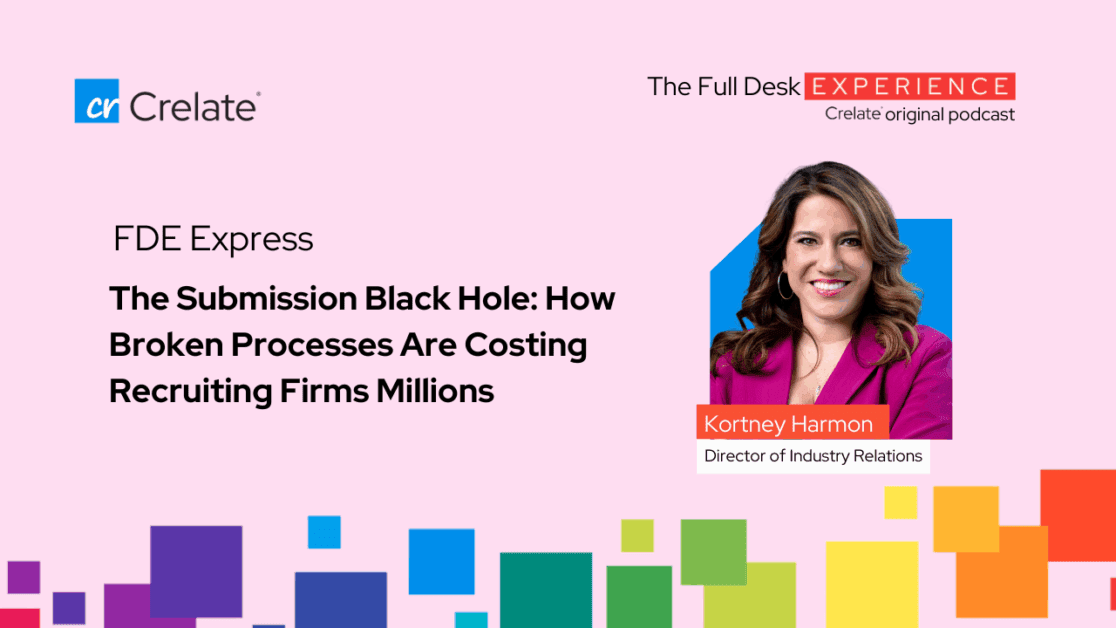
The Submission Black Hole: How Broken Processes Are Costing Recruiting Firms Millions
Show notes
What happens when candidate submissions disappear—and no one can explain why? In this FDE Express episode, host Kortney Harmon breaks down how undefined submission processes quietly drain revenue and momentum.
Drawing on real-world audits, Kortney reframes failed submissions as an operational issue, not a recruiter problem. She outlines how inconsistent formats, missing follow-up, and lack of visibility create a costly “figure it out” tax—and what a revenue-protecting submission framework actually looks like.
Key Takeaways
• Why submissions are as revenue-critical as invoicing
• The hidden cost of letting recruiters “figure it out”
• What a standardized, flexible submission process includes
• How visibility and tracking protect placements and momentum
Listen in for practical strategies you can implement immediately to bring consistency and control back to your submission process.
___________________
Follow Crelate on LinkedIn: Crelate
Want to learn more about Crelate? Book a Crelate demo
Subscribe to our newsletter: https://www.crelate.com/blog/full-desk-experience
Transcription
Kortney Harmon [00:00:00]:
There’s a huge difference between micromanaging and providing operational framework. You can have a standardized submission process while still allowing relationship based flexibility. In fact, when you remove the operational uncertainty, your recruiters have more time to focus on relationships. And that’s going to be a big focus in 2026. You’re going to hear a lot more about. But think about it this way. Does your firm have a standardizing invoicing process? Of course it does. Because you understand that billing is too important to leave individual interpretation.
Kortney Harmon [00:00:33]:
Submissions are just as revenue critical, but most firms treat it as a figure it out yourself territory. Hi, I’m Kortney Harmon, Director of Industry Relations at Crelate. Welcome to FDE Express, a short, sweet format of the Full Desk Experience, a CRELATE original podcast. We’ll be diving into specific topics to show you how you grow your firm within 10 minutes or less. Yes, each episode will cover quick hit topics to give you inspiration and food for thought for your talent businesses. Let me paint a picture for you. One of your recruiters just spent hours sourcing the perfect candidate. They’re excited.
Kortney Harmon [00:01:17]:
They craft what they think is a great submission. They hit send and nothing happens. The candidate disappears into what I like to call the submission black hole. Now here’s the uncomfortable question. Is it your recruiter’s fault that there’s no response? Or is it a symptom of a broken process that they never had in the first place? Welcome back to another episode of the Full Desk Experience. I’m Kortney Harmon and today we’re having a conversation that might make some leaders uncomfortable. Because we’re not just talking about why submissions fail. We’re talking about why your firm doesn’t have a standard process, but more importantly, how much revenue that’s costing you.
Kortney Harmon [00:01:57]:
If you’re an operations leader or a practice head or a firm owner. This episode is absolutely for you. Because the submission failures your team is experiencing, they’re not just individual performance problems. It’s not just a client problem. They’re your operational voids. Maybe the gaps in your process where you’ve essentially told your team in the best possible way, figure it out yourself without giving them that framework tool or maybe even standard process to succeed. And every time a submission fails, you’re leaving money on the table. And that was effort and time to put into the goal of that submission or placement.
Kortney Harmon [00:02:35]:
Let’s start with business impact, because this isn’t just about candidate experience or recruiter frustration. This is about revenue. According to recent research, about 52% of job hunters say lack of of Response from employers is their number one complaint. But here’s what that means for you and your business. Those candidates are also talking to your competitors. Every submission that disappears into the void is a candidate who might have accepted another firm’s placement. The data shows that only 3% of applicants actually get invited to an interview. Now think about that from a process perspective.
Kortney Harmon [00:03:13]:
Are your recruiters missing 97% because they’re submitting bad candidates? Or is it because you haven’t given them the defined process for maybe how to position, present and follow up on your submissions? I’m willing to bet it’s the latter. And here’s how I know. When I talk to firm leaders and ask them, what’s your standard process? The most common answer I ever got is some version of, well, we tell them to send a resume over and a brief overview. That’s not a process. That’s lack of process disguised in delegation. So let’s do some quick math. For external recruiters, let’s say an executive, maybe they earn around 20% of the candidate’s first year salary as their placement fee. For $100,000 placement, that’s $20,000 fee to your firm.
Kortney Harmon [00:04:06]:
Now, each of your recruiters lose just two placements. If we say they lose two placements a quarter due to submission process failures, candidate maybe went dark, client never responded. Timing it was off. That’s $160,000 per recruiter annually left on the table. For a firm with 10 recruiters, that’s $1.6 million lost in revenue. It’s not because your team isn’t talented. It’s because you haven’t built the operational infrastructure they need to succeed. So when I would audit firms and I would work with offices, I consistently found some of the same operational gaps.
Kortney Harmon [00:04:46]:
And you might not think they’re gaps, you might think that they’re just par for the course. But let me go through them. Gap number one is there’s obviously no standard submission process. They’ve told their team send great candidates, but they haven’t defined what a quality submission look like. What’s the format? Is there information required? Is there any positioning elements on how you want to present that candidate? Did you have to blind the resume? Your recruiters are doing it differently for each recruiter, each client, which means you have no way to diagnose what’s working and what’s not. Gap number two is there’s no tracking requirements. I know this sounds silly, but oftentimes we’re tracking it on a whiteboard. But how many of you can tell Me right now.
Kortney Harmon [00:05:34]:
How many candidate submissions are outstanding with no response or no details from the client? How long have they been pending? What’s the next action step? If you can’t answer that, then you have a tracking void. Your recruiters are operating blind and so are you as a leader gap number three, maybe. There’s no communication protocols. And this is what I found most commonly. When should recruiters follow up after a submission? How? What information should they gather from their clients before submitting? These aren’t minor details. They’re revenue critical steps that most firms leave entirely up to individual discretion. The statistics really back this up. Only 11% of organizations track candidate satisfaction or client satisfaction throughout that process.
Kortney Harmon [00:06:24]:
That means 89% of firms, probably including yours, have no systematic way to measure what’s happening after the submission. You’re flying blind on one of the most critical stages of your revenue cycle. Now some of you are probably thinking, but my top performers figure it out. They have a great submission process. And you know what? You’re probably right. Your top performers have probably built their own submission systems through trial and error based client per client. But here’s the problem that knowledge lives in their head, not in your operation manuals. Which means it’s not scalable.
Kortney Harmon [00:07:02]:
When you hire a new recruiter, they have to reinvent the wheel. How long does it take to help them figure out what your top performers already know? Six months, probably at least a year. That’s six to 12 months of lost productivity, lost revenue because you’re making everyone learn the hard way. What else? It’s not consistent. When every recruiter has their own approach. You can not identify patterns. You can’t say this submission format converts at 30% while this one converts at 10 because you have no standardization to what to measure against. And last but not least, it creates a knowledge risk.
Kortney Harmon [00:07:42]:
What happens when your top performers leave? They take all the institutional knowledge with them. You are back at square one. And then there’s this thing that I like to call the figure it out tax. It’s the hidden cost of not having a defined process. Every time a recruiter has to go figure it out on how to handle a submission situation, that’s time they’re not spending on revenue generating activities. Research shows that 45% of business leaders spend more than half of their time on talent acquisition tasks. How much of that time is wasted because they don’t have a clear process to follow? Let me give you a real example. I worked with a mid sized executive search firm that couldn’t figure out why their submission to interview conversion rate was so low, when we dug in, we found that every recruiter was doing their submissions differently.
Kortney Harmon [00:08:34]:
Some sent resumes just via email. Some sent resumes while they were on the phone. Some created elaborate PDF presentations. Some blinded their resumes. A few used a client portal. But inconsistently and most importantly, majority of them had no follow up system at all. These firms never had defined processes. They literally couldn’t diagnose what was wrong.
Kortney Harmon [00:09:04]:
Once we implemented a standardized submission process with clear steps, their conversion rates increased by 42% in six months. Not because they hired better recruiters, but they gave their existing team a repeatable process. Now here’s the uncomfortable truth. When you don’t have a defined process, your team fills that vacuum with whatever is easiest, not with what’s most effective. Email submissions are easy, so that becomes default. Even though that we know hiring manager inboxes are black holes. Do you recommend a phone call at the time of submission? Because I do now. No follow up tracking is not easy, so submissions often get forgotten.
Kortney Harmon [00:09:50]:
Skipping the pre submission, the client call is faster, so context gets lost. Oftentimes we’re not able to relay what’s really most important of what that client’s looking for. Your team isn’t choosing these approaches because they’re best practices. They’re choosing them because it’s the absence of a defined process. They’re optimizing for what’s easiest in the moment, not what drives revenue. Now let’s take it one step further. Let’s talk about the leadership blind spots that creates these process voids in the first place. The most common thing I hear from firm leaders is we are experienced recruiters.
Kortney Harmon [00:10:29]:
They should know how to submit candidates. Let’s face it, I hear the same thing in coaching. I don’t need to tell a 10 year old where to throw the ball. They absolutely know. But let’s face it, that is not the case in any of those situations. The reality is every firm has a different client expectation, different value propositions, different competitive positioning. Your submission process should reflect your firm specific approach to the market. If you haven’t defined that you’re expecting your recruiters to be mind readers and that they are not.
Kortney Harmon [00:11:02]:
Plus, let’s face it, the market has changed. The submission best practices from five years ago do not work anymore. According to recent data, 70% of candidates still prefer in person interviews despite remote work trends. But how many of your recruiters are building that human connection before they submit? Have you made it part of their process? I also hear a lot of that used to Be the case. We don’t want to micromanage. We want to give our recruiters freedom to work their relationships. But there’s a huge difference between micromanaging and providing operational framework. You can have a standardized submission process while still allowing relationship based flexibility.
Kortney Harmon [00:11:45]:
In fact, when you remove the operational uncertainty, your recruiters have more time to focus on relationships. And that’s going to be a big focus in 2026. You’re going to hear a lot more about. But think about it this way. Does your firm have a standardizing invoicing process? Of course it does. Because you understand that billing is too important to leave individual interpretation Submissions are just as revenue critical, but most firms treat it as a figure it out yourself territory. Some leaders think if they change an ATS or a CRM submission, problems will fix itself. But technology without process just automates chaos.
Kortney Harmon [00:12:24]:
I have seen firms invest in expensive platforms, additional tools for client submissions, but nobody tells them that there’s actually a problem before that there’s no process requiring them to do so. Everybody uses something differently, which defeats the purpose. Technology should absolutely support your processes, not be your process. If you haven’t defined what a quality submission looks like, what information needs to be tracked, what’s the follow up protocol? No technology platform will solve that for you. So let’s bring it back to the numbers, because that’s what matters to business leaders. Research shows that 60% of leaders express doubt about their hires at the time they make them. That’s 60%. That uncertainty often comes with insufficient information during the evaluation process.
Kortney Harmon [00:13:15]:
When your recruiters don’t have a process for providing context. Cultural fit analysis strategic positioning because you haven’t defined what that looks like, your clients are really going to be making decisions with incomplete information. And when your clients are uncertain, they delay decision making, they pass on good candidates, and your revenue pipeline stalls. Every delayed decision is a cost. The average time to hire is now around 44 days, give or take, and depending on your industry. But how much of that is wasted because your processes are really gapping? And how your team submits and follows up and has communication with candidates and clients. Now let me tell you what a good process looks like instead. What does a revenue protecting submission process actually look like? Your firm needs a documented standard for every submission.
Kortney Harmon [00:14:13]:
It includes formatted candidate, not just a resume. So what are you submitting to your candidate or your client? Overall strategic fit analysis explaining why this person is right for this role. Maybe it’s a cultural assessment or alignment. Given those examples, maybe there’s a personality assessment that goes along with that, but there needs to be specific examples tied from the candidate to the job requirements. A clear next step to call to action. This shouldn’t be rigid. Your recruiters can adapt specific relationships, but the elements should be consistent across your firm before any candidate gets submitted. Your process should require a live conversation with a hiring manager, not an email to gauge current priorities.
Kortney Harmon [00:15:00]:
Confirmation on the client’s review timeline because, let’s face it, sometimes our jobs aren’t real, that we’re working on understanding who else is involved in the hiring decision and then agreement on how feedback will be provided. This isn’t micromanagement of your clients, but it’s protecting your team from submitting candidates into a black hole because they didn’t have the information they needed. Here’s where technology comes in, but as a requirement, not an option. If your firm has a client portal functionality like ours does here at Crelate, your process should require its use. Not because it’s fancy, but because it provides information. It’s professional and consistent. There’s tracking visibility for both the recruiter and leadership, there’s accountability for next steps, and there’s data that you can analyze and improve conversion rates. It helps your clients and you if you’re leaving submission method up to individual preference, you’re leaving revenue on the table.
Kortney Harmon [00:15:59]:
So I would encourage you to define your process. Figure out what your timeline is for follow up based on submission method, what information to gather in follow up conversations, how to escalate submissions when they’ve gone dark, how to capture and share feedback across your team. This protects your recruiting firm from the awkward should I follow up or should I wait? Paralysis that kills momentum. As a leader, you should be able to see this at any time. How many submissions are outstanding? How how long have they been pending? What’s the next action step? Which clients are responsive versus which ones are black holes? And if you can’t see this, you have a process problem that’s costing you revenue. So as we go into the new year, I know what you’re thinking. You’re probably thinking it sounds like a lot of work to implement or it’s just fine for now, but I would encourage you move into the new year tightening up those straps. You’re right.
Kortney Harmon [00:16:56]:
Defining processes, documenting standards, training your team, holding them accountable to new ways of working all takes effort. But here’s the question. What’s more expensive? Investing time once to build operational infrastructure that protects revenue going forward or continuing to lose $400,000 per recruiter or $150,000 per recruiter? Annually because they’re figuring it out as they go. The firms that are winning in this market are the ones that are growing while others are struggling. They’re not winning because they have better recruiters. They’re winning because they’ve built operational systems that let their recruiters perform at the highest levels. So here’s the good news. You don’t have to build it from scratch.
Kortney Harmon [00:17:41]:
You don’t have to buy an additional tool. The right technology partner can provide framework and tools and make standardized processes easy and create easy follow up. This is exactly why crelate build its client portal for tracking functionality the way we did, to give firms the operational infrastructure that makes quality submissions the path of least resistance, not the path of most effort. When your processes and your tech are aligned, compliance isn’t something that you have to force, it’s just how work gets done. Now here’s my challenge to you as a leader. Can you describe your firm’s submission process in detail right now? If someone joins your team tomorrow, is there a documented process that you can hand them? Are they going to have to figure it out by watching others? If you don’t have clear submission standards, tracking requirements, and follow up protocols, then you have a process void. And that void is costing you revenue every single day. Good news is it’s fixable and it requires leadership acknowledgement that this is an operational problem, not an individual performance problem or a client problem.
Kortney Harmon [00:18:46]:
Your team can’t fix process voids on their own. That’s your job as a leader. So start by auditing where your process gaps are, committing to filling them because your revenue depends on it. If you want to talk more of how your teams are building these operational systems, or see how firms are using technology like CRELATE to make good processes easy to follow, reach out to me on LinkedIn. Thanks for listening to the Full Desk experience. And until next time, remember your team will perform at the level of systems that you build for them. Make sure that those systems are worthy of their talent. That’s all for today’s episode of FDE Express.
Kortney Harmon [00:19:25]:
I’m Kortney Harmon with Crelate. If you have any questions or topics you’d like for us to cover in future episodes, please feel free to submit them to [email protected] or ask us live next session. And don’t forget to subscribe to our podcast wherever you listen and sign up for our monthly events to keep learning and growing your business. Thanks for tuning in to FDE Express, a short and sweet format of the Full Desk experience. We’ll see you next time.