Episode summary
This episode shares Kortney Harmon’s keynote from Benjamin Mena’s Elite Recruiter Sales and BD Summit, for agency leaders and producers facing longer sales cycles. Kortney Harmon explains why narrowing focus, choosing the right accounts and building repeatable systems wins more revenue than adding activity in today’s staffing market.
Key takeaways
- Kortney Harmon notes that 60 to 80% of agency revenue typically comes from fewer than 20% of clients, so account selection is a strategy decision.
- A $10 million firm at 25% gross margin that loses 10% to inefficiency gives up $250,000 a year without losing a single client.
- Replacing an experienced $70,000 recruiter costs $70,000 to $105,000, so burnout from unfocused activity drains real money from the firm.
- Decide which accounts get senior access, tailored insights and thoughtful follow-up, since intentional selling means saying no as often as yes.
- Before adding another tool, audit what your current ATS and CRM already do and have your best adopters review overlapping functionality.
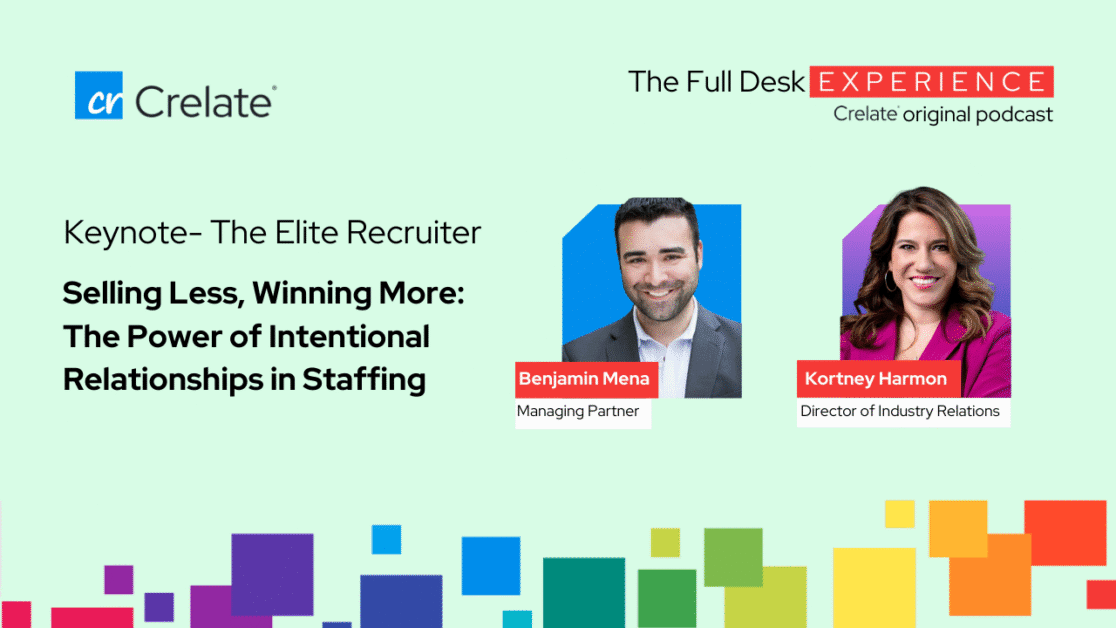
The Elite Recruiter- Selling Less, Winning More: The Power of Intentional Relationships in Staffing
Show notes
What if growth in 2026 isn’t about doing more — but choosing better? In this keynote from Benjamin Mena’s Elite Recruiter Sales & BD Summit, Kortney Harmon reframes what winning looks like in today’s staffing market.
In this episode, you’ll hear insights from Kortney Harmon’s keynote at Ben Mena’s Sales and BD Summit, where she explores why narrowing focus, redesigning revenue strategy, and protecting the right relationships are critical in today’s staffing market. As sales cycles lengthen and effort becomes more expensive, Kortney breaks down how intentional account selection, system alignment, and leadership judgment can eliminate wasted activity and margin erosion.
From confronting burnout and revenue concentration to building repeatable processes that reduce reliance on heroics, she shares practical frameworks to help firms move from reactive selling to relationship-driven growth
Whether you’re an agency leader, full-desk producer, or building the next phase of your firm’s growth, this episode challenges you to rethink where your effort is going — and whether it’s truly compounding.
____________
Follow Benjamin Mena LinkedIn: LinkedIn: Benjamin
Frequently asked questions
Why isn’t more sales activity working for staffing firms?
Kortney Harmon says effort has become expensive. Sales cycles run 30 to 40% longer and call and email volume show weak correlation with placements, so focusing on the right accounts matters more than volume.
How much does inefficiency cost a staffing firm?
Back office inefficiency and rework can cost 10 to 15% of gross margin. For a $10 million firm at 25% gross margin, a 10% inefficiency equals about $250,000 a year.
How should staffing firms reduce their tech stack?
Start by reviewing what your current ATS or CRM already does, including new releases. Kortney Harmon suggests having your best adopters audit overlapping tools before you add another one.
Transcription
Kortney Harmon [00:00:00]:
Modern selling isn’t about becoming transactional. It is about relationship-based, but it’s also about understanding where those relationships sit and where you’re moving them forward. Intentional is where most firms think they operate, but when they honestly take a look in the mirror, very few people actually do because nothing changes intentional unless a leader makes a choice.
Hi, I’m Kortney Harmon, Director of Industry Relations at Crelate. Over the past decade, I’ve trained thousands of frontline recruiters and I’ve worked with hundreds of business owners and executives. To help their firms and agencies grow. This is The Full Desk Experience, a Crelate original podcast where we will be talking about growth blockers across your people, processes, and technologies. Welcome to another episode of The Full Desk Experience.
Kortney Harmon [00:00:57]:
Welcome back to another episode of The Full Desk Experience. I had the opportunity to speak at Ben Mena’s Sales and BD Summit in January and had an absolutely amazing time. Ben’s a true rock star in our industry, and I had the privilege to be a part of his community, which is oh so great, great conversation, great banter and insights in the chats.
And I got the opportunity to talk about why selling less but focusing more intentionally is actually how firms win in today’s market. We covered the idea of narrowing effort and investing deeply where it matters most. So let’s jump right in and I hope you enjoy the replay.
I’m so excited to be here. Ben does such a wonderful job in putting on these events and so excited to always be a part of them, not only as a panelist and a speaker, but with Crelate as well.
Kortney Harmon [00:01:53]:
I am so excited to talk a little bit more about selling and what we’re here to talk about today. So let me go ahead. If you didn’t get to connect with me, I would love for you to do so and, uh, would love to hear all about the summit and what you’ve learned.
But here we are to talk about selling less, winning more. So before I get into anything tactical, I really want to ground us in why this conversation matters right now. And I’m going to do it from a few aspects, cuz not only, yes, I work at Crelate ATS CRM, So I hear some of that, but I run our podcast.
Ben has been on our podcast as well and will be here again in March. So I run a podcast talking to offices.
Kortney Harmon [00:02:33]:
I was like you, I actually ran a desk, so I’m not doing it actively today, but have done there, have been there. So I’m hearing a lot of conversations as well. And most firms I talk to aren’t really struggling because their teams aren’t working hard.
Let’s face it, they’re struggling because maybe effort has become expensive and maybe you’re not struggling. I’m excited for you if you’re not. It just seems like the world has become a different place and a little bit slower right now, and maybe the staffing and recruiting world.
So that’s kind of the lens I’m going to focus on today. So what I’m hearing for some firms, hiring has slowed, sales cycles have maybe tightened, and maybe the margin for wasted activity is gone.
Kortney Harmon [00:03:13]:
So whenever I say selling less, I don’t mean disengaging, pulling back, or doing less. What I really mean is being intentional, far more intentional about where we sell, who we invest in, how we redesign revenue so we don’t have to rely on heroics or just our top performers.
So this session is about how high-performing firms are resetting their approach to growth, not by doing more, but by focusing on the right relationships and backing focus with systems that make it repeatable.
So by the end of this, my goal isn’t to give you the exact playbook, which I’m going to give you some playbooks, but I want to help you see where your attention needs to be focused and where you might be quietly costing yourself some revenue as we head into 2026.
So what if the market isn’t slowing, it’s demanding different decisions? This market didn’t suddenly get harder. I think it really got more honest. It’s exposing where we focus on processes and decisions that maybe haven’t kept up. So we’re going to talk a lot about that today.
Kortney Harmon [00:04:13]:
So when I look what’s happening right now in staffing and recruiting, none of this should feel surprising. Hiring demands are down, sales cycles are longer, and recruiter productivity is slipping. And I don’t mean not because teams aren’t working, because every placement takes a little bit more effort than it used to.
At the same time, most firms are really discovering that they’ve— something that they’ve probably always known but couldn’t afford to ignore in better markets. A huge percentage of our revenue comes from a very small number of clients, and I’m going to help you with that and how to identify in a little bit.
I taught a class across the country for some MRI offices, so I’m going to share that with you. The pressure hits when the instinct is to push for more activity, more calls, more outreach, more pipeline. That reaction totally makes sense, but in this market, inefficiency isn’t a rounding error.
Kortney Harmon [00:05:03]:
It kind of so shows up in a few different places. It shows up in burnout, it shows up in margin, and it shows up on how hard it really feels to generate some revenue. So the playbook itself didn’t fail, the market simply stopped rewarding it.
And that’s why effort alone no longer wins. So what do most firms do when pressure hits? Feel free to throw it in the chat if you think something differently. What is the default reaction when pressure hits your firm or your desk? Do you increase activity?
Do you chase more accounts? Do you build more pipeline? There’s really no stats, no blame, no recognition to do the work. But when the market tightens, most firms respond in the same way. They don’t necessarily slow down.
Kortney Harmon [00:05:45]:
They speed up. And we’re all guilty of it. I’m guilty of it. Even when I ran my desk, they speed up. They push for more activity. They tell teams to build more pipeline, touch more accounts, make better decisions. And to be clear, their reaction makes total sense. It feels productive.
Kortney Harmon [00:06:01]:
It feels like leadership. But here’s the problem. Effort is already expensive, and adding more activity doesn’t necessarily increase leverage. It kind of dilutes it. And it— more calls don’t fix unclear priorities. More pipeline doesn’t fix poor focus, and more outreach doesn’t shorten any buying cycles that are a different structure.
In this moment, where good intentions really kind of go to wasted effort, and this is where selling starts to feel harder than it should, and we don’t want that to happen. So we’re going to talk about that today.
Kortney Harmon [00:06:33]:
The shift I’m seeing with firms that are actually winning in this market, because I am seeing it, I went to a conference 2 weeks ago and I either had one of 2 conversations. It was the hardest year of my life or it was the best year of my life.
And I had a conversation with Ben a few weeks ago about this too. And it was like, relationships are winning in these cases. And we’re going to talk more about that. And it’s no surprise, but they’re not necessarily having to sell more. They’re not chasing volume.
They’re not asking teams to work harder by adding 5 more tools.
Kortney Harmon [00:07:03]:
And tools are a part of this too. We’re going to talk about that as well. But there is far more intention where sales effort go and why and where we should focus, because effort becomes expensive when we’re spreading it so thinly. So it’s about helping answer the question of leadership.
And this is what we’re going to focus on today. Where should your sales efforts go and why? Because clarity on that question is what separates where firms feel constantly behind or they feel completely in control. So we’re going to talk first about the market reset.
We kind of touched on it.
Kortney Harmon [00:07:35]:
You saw some stats. If you need those stats, I can also put a picture in my Hey Summit speaker panel because they are on par. This is the backdrop for everything we’re talking about today. So staffing firms, if you saw on that slide, are seeing sales cycles that stretch by 30 to 40% while job openings remain above 20% peak levels.
Yes, please put those stats. Give me one second. I’m going to go back to those in case anyone wants to take a quick snippet. We’ll talk about them real quick.
Kortney Harmon [00:08:03]:
Because I want to keep referencing those 20 to 25% US job openings have declined from 20 to 20% at peak levels in many sectors. You’ve seen that from the SIA and ASA stats. It’s in the trends in the BLS. But why does that matter?
There’s fewer reps. Every sales motion matters more right now. Number 2 is sales cycles and staffing are longer. Staffing deals and cycles extend 30 to 40% than they have in the past 2 to 3 years. Why does that matter? Volume selling really strains teams without accelerating revenue.
Kortney Harmon [00:08:37]:
That’s not really what we want to see. Number 3 is recruiters spend more time but place less. The average recruiter productivity has dropped around 15 to 25% year over year, according to SIA operational benchmarks, and effort is up. So effort is up, yield is down.
That’s why it matters. Client concentration is extreme, and we’re going to talk about this. 60 to 80% of agency revenues typically come from fewer than 20% of their clients. The Pareto principle applicable everywhere.
Kortney Harmon [00:09:10]:
So in this matter, focus is really what matters. Activity metrics don’t predict revenue. And that’s where I was kind of talking that, that wheel that we spin more. Call volume and email volume show actually a weak correlation to placement outcomes in mature firms.
That’s according to SIA. So activity doesn’t necessarily equal effectiveness. And last but not least, the cost of efficiency is rising. So when you think about that, back office inefficiencies and rework cost staffing firms around 10 to 15% of gross margin.
Kortney Harmon [00:09:43]:
Why does that matter? Inefficiency now directly hits your profitability. So All right, there you saw stats. I will also put those in that speaking panel on my Hey Summit. So this is a part of the market, the reset, that it really gets underestimated.
It’s not just that hiring has slowed, but this is why buying has really changed. So I don’t know if you’ve seen it, and I would love to hear from you in the chat. Decisions oftentimes involve more people than they have in the past whenever you are positioning to a hiring authority.
Do you require more hiring managers or stakeholders to be in the conversations? Answer that in the chat.
Kortney Harmon [00:10:20]:
Maybe there’s more scrutiny around who you’re sending, and they want to see more, very much more intentionality of the candidates that they’re seeing. And maybe there’s more internal alignment than they’ve had maybe in the few, the past few years. Lauren was like, yes to all three.
So that means deals didn’t move forward just because of you’re fast or persistent. And speed has technically been the differentiator in the past. I’m not saying it’s not important now, so please don’t take that away from this. But these are the reasons why sales maybe feel harder right now, even when teams are doing the right things.
Speed used to create an advantage.
Kortney Harmon [00:10:58]:
Today it creates maybe some noise of— that’s not really paired with the resilience. And when buying changes, selling doesn’t. So Friction shows up in every place for us. So again, this is— buying has changed from our clients. For a long time, from us, staffing, the answer was pressure was simple.
It was like work harder. And that probably still is the case because we have hustle to the nth degree in this industry. We call, but now it’s focused on more calls, more outreach, more pipeline.
Kortney Harmon [00:11:31]:
And to be fair, that worked and it still does to some extent. But when demand was high and cycles were short, volume created leverage. But that math has changed. Today, volume doesn’t necessarily create an advantage. It creates a little bit of noise. And speed solely on its own doesn’t win deals anymore.
Clients are a little bit slower, a little bit more intentional. Decisions make— and have it involve more people.
Kortney Harmon [00:11:57]:
And moving fast necessarily doesn’t give you advantage. It may hurt your credibility. To an extent. When we see across the staffing firms altogether, as teams are putting in the same or more effort, getting less return per hour, per relationship, and per account, that’s not a motivation issue.
It’s a signal that the old equation no longer balances. And that also is our internal reflect on our team and how we’re treating our teams. What is your expectation and what is your encouragement for your teams? If you see this little guy on the treadmill, I feel like as when I was a coach in the industry, it was like, How many candidates are you reaching out to?
How many calls? How many LinkedIn messages? How many hours of talk time? But it’s like, what’s happening in those calls? What’s happening in those messages? What outcomes are they giving? So when the effort stops compounding results, the work just feels harder. It becomes the wrong answer, even if it’s intentional.
Kortney Harmon [00:12:48]:
So when you think about this, what is the cost of wasted effort? We all know that it’s a thing, but I love to put pen to paper. I love me some stats. So you’re going to continue to see this throughout this thing, this whole presentation.
This is where impact becomes very real. Effort becomes misallocated and cost shows up in 3 different places from what I see. First is burnout. Your best recruiters and sellers get pulled into noise. They’re busy but not effective, and eventually they’re going to disengage or they’re going to leave or they’re going to think grass is greener on the other side.
Kortney Harmon [00:13:21]:
And we don’t want that to happen because they’re the heartbeat of your industry or your office. 25 to 35% annually, there’s a turnover in down or volatile markets according to the staffing industry or Staffing Advisor benchmarks. So replacing one experienced recruiter costs you 1 to 1.5 salary when you factor it in.
So loss of placement, ramp time, it’s usually 6 to 9 months, manager time, loss of maybe client continuity. So to put it in real terms, if you think of a $70,000 recruiter, $70,000 to $105,000 is the real cost on departure. So losing 3 strong producers can make you down to $210,000 to $315,000 before revenue loss.
So burnout doesn’t only cost morale, it really quietly drains hundreds of thousands of dollars. It’s really hard to look at it that way.
Kortney Harmon [00:14:16]:
Second is margin erosion, something we don’t necessarily always think of firsthand, but inefficiency just doesn’t slow down revenue. It eats profitability, rework, low pipeline, chasing wrong accounts. It all compounds. So what’s happening? Back office inefficiencies, rework misalignment really cost staffing firms 10 to 15% of gross margin according to SIA.
So when you think about a $10 million staffing firm at 25% gross margin, it’s $2.5 million in gross margin. So that 10% inefficiency costs you $250,000 of loss annually. And that’s without losing a single client. So most firms think that they have a revenue problem when they actually have a margin leak problem.
Kortney Harmon [00:14:58]:
So those are two different factors. And third, false confidence. A big pipeline looks healthy on paper, and we all love to see that. I’m sure you do too. But in staffing, we all know the truth. A large percentage of pipeline never truly converts. So what’s happening? It’s constrained markets. 60 to 70% of staffing pipeline never converts.
Kortney Harmon [00:15:19]:
That’s a large number, 60 to 70. I would love to know if you understand that in your office, how much of your pipeline actually converts. So leadership time gets pulled into deals that feel real but never close. So what is the cost of that?
Senior sellers probably waste 20 to 30% of their time on low probability opportunities. So that’s not necessarily time spent on deepening top accounts, protecting revenue, concentrating on expanding trusted relationships. So to put it simply, it really comes down to a full pipeline must be an expensive illusion in some businesses if you’re not properly tracking.
So it really has— comes down to focus. Again, this is the most important reframe of the entire conversation.
Kortney Harmon [00:16:03]:
What’s happening right now, I don’t know about you, I don’t necessarily know it’s a slowdown. I think it’s a signal. Put in the chat what you think. I think in my conversations, what I’m hearing, it’s It’s a new status quo. It’s the new stagnant market.
Like we’ve all readjusted to work, even on our own businesses. We readjusted to the tech that we’re using and the processes that we have and how our clients are facing. So the signal is the new reality.
Kortney Harmon [00:16:28]:
It is very— it’s what I’m hearing across every podcast, every conference, every one of my conversations. It signals that effort has become expensive. Focus matters more than volume. In all relationships do not deserve equal investment. The not was very important there. We’re going to talk about that in a second. Markets like this don’t reward in this motion. They reward judgment.
Kortney Harmon [00:16:53]:
They expose where systems are truly unclear. And let’s face it, we move so fast, it’s pretty common in our industry. And revenue has been left in chance instead of design.
So the firms that are struggling in this market often see as something to push through, but the firms that win see it as an opportunity to reset, to decide where they sell, who they sell to, who deserves their energy. I don’t know if any— there’s any T-Swizzle fans.
I have a 10-year-old here and I am forced to be a Taylor Swift fan because she listens to it nonstop. We’re going to talk about a quote from her that is actually perfect for this. This market isn’t asking you to do more.
Kortney Harmon [00:17:31]:
It’s asking you to choose better. It’s asking you to do better with your processes, with your tech, and who you’re selling to. And that’s the shift that we’re going to continue to unpack. So let’s talk about the focus problem.
If we step back for a second, we’ve talked about the market reset, we’ve talked about how buying has changed, and we’ve talked about the real cost of wasted efforts and burnout margin and that false confidence, right? So here’s the important part. Most firms don’t lose in the market because they lack talent.
Never. They don’t lose because people aren’t working hard.
Kortney Harmon [00:18:03]:
They lose because our attention gets spread so thinly and evenly while revenue does not. This is where I call the focus problem. It’s the gap between what leaders intend to prioritize and what actually consumes our everyday time, energy, our senior’s attention, and day to day.
Once effort becomes expensive, the gap becomes— stops being theoretical. It actually becomes part of our costly problems in our business. So let’s look at where teams think time goes versus where they go. I was at a place prior to Crelate, and whenever we were talking, we were talking about what leadership thought was happening versus what was really happening.
And it even came down to like activity types.
Kortney Harmon [00:18:43]:
You have the best intention to note an activity for your team to use a certain activity to say, whether it’s talent in chair or placed or a certain note action or a certain activity that is supposed to speak a certain way, but leadership intends it a certain way, it’s trained a different way.
And it shows up in your forecasting completely different because leadership thinks one thing and your teams are doing something else. And everybody thinks they’re doing something right. There’s not a fault, but there is a solution.
If you ask leadership teams where their sales and recruiting time goes, the answer usually sounds like, oh, it goes to our top accounts, it goes to strategic relationships, it goes to revenue drivers. And to be clear, this is where leaders intend effort to go.
It reflects on how most firms want to operate. They’re focused on the right clients, investing in relationships that matter.
Kortney Harmon [00:19:31]:
And on paper, that is the absolute right answer. But the intention isn’t the same thing as execution, especially in our fast-moving, service-driven businesses like staffing and recruiting. And the gap between is where we think we’re prioritizing and what actually consumes our time and where focus breaks down quietly.
And I see this across all offices. I managed 65 offices, all newcomers. And as I was talking to owners, as you start to dig in with coaching appointments, figuring out what’s happening, this is very real. So when we look at calendars and inboxes and pipeline, this is where the time actually goes.
This is where the gap shows up.
Kortney Harmon [00:20:11]:
Time doesn’t flow to our most valuable relationships. It flows to whoever’s loudest, whoever’s most urgent, and never clearly deprioritized. Noise sometimes fills our day. Low ROI accounts continue to consume our attention because they’re needy, and that’s okay. It happens. We all have them. Legacy relationships really receive effort simply because they always have. And here’s where it becomes expensive.
Kortney Harmon [00:20:37]:
Across services business like staffing and recruiting, 20 to 30% of the time is lost due to interruptions, context switching, and at the same time, 30 to 40% of activities or active accounts often generate less than 10% of their revenue, yet still they demand effort.
The result is your team is constantly busy, not continually focused. Effort is not the problem. Unfocused effort is. So what is— we talked about the hidden cost of being busy, right? It’s when it gets lost in effort, it’s judgments. And this is why being busy isn’t really a neutral place.
It actively crowds out and requires different thinking to grow. So this is where numbers are the force of different conversation.
Kortney Harmon [00:21:23]:
If you do an honest assessment, and I don’t know, many of you might, I went across the country to do this training. It was called, in certain terms back then, it was called key account development, because oftentimes we think we know where revenue’s coming from.
We think we know what the potential pipeline is out of these clients, but it’s not always the case. There’s a different realization once we put pen to paper. Obviously, the Pareto principle is very real here. 60 to 80% of revenue typically comes from fewer than 20% of our client relationships.
That concentration exists whether we plan for it to or not. What happened determines performance, whether it’s revenue or concentrated.
Kortney Harmon [00:22:00]:
It’s leadership, whether leadership knows where it is and protects it. When revenue concentration is invisible, focus becomes accidental. We don’t want that to happen. So I do not wanna spend the time. I’ve done a podcast on this. I’ve spoke many times about this, but I would love for you to scan this QR code.
This is actually a workbook to take to your desk or your organization for your teams, but this is the shift leaders have to make right now. Focus is not a personality trait.
Kortney Harmon [00:22:30]:
It’s not an individual discipline. It’s not a rep-level problem. However, you can start there if that is who’s attending today. It’s a focus sales strategy, and it’s leadership’s job to protect, to feel what gets prioritized. And that’s exactly the problem that key account development ebook will help you solve.
It’ll help you look at the sections and guide you through the tactics or the outreach. It starts with an assessment of where you are today, where your revenues came in. It also goes step by step back to elevate where you actually have influence that exists.
Kortney Harmon [00:23:04]:
Where relationships have depth versus just activity and where effort is real and a real chance to compound into long-term value. Because I don’t know about you, I would rather have recurring revenue than one revenue that I have to chase every time. Now, that can’t be the case with all of our clients that we have today, but there can be a few that we really focus on.
So this key account development is going to help you do that because that key account approach is disruptive by design. It requires saying no to some work that you can say yes to more intentionally somewhere else. The book walks through identifying trust and influence where you already have it, where you need to have it.
It isn’t about labeling accounts good or bad. I want you to realize that it’s about protecting the capacity of relationships that actually moves your business forward.
Kortney Harmon [00:23:51]:
And markets like this, this is where we need to focus by design to scale. When it’s left to individuals, sometimes it gets lost in translation, and that’s okay. But if you’re an individual contributor, this is a place to start. This is where intentional selling actually begins.
If you cannot get this, also let me know. I will also put it in my speaker profile as well. Okay, here’s my Taylor Swift quote, and I hate that I’m even saying this, but leave it to Taylor Swift to accidentally describe the modern sales strategy, because you should think of your energy like it’s a luxury item.
Not everyone can afford it.
Kortney Harmon [00:24:27]:
This is a quote by her. That’s exactly the problem key account development is trying to help you solve, because most firms’ energy is treated like it’s unlimited. Everyone gets access, everyone gets account time, everyone’s request feels urgent, and honestly, every conversation sometimes feels like a dumpster fire.
But in reality, your energy is one that is the most expensive resources in our business. Our senior’s attention, our seller’s focus, our strategic thinking. And not every relationship can afford that level. Only Taylor Swift. You are absolutely right.
Kortney Harmon [00:25:00]:
It’s about being intentional. It gives leaders permission to protect your energy, your focus, where it actually makes sense. And we stop pretending every relationship is the same because it’s not. And that’s okay. And in this market, protecting energy isn’t selfish, it’s strategic. So this is the relationship focus.
Relationships are where I’m seeing people win, and honestly, When I’m having conversations, some of my smaller offices are doing better than these enterprise offices that I’m seeing because they have these established relationships. And up to this point, we’ve been able to talk about focus.
Kortney Harmon [00:25:35]:
But here’s where the rubber meets the road. This is where focus shows up most clearly. Modern selling isn’t about becoming transactional. It is about relationship-based, but it’s also about understanding where those relationships sit and where you’re moving them forward. So what changes at intentional?
Intentional is where most firms think they operate, but when they honestly take a look in the mirror, very few people actually do because nothing changes intentional unless a leader makes a choice. It isn’t about working harder on relationships. It’s about deciding the depth of the relationship earned first.
Who gets your time? Not every account gets senior-level access.
Kortney Harmon [00:26:15]:
Not every conversation gets the same preparation, and oftentimes we all want to feel prepared. If you’re Type A like myself, you do that. Second, okay, earlier access. We’ll talk about that. Second, who gets insights?
When you think about your conversations with your clients that you’re having, intentional relationships get context, they get perspective, they get the insight to you and that consultative perspective that you want to give everyone. But you can’t. You don’t bring insights to every account.
You bring it to the ones who— where it compounds.
Kortney Harmon [00:26:48]:
And third, who gets followed up with. It’s not about automated check-ins because let’s face it, we’re an ATS. I know it happens. And that is really what has to happen in order to stay in front of people, to stay top of mind. But it’s not about reactive responses. It’s not about automatic check-ins. It’s about being thoughtful. It’s about being relevant.
Kortney Harmon [00:27:05]:
It’s about being timely and making sure you have time on your calendar for them. This is where selling shifts from emotional to meaning. It’s where teams become uncomfortable because they don’t have the time, because being intentional requires you to say no as often as it requires you to say yes.
Y’all okay to that? That is a hard pill to swallow because with these decisions— without these decisions, everything stays transactional. And that is a part of our business. But not everything needs to be transactional, even when we tell ourselves rationally that this is the way it should be.
So I need leaders to have a shift in how they’re having their teams talk. This is another ebook.
Kortney Harmon [00:27:43]:
This is a training book that we had that I used with many of my resources, but it’s about focus. It’s really about having the right conversations. It’s not necessarily having conversation for conversation’s sake, but it’s asking where their challenges are, where their opportunities are.
It’s where you actually influence the decisions that are being had. So I would love for you to download this ebook as well. I could do a whole talk on this one alone, but whether you’re talking to prospective new clients about challenges and opportunities, whether you’re just trying to spark a conversation and move the conversation forward, it gives you actionable questions to ask.
Because I used to laugh in my training methods, I would say this is my oh shit list of questions. Because let’s face it, there are times that I would be on a call with a client and I’m like, I know I need to ask a question and they are just plowing through the conversation and trying to get me off the phone.
Kortney Harmon [00:28:35]:
But what can I ask them to stop them in their tracks? And let’s face it, oftentimes we’re on the phone and we can’t do it. So this is your oh shit list of questions with your clients. This is the most persistent thing in beliefs when it comes to staffing and recruiting.
When revenue is strong, we credit great sellers and they’re part of that. But when revenue slows, we look for better ones. We look for better sellers, but the data tells the difference. Across many staffing firms, a small number of top producers carry 40 to 60% of the total revenue.
But how can we level up those B-level producers to the A-level producers? That’s where we need to shorten the gap.
Kortney Harmon [00:29:14]:
This is what strength looks like. It means revenue is concentrated on not just accounts. So as we think about this, this is why firms with star-driven revenue often feel busy and successful right up until that key person burns out or leaves or shifts focus.
But this is not a talent problem. It’s a design problem. And this belief that recurring revenue lives within people is where firms stay stuck. So great sellers don’t create recurring revenue. They temporarily absorb a system failure because you’re not doing that across the board.
Kortney Harmon [00:29:49]:
So think about how you can uplevel your B-levels to your A-levels, your C-levels to your B-levels. I look at it as a sports team. I’m a sports junkie. I don’t know if anyone knows, I played Division I college softball. I was a pitcher, and I do lessons all the time.
I coach my daughter’s 10-year-old team, and it’s literally the idea of how do I make that one person one step higher on the staircase? What do I need to do to get them a little bit further? I’m never going to make them my star seller right out of the gate, but it’s incremental process, it’s incremental progress.
It’s not perfection. So the reality of all of this lack of recurring revenue is a system problem.
Kortney Harmon [00:30:28]:
And that key account development is going to help you with that book. But here’s what I hear oftentimes firm leaders say behind the scenes. Well, we have great sellers and they’re right. They’ll say clients love working with us. And that’s absolutely true. And then they’ll admit something quietly. Every quarter still feels like a reset. Relationships don’t seem to compound the way they should.
Kortney Harmon [00:30:50]:
Revenue doesn’t repeat unless the same people stay involved. And momentum depends on who’s paying attention that month at that time. And if they put it on their calendar, that’s not a people issue. When we look at something like that with recurring revenue, it hasn’t been designed into your business.
So I want you to put the mirror up. And I want— when relationship ownership really involves a lot of boxes, context disappears between quarters, follow-up depends on memory instead of structure. We want to get rid of all of that because the right systems will change that.
They carry the context forward, they protect the relationship and the continuity, and they allow you to repeat without relying on heroics.
Kortney Harmon [00:31:30]:
And I’m going to say heroics is your top seller, your person that is carrying your business forward. We want a bunch of heroes in your business. It’s not a motivation problem. And that’s the shift that we’re talking about. Okay. Those systems, those processes, oftentimes you have them built in.
So if you are an ATS like ours, like Relate, you maybe have your sequencing built, your automatic text messages, your automatic emails that go out. But oftentimes, like, do you have a touchpoint strategy for everything post a placement, post an interview? Post a conversation, post taking a job order.
Kortney Harmon [00:32:05]:
This is where we really can see the shift, and this is where I’ve seen the most successful firms be on it because they’re not just saying, oh crap, I had that job order last week, I need to present, I need to send them the follow-up.
We need to do things to help us. We need to have a process in play. Now, now, this is just one. This is the multichannel touchpoint strategy, and this is from a sales side. But like, what do you do first? I don’t know, you may argue this.
I always connect with my people first on LinkedIn, first and foremost, because when I have a connection, it always is like, oh, my name sounds familiar. Whenever I like and comment on something and then I email them and then I have a phone call.
Kortney Harmon [00:32:44]:
You may have a different process. You, your industry might speak differently to something. But here I have an action and a script and what our process was. If not, you also have a blank slate here to say, I want my teams to develop their own process.
So it is in this ebook as well. I do not know if you were able to scan this one. I haven’t gotten anything in the chat, so I think we might be good. Again, it’s not about individual discipline.
Kortney Harmon [00:33:08]:
This isn’t a rep-level problem. This is a focus strategy of your entire team. So if you’re leading a team, you’re a manager, or heck, you’re just an individual contributor right now, this is a great place to start. And this is the exact problem. This one isn’t pulling for me. Oh, dang. I am like 1 for 3 today. Well, 1.5 for 3.
Kortney Harmon [00:33:29]:
I will get those to both of you or to all of you. Again, key account, develop, figure out your assessment, figure out who you’re talking to and how you’re talking to them, and also figure out what your touch plan strategy is. Okay. I love that training is like the first and foremost in my book.
So I don’t have any more ebooks. I apologize, but I have 3 and I will ensure that all of you have them when we’re done. But we need to say that is the starting point. But what is your system of layer? How does your systems help protect your focus?
Because when we think about recurring revenue, which is what we want out of these key accounts, it only gets repeated because great sellers are pushing forward in the past.
Kortney Harmon [00:34:08]:
It’s not about scale. It’s not about process. It’s not about anything else. And let’s make it that way. Heroics feel great in short. One great month, one great person. They save quarters. They close gaps.
Kortney Harmon [00:34:19]:
And they are amazing and they feel great. They make numbers look better, but they’re also hiding something important. They’re hiding some broken workflows. They’re hiding unclear prioritization of what’s important. They hide the fact that business only works when the right people get overextended.
And in staffing and recruiting, remember we talked about that 20 to 30% of their time is compensating for gaps, and we don’t want that to happen. We don’t wanna chase context. We don’t wanna recreate relationships.
Kortney Harmon [00:34:49]:
We don’t wanna fall short. The effort doesn’t show up as the problem on dashboards. It shows up on burnout. It shows up on fragile forecasting. It shows up on lack of growth as it collapses when someone steps away. So because systems aren’t working for you, they slow down great sellers. They slow down great teams. I’m not here to just tell you about Crelate by any means.
Kortney Harmon [00:35:11]:
I would love for you to look at it. And a platform and a system that works. But I would encourage you to look at every single system you have to say, how could I be using it better? Do you have a team or a person dedicated to that?
Are they helping you close gaps? Are they looking at where your teams are compensating for? Are they looking at your forecasting to see what truly closes? The effort, again, doesn’t show up as a red flag in reports. It shows up on frustrated team members and frustrated people.
Forecasting that doesn’t come true to fruition, but they’re your warning signs. Systems oftentimes also get misunderstood, and I say that with context because I trained over 2,000 people in this industry, and honestly, they’re frustrated. They feel like when they hear systems, they think more steps, more approvals, more friction.
But high-performing systems, they need to talk to each other, and they won’t create friction— they remove it.
Kortney Harmon [00:36:05]:
They eliminate decisions that teams should have to make repeatedly, like when I should reach out to somebody, how frequently I should reach out to somebody. They preserve context to people who shouldn’t have to remember, because I don’t know about you, I know a few people that I still recruited.
My husband actually takes someone fishing that I recruited back 15, 20 years ago. But there are other people that I talk to and I could see a name and I’m like, I know that name sounds familiar, but I don’t remember when or how or where.
So most importantly, your systems also provide some guardrails. Guardrails aren’t to slow you down. They’re to show and prevent your drift, prevent you from going off the rails, or potentially to protect your focus. They quietly ensure the right work gets done when no one’s watching.
Kortney Harmon [00:36:49]:
Because if they’re helping you and assisting you and not just slowing you down, this is what we want it to be. I, at my conference 2 weeks ago, they’re like, well, I’m not going to invest in a new ATS because they don’t use the one they have.
Well, not necessarily the ATS’s problem. It could be the lack of abilities to use the ATS or what it does or how your systems were set up. So I would encourage you, the goal isn’t to be more process-driven in any of these situations.
It’s to help you protect your focus and what your teams are doing and how they’re doing it. So if you haven’t, I would encourage you to have your teams look at your processes. Maybe ideally design your process around, if you don’t have any, design it around your top performer right now.
Kortney Harmon [00:37:31]:
Or what you’re doing today if you’re growing your firm, but put that into your system to make it repeatable so your teams can make decisions easier because data is important. Does data always provide clarity? That’s my question. Most firms don’t necessarily have a data problem.
They have a clarity problem. Do you know what that means? What does that mean to you? Dashboards tell you what has happened. Whenever you think about that, they don’t tell you where to focus on next. So, you know, activity levels, pipeline size, conversion rates.
And if you don’t know those, I would encourage you to figure that out.
Kortney Harmon [00:38:05]:
But yet the struggle is to answer the most important question is where should our best efforts go right now? Where should I be putting my effort? Data without prioritization creates misdirection. We need to create confidence in this process. It constrains our markets. More than ever.
So, direction matters more than volume. Whenever we think about the leadership question, where should our people focus? What— how are you doing that? Are you constantly shifting? Are you just figuring how fast your people can move, how much they can work on, how many people it can replace, even if it’s with AI?
This is what systems are meant to answer. They’re the opportunity for leaders to actually look for the real value. And AI is the topic of everyone’s business right now, right here, right now.
Kortney Harmon [00:38:53]:
The conversation is, is it replacing people? Is it making people move faster? I’m not seeing it replacing people fully. I am seeing it make people move faster. The new speed at which we work is crazy. The things that we have on our plate is so fast.
We are in this car with the pedal to the metal, just going full force. But if we have the other systems in place, that it’s going to keep our car within those guardrails. It’s going to help you reduce the cognitive load on your best people and maybe eliminate some hours of hunting for information that maybe already exists.
So there are a bunch of tools.
Kortney Harmon [00:39:27]:
When intelligence lives inside of these records and maybe not a separate tool, I will tout Crelate for this. Maybe your team doesn’t have to learn something new. They don’t have to switch contexts. It’s going to help rebuild trust with yet another data source, and maybe it doesn’t fault them for not remembering it.
Maybe it’s not automation, it’s leadership leverage. So AI is so important, but it has to be used the right way. So across firms with us, we have something called Insights Agent and a Discover Agent. So Insights is giving you insights into your database.
Kortney Harmon [00:40:00]:
Discover is helping you find people in your system. So think of it like your sourcing tool built into your ATS. We’re seeing some firms using agents cutting back 10 to 25 hours per recruiter per month. What could you do with 10 to 25 hours a month by speeding up people?
Could you get more revenue putting in less manual effort? AI is truly going to change what we continue to put our efforts on. Here’s actually our insight agents to show you if you want to take a look at these and whether you have Crelate or don’t have Crelate and want to see Crelate with these things inside, you’re going to help get faster decisions.
You’re going to use your data in your systems. You’re going to be continually focused on the data that’s most important in your systems, that’s going to help move your business forward. Know where you should intentionally follow patterns that you wouldn’t maybe follow on your own.
Kortney Harmon [00:40:51]:
Focus on your accounts, seeing the revenue and the forecasting. But I won’t talk too much about Curly, but if you would like to look at it, I would love to be able to show you. But this is where intentionality is built in. And your teams should focus on what you’re doing.
But in full restraint, you should need a platform and you should make sure your platform of your ATS is talking to other things, whether it’s a Pin or a Talon or anything else. That information should flow freely to give you more time. So up to this point, we’ve been talking through design, we’ve talked through systems, we’ve talked about how to protect your focus.
Your systems carry context.
Kortney Harmon [00:41:29]:
How decision intelligence is maybe reduced waste. But here’s the reality: none of that exists in a vacuum. How leaders are reacting right now isn’t necessarily theoretical. It’s coming from real pressure in our markets. And if we zoom out across firms, across models, across deal sizes, you see the same thing starting to show up in patterns again and again.
And those patterns aren’t the problem to fix— they’re signals. So We’re going to talk through some signals that I’m seeing, 8 market signals that I’ve seen across the board so far coming into 2026 and how it’s shaping how leaders are actually making decisions.
So I’m going to call it a reusable spine.
Kortney Harmon [00:42:10]:
It’s really how we focus, where we zoom out. But it really comes down to I’ve literally heard the same thing over and over in very different rooms. And it happens frequently, and it’s not just noise. It’s the market telling us a few important things, and these signals don’t exist in isolation.
So together they explain why selling feels harder, even when teams are working just as hard. So as we walk through these, I want you to think, do I agree? And I would love this affirmation or disagreement in the chat if you agree with these signals.
So ask, where does your business show up already? Is it showing up in your business today? Do you feel it? Do you think it? Or maybe it’s not speaking to you at all. So before we move to signal 1, at the end of this, I want you to be saying, pinpointing where your effort is leaking.
Kortney Harmon [00:42:58]:
That is the whole goal of this and where your attention actually deserves in 2026. So first one, activity is up and effectiveness is down. Buying didn’t stop. It changed. Do you agree with that? We talked about stakeholders being involved, more scrutiny, more internal alignment, more requirements.
In this environment, speed alone— we talked about it— doesn’t win. This is one that slows down just enough before we’re getting pulled closer. This signal isn’t about patience.
Kortney Harmon [00:43:27]:
I love for those of you who think it’s about patience, but it’s about precision. We’re using a scalpel now. When buyers move slower, the advantage shifts to whoever understands that reality best. Number 2, Buying signals are slower. Buyers are moving slower. Do you feel that? Effort without focus is a compound loss. Most firms didn’t slow down when Titan’s market— they actually sped up. We talked about that.
Kortney Harmon [00:43:56]:
And yet you look at the outcomes— revenue per seller, revenue per account, conversation per hour— effectiveness overall is down. And again, we have to remind ourselves it’s not a motivation issue. It’s a math problem. And when effort gets spread across too many accounts, too many priorities, too many maybes, the return on effort collapses.
And the signal here isn’t that teams aren’t working hard enough. It’s that effort without focus doesn’t stall growth. It compounds loss. Oh, Tim, I love— that’s crazy.
Kortney Harmon [00:44:27]:
I’ve heard the same thing. Spoke with the president of an organization and they’re pushing out candidates until April. We’re trying to survive the first quarter. I didn’t want to say the survive word. Survive in ’25. Did you? I got tired of saying that.
Signal 3: Revenue is concentrating. Are you seeing that? Are you feeling it? When firms step back and actually map out revenue, the picture is almost always lopsided.
Kortney Harmon [00:44:50]:
A small percentage of accounts are driving a disproportionate amount of revenue, and a long tail of accounts is consuming time without creating much value. Probably have that as well. What’s changed is that the market is no longer forgiving this imbalance. Revenue is concentrated.
It used to be manageable, but now it’s risky. My mom and dad, whenever I was growing up, it used to be the concept of eggs in a basket, right? We can’t have all of our eggs in one basket or two baskets. This signal isn’t telling leaders that it’s something uncomfortable.
Account selection isn’t a sales decision.
Kortney Harmon [00:45:27]:
It’s a strategy decision. And the firms that acknowledge it are more resilient. They’re pushing through these markets because they’re getting different revenue, different places, not all in one basket. Signal number 4: more pipeline isn’t the answer. And I don’t know if you guys feel that.
I would love to know your guys’ comment in here. Volume without prioritization often drains us as leaders or in this industry. Do you guys see pipeline coming in and never closing? Because I think last quarter I heard a lot of Well, people are just putting out jobs.
Kortney Harmon [00:46:00]:
Who knows if it’s real? I think I’m still hearing the same thing. I don’t think this is as much of a focus, but it’s still there. We just kind of have added it to the back burner. So obviously for years pipeline was more just a safety blanket for us.
Growth oftentimes slowed, but the answer was all the same— more deals, more logos, more leads, more volume. But today’s market, I would encourage you to focus your prioritization and give the effort where it doesn’t just inflate your forecast. The signal isn’t anti-pipeline, though.
It’s anti-false confidence because volume doesn’t fix the problem.
Kortney Harmon [00:46:37]:
Prioritization fixes it. It helps hide it. This has always been our industry. Please don’t let anything fool you that this is new. Relationships strengthen revenue. Are you seeing that in this market right now? Because most firms, we still measure what’s easy, right? Because calls made, emails sent, meetings booked, they’re all easy, but they’re trailing indicators of effort, not leading of revenue.
What’s actually predicting growth right now is your relationships. Are you seeing the same thing in your industry? Depth of access.
Kortney Harmon [00:47:09]:
You should be thinking about how many people am I talking to at every organization? Consistency of engagements. I had standing calls, and I’m not trying to tell you how to run your business by any means, but We’re a Microsoft Gold Partner, and literally I had calls every 2 weeks with reps and there was never a canceled meeting.
I learned about in-laws, I learned about soccer tournaments, I learned about airplane models and all kinds of other stuff. Even if it wasn’t an effort about business, I was finding that out, but I was building relationships. That’s why I still have some of those relationships today.
But the consistency of your engagement and the trust that was developed before a requisition ever opens is what matters. This is the signal. It’s subtle but powerful.
Kortney Harmon [00:47:50]:
It’s hard to measure. Honestly, firms that are winning are still constrained in markets, aren’t doing more. They’re focused on the relationships. What are you doing for clients? I had someone on the podcast. His name was Chris. I think Chris Allaire.
He was talking about going back to the well, but what he was doing with those people was he having conversations with kids going into the job market, giving them insights for their clients. You just have to show up differently right now.
Kortney Harmon [00:48:16]:
And none of that shows up in an activity dashboard. It shows up long-term into revenue. Heroics mask broken systems. I don’t know if you guys agree or see this, but we talked about this. Oftentimes growth depends on specific individuals. It feels impressive. It doesn’t hide that heroics inefficiency. We all have amazing top performers and we want to keep those.
Kortney Harmon [00:48:40]:
But we don’t want to rely on a good sales month and a good sales leader, we oftentimes lack being able to scale, lack being able to grow because we put all of our eggs in that basket. Fragile growth isn’t growth, it’s exposure. And the longer a firm relies on that, the longer and harder it becomes to see that the system is actually failing.
Signal number 7 is more data isn’t clarity, but information is insight. When you think about this, firms have more data than ever. Do you guys? Because I, I think you probably do. I know what our systems produce. You have more reports, more dashboards, more metrics, and yet leaders are still asking, where should we focus?
The signal shows up when data answers what happened, but not what to do.
Kortney Harmon [00:49:24]:
Information without interpretation creates some hesitation on our end, and we often need to use those indicators to figure out how we’re pivoting, how we’re moving. At what capacity are we moving? Are we moving weekly? Are we moving monthly? Are we moving quarterly? Hesitation is very costly in tight markets.
And the advantage now is having more data, having clearer judgment about what matters most. So look at those forecasting. All right. Signal number 8: AI is shifting prioritization, not just pace. Judgment is going to beat speed. The biggest misconception about AI is The value is speed.
Kortney Harmon [00:50:02]:
Speed matters, not the differentiator. The real shift in prioritization is when AI is changing what gets attention. Okay, what we’re not forgetting, which accounts are showing risk, which relationships are stalling, which opportunities are hiding in plain sight, which leaders of top firms have left and now have a new opportunity or looking.
The firms pulling ahead aren’t just using AI to do work. They’re using AI to decide what not to work on. And that’s the signal that ties everything together. The future advantage isn’t productivity, it’s judgment. And AI can’t replace your judgment.
Kortney Harmon [00:50:41]:
It can give you the information, but it doesn’t replace your judgment. What these signals actually are saying is the constraint isn’t effort, it’s focus. That’s why you need to go back to your key accounts. So far, everything we’ve laid out is truth. It’s not about effort, it’s about focus.
Attention is more scarce than opportunity. Revenue concentrating is not expanding. And now your systems are not just your hustle, are determining whether effort goes.
Kortney Harmon [00:51:08]:
So when everything feels important, nothing compounds. We need to be able to get recurring revenue, more intentional revenue, and really focus on who and what needs us most. So what the most winning firms are doing— most firms are reacting to volume, chasing pipeline, depending on heroics, and measuring activities.
Winning firms are designing focus, protecting relationships, carrying context within their systems that speak to each other to give you the real picture, not data in silos. And they don’t do more. They decide better. I’m going to end on this. And a lot of my conversations and a lot of my leaders systems are a frustration for people, and sometimes it’s not in the budget to change a system.
Kortney Harmon [00:51:54]:
And honestly, it’s a big effort, let’s face it. But what it comes down to is you as an operations leader may have 12 reports to run to make a consolidation to one. If you are feeling that way, how disjointed is the data in your silos for your people and what they’re working?
So we need to decide better on our systems, on our processes, and with our people. I just realized— oh, I got rid of it. It went away. Hold on, let me pull it back up. Just like Ben, I run a podcast. It’s called The Full Desk Experience.
Kortney Harmon [00:52:26]:
We do live events like these, uh, 4 times a year, and this is the conversation we have on the podcast and the community and all year long. And if that resonated with you today, you’re not behind. You’re adapting to our new reality. We bring leaders on like Ben.
We do workshops like this, like the key account development, and we do many other things. So would love for you, if you want to be a guest, feel free, reach out to me. We do that as well. But scan this QR code, follow us for the full desk experience.
Kortney Harmon [00:52:56]:
You’ll see Ben again, probably there in March. And this market is ever-changing. Keep your focus and keep evaluating your focus. If I can tell you anything, But I hope I can see more of all of you, whether it’s a full desk experience, whether it’s our live events, or whether it’s connecting on LinkedIn.
I was super excited, and thank you, Ben, so much for having me here today. If you have any questions, feel free to put them wherever questions exist. What is exactly meant by systems? When I say systems, I want you to think about what technologies you touch.
Whenever you think of systems, what, what do you touch on your daily lives in your recruiting? Do you Have an ATS, a CRM? Are those things two separate systems? Are they one and they speak? Do you have sourcing tool? Is it built in?
So are you using ZoomInfo? Are you using LinkedIn Recruiter? It’s your tech stack.
Kortney Harmon [00:53:48]:
Whenever I say a system, or if you hear the word platform, your platform is your one core system that everything speaks to. But it’s really about what systems you’re using.
And let’s face it, we oftentimes get lost in those systems because it comes down to— I don’t know about you, I’ll go to LinkedIn and I my Type A personality still has ADHD and I am literally on Ben’s profile. And then I go to everyone on the right-hand column who also looked at Ben or who else did they look at if they looked at Ben.
So that is the answer to systems. And this kind of goes hand in hand with the next question. Tim asked, what advice do you give someone trying to downsize their tech stack? That is a great question. Honestly, it’s a question I’m hearing a lot of, and I’m hearing a lot of it for two different reasons.
Kortney Harmon [00:54:33]:
Number one reason is tech spend. Right now, everyone seems to be doubling down on what money is going out, as they should, because honestly, the past year and a half, probably, we’ve had shiny object syndrome where it’s like, ooh, something shiny. Ooh, I need to do this.
And ooh, I need to do that. But what I would encourage you, Tim, 15 solutions. Tim has 15 solutions. Fair. It happens to the best of us and it compounds quickly.
Kortney Harmon [00:55:00]:
What I would encourage you to do first is look at your original, your ATS, your CRM, what you have today and what it does. Because I will tell you, even from our perspective, the releases that are coming out, new technologies and new tools are being added in every single release.
So even if your ATS maybe didn’t have a sourcing tool, it’s now built in. There may be a cost for it, but it’s probably a large percentage less than what you’re paying for another tool. I would encourage you to see what your system does today, what the latest releases are, and honestly, Most of the time I would say multiple systems do multiple things.
So I will tell you, you’re getting lost effort from your team as well, because maybe someone’s doing it in this tool and someone’s doing it this tool. How do you want that to be done? Because your revenue’s kind of getting lost in translation as well.
But I would encourage you to have a panel, a tech panel.
Kortney Harmon [00:55:50]:
I used to have Maurice Fuller on, he was amazing, but he always had tech trends and he would always talk about consolidation of tech stack. Do you need someone to come in and do it for you? Absolutely not.
But would I encourage you to have stakeholders within your own office that are using your tools, best adopters, help you go through an assessment of where you are today and what you’re not getting, or maybe where overlapping functionality comes cross-board?
Because I will tell you, so many tools are doing more and more, and I’m in charge of our partnerships and we have so many that it’s like, oh, they were just this, but oh, guess what? They rebranded and now they do this and this.
I can’t even keep up and I am in the tech space and HR tech and it is a lot. So I would encourage you to have someone leading that charge to be aware and continue to follow people like Ben because Ben does a great job being agnostic about the tools that are coming out and giving you information.
But I would always encourage you to do an audit of what’s happening before you add a new one, because we can get very lost in a shiny object to think something can solve our problems, but it’s not embedded into our processes correctly, we’re not measuring it for efficiencies.
And oftentimes we end up getting rid of it because it didn’t work how we wanted it to in the first place. So anyways, if you’re not following Kortney, make sure to follow Kortney.
Kortney Harmon [00:57:07]:
Ben, thank you for being you and doing amazing things. I’m Kortney Harmon with Crelate. Thanks for joining the Full Desk Experience. Please feel free to submit any questions for next session to [email protected]. Or Ask Us Live next session. If you enjoyed our show, be sure to subscribe to our podcast wherever you listen and sign up to attend future events that happen once a month.