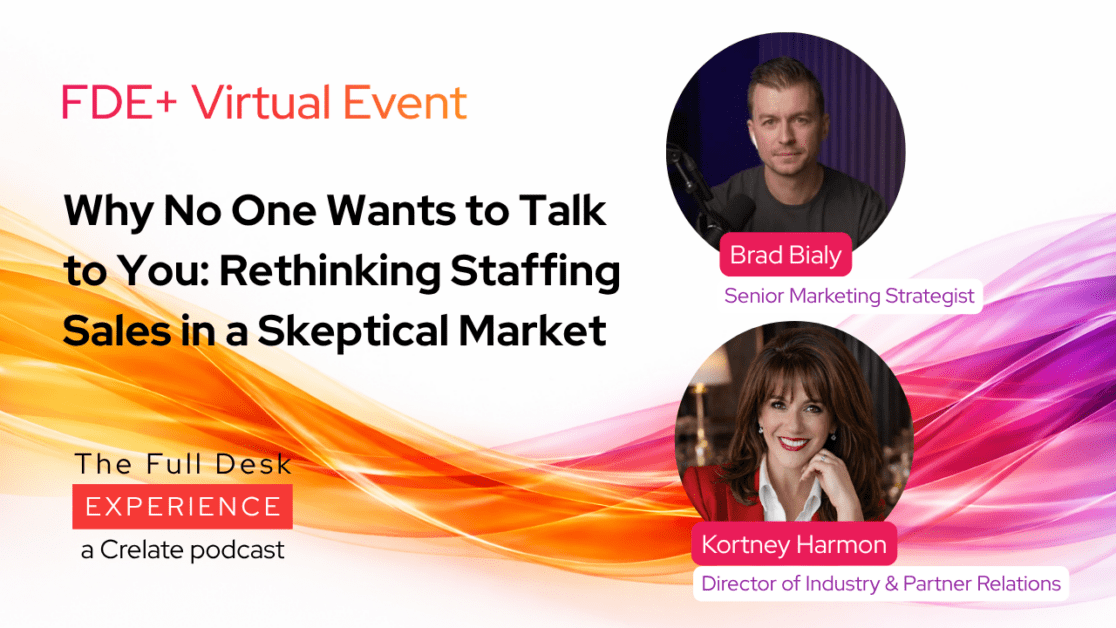
Why No One Wants to Talk to You: Rethinking Staffing Sales in a Skeptical Market with Brad Bialy, Haley Marketing
Show notes
Why has earning a conversation become the hardest part of staffing sales? In this featured session from the FDE+ Q1 Virtual Conference, Kortney Harmon sits down with Brad Bialy to unpack why today’s buyers are more skeptical, distracted, and informed—and what that means for relationship-driven revenue.
Brad challenges outdated sales playbooks and introduces a system-first approach to winning attention. He breaks down the reality of the 72-touchpoint journey, along with the role of trust, consistency, and buyer psychology. The result is a clear path for how top firms are aligning sales and marketing to earn—not chase—conversations and build meaningful engagement in today’s skeptical market.
• Build systems, not just sales goals
• Use marketing to support and scale outreach
• Reduce risk to overcome buyer skepticism
• Create clarity to stand out in a crowded market
Transcription
Brad Bialy [00:00:00]:
Friends, at the end of the day, no one wants to talk to you. Buyers are more skeptical than ever. They’re busier than ever. They’re more sophisticated than ever. They’re more educated than ever. No one wants to talk to you until they have a reason to.
Kortney Harmon [00:00:13]:
Hey, guys. Kortney Harmon, host of FDE. In case you missed it, we recently hosted a live virtual event and it was one for the books. We brought together some of the best thought leaders in the recruiting and staffing industry for two full days of real, no fluff conversations. And what that’s actually working right now. From building trust with clients to using AI without losing your edge, to growing revenue through relationships. These sessions were absolutely incredible and we didn’t want you to miss out. So we turned every single session into its own episode.
Kortney Harmon [00:00:49]:
And over the coming weeks, we’re dropping them one by one right here. Each episode is a standalone session from the event, so whether you’re tuning in for the first time or you were there live and you want to revisit all of your favorites, there’s something for you. Stay tuned. You’re going to want to hear from every single one of our speakers. Trust me. Enjoy. For those of you who haven’t got to meet Brad, feel free. If you’re seeing him for the first time, put it in the chat because I’d love to know that, because he is absolutely amazing.
Kortney Harmon [00:01:22]:
Brad is doing a talk and he has spent over a decade helping staffing and recruiting firms cut through the noise and actually get heard. He is the senior marketing strategist, I believe, at Haley Marketing Industry leading voice with his podcast as well. Worked with more than 300 agencies to sharpen their message. He does the Take the Stage and Insights podcast and he has presented over 150 industry conferences. Brad, you’re absolutely one of the best in the industry and I am so happy that you took time out of your busy day to join us and talk about this talk. I haven’t got to hear this one, so I’m super excited. And for those that are listening, feel free to put any questions you have in the chat because we will have probably have some time at the end to be able to answer those. So with that being said, Brad, I’m going to jump off stage and let you talk to this group.
Brad Bialy [00:02:11]:
Sounds great. Thanks for having me, Kortney. Always good to see you. It was good to come on a little early and see Ben too. I haven’t seen Ben since the Naps conference in Vegas last year. Oh, I don’t, I don’t run into Ben, a heck of a lot. But it’s always good to see the two of you and I appreciate you having us and having me be here. Today.
Brad Bialy [00:02:28]:
We’re going to talk about a topic that is on my mind a lot lately. You know, anytime I get the chance to consult with staffing and recruiting firms, it seems to me like the overwhelming consensus is, Brad, it’s harder than ever to sell staffing services. No one wants to talk to us. The process, I don’t know that we have one. And frankly, I don’t know that it’s any different outside of staffing and recruiting. Because when I look at what’s going on in my own world and you look at sales reps, you look at people cold calling, you look at people prospecting, you look at just the number of calls that you get on your cell phone that you’re screening and ignoring, friends, the truth is no one wants to talk to you. So for this conversation, we’re going to talk about how to get that conversation and sale amid changing buyer behaviors and increased sales skepticism. As Kortney said, my name is Brad Biley.
Brad Bialy [00:03:21]:
I am here by way of Buffalo, New York, what I consider to be the greatest city in the world with the greatest football team in the world. If there are any Josh Allen fans in the chat, would love to know that. Usually because I do work from home, I let you know that these are the three people that could walk in behind this door at any time. But I’m home alone today. Bryce, Blair, and Rachel are all either at work or school. Rachel’s a teacher too, so I guess she’s also at school. But my lovely family here on the screen, I always try to say listen, because of where I do work in the house, there’s a good chance you’re going to hear or see one of these individuals, so you might as well put a face to a name. But this is my lovely family and the people that get to call me dad every single day.
Brad Bialy [00:04:00]:
And if you don’t know me again, as Kortney was alluding to, I’ve been with Haley Marketing now for over 13 years as our now senior marketing strategist, which has a great way of saying I could talk to as many clients and prospects as possible throughout the week to keep my ear as low to the ground in the industry and learn exactly what’s going on and what you’re experiencing so that we can ultimately put together some great marketing recommendations to help alleviate a lot of that pain. I also host a podcast over here called Take the Stage and Insights. Have an Absolute ton of fun with it. If you haven’t checked out the show, I’d encourage you to do so. But basically every other week I get to sit down and talk to an industry expert. Kortney’s been on the show. Ben’s been on the show. Couple of people from this summit.
Brad Bialy [00:04:39]:
I’ve been on the show before and hopefully we’ll bring everybody else on very, very soon. That’s not why you’re here. You’re here today to learn about the hard truth, which is what worked five years ago is hurting you today. Too oFDEn I have calls with individuals and I hear that the sales process people are deploying today is the same thing they deployed pre Covid or worse, longer. The challenge with that is buyer behaviors have changed. We’re going to talk about that in a second. How we buy has changed drastically thanks to Amazon having a funny way of screwing things up for all of us. But the hard truth is what worked five years ago is hurting you today.
Brad Bialy [00:05:20]:
Friends, if you can use the chat window, and I know there were a couple people in the chat. Kim, great to see you again. Dan, Megan, glad you’re here. Megan, also glad you’re here. If there’s other people in the chat that didn’t let us know where they’re calling in from, I’d love to know, just for frame of reference, how many touch points are in your current sales process. So let’s say for sake of conversation, you desperately wanted to work with Brad from Brad’s Widget Shop, and I was a key account for you. You’ve never met me before. You’ve never worked with me before.
Brad Bialy [00:05:51]:
I am a cold prospect. How many touches are in your process to ultimately, let’s say, captivate my attention and try to get a hold of me? Try to have a conversation with me. Cam, great to have you here. Welcome. Even though you’re from Pittsburgh, I gave you a bill shout out a little while ago. We’ll still let you stick around and hang out. But again, if you can, let’s use that window real quick. Let me know how many touches are in your sales process.
Brad Bialy [00:06:18]:
Got a couple saying 10 to 12, which is the standard. And I appreciate that. I heard. I was in Boston two weeks ago at the Massachusetts Staffing Association’s annual conference. Somebody had mentioned 20 touches, another good number. Now, I don’t want to scare you, and this is a funnier slide when I’m in person, but please promise me you won’t shoot the messenger. But the new normal is this. It takes 72 touches to create Awareness in the buying process right? Now, let me say that again.
Brad Bialy [00:06:49]:
For someone to fundamentally know that your company is on this planet, not to get the order, not even to earn the right to have a conversation, just to know that Brad’s staffing firm is on this planet takes 72 touches. We learned this data at an industry conference last year. If you want a smaller number at Staffing World last October, there was an individual on stage who shared from Asa. It takes 50 touches to create awareness. So let’s say for sake of argument, it’s somewhere in the middle. Even still, your 10 to 12 step sales process is mathematically not enough. So we’re sitting here and we’re wondering, well, why can’t we get the conversation? Why can’t we get the order? And friends, in a lot of ways it’s a volume play, it’s a numbers play. And when we think about 72 touches and we’re going to go through some more stats here in a second, when we think about what goes into 72 touches, it’s not just calling Brad from Brad’s widget company 72 Toms, because if you’re going to do that, I’m running for the hills, right? It’s not spamming somebody with 72 emails, but it’s creating what we would call a systematic effort, pairing sales marketing to get closer to those 72 touches.
Brad Bialy [00:08:00]:
We’re going to talk about how to do that in a little bit. But friends, if you’re listening today and you have that 10 to 12 step sales process and a lot of great sales coaches in this industry will put together a 10 to 12 step sales process. I’m friends with a heck of a lot of them. That’s a foundation. From there we still need to think about the 60 additional touches that marketing can support to get you closer to that 70 number. 61% of buyers prefer a rep free buying experience. Again, no one wants to talk to you. 54% of a staffing sale is already done before the first call.
Brad Bialy [00:08:30]:
That’s a number from Eric Gregg over at Clearly Rated Friends. They’re not calling you to learn about you. They’re calling to reaffirm their beliefs of what they already know is true. They’ve done their due diligence, they’ve done their research. They’re now picking up the phone to see if you can prove everything that they think they know about you. So that first call, they’re already doing their due diligence. They’re doing that research. They don’t want to be sold.
Brad Bialy [00:08:52]:
They want to be reaffirmed of their already existing beliefs. 96% of prospects have done their own research before speaking to a rep. That’s the data that we came across over here at Haley Marketing. I would argue that number is closer to 99, if not 100%. I can’t think of anybody who is not doing some form of research before buying anything, especially B2B services. I mean, heck, I’m reading Amazon reviews for a pair of socks at this point, right? I’m doing my research on minor, minor items in my life. But if I’m doing that, I’m absolutely doing my due diligence. When I think about working with a new staffing or recruiting partner.
Brad Bialy [00:09:30]:
And there’s a 450% higher response rate when you respond within one hour of inquiry. I think that part’s very, very important. We’re going to talk about really what I consider the framework in a little bit here of how to get people to talk to us. But the biggest issue here you’re seeing on your screen is that There is a 450% higher response rate when we respond within one hour of somebody reaching out and friends. That’s including nights and weekends because the Internet doesn’t sleep. And if somebody has a need or somebody has a challenge, they want the answer now. You know, perfect example here. Two weeks ago, we had a really bad storm in Buffalo.
Brad Bialy [00:10:09]:
Ton of rain on top of that melting snow, ton of water. Your friend here, Brad Biley over in Buffalo, New York, doesn’t have the best basement when water is at play. Luck would have it, my sump pump also decided that it didn’t want to work that day. 450 higher response rate when responding within one hour. I called two companies that I know like and trust who got my business the truck that showed up first. Right. That response rate has to happen quick. Speed wins.
Brad Bialy [00:10:37]:
I also said on LinkedIn the other day, I think speed trumps relationships in a lot of ways. But there’s a higher response rate when responding within one hour of inquiry. And the Internet does not sleep. So if people are reaching out nights and weekends, we need to have some sort of automations in place. We need to have some sort of workflow in place where we’re still reaching back out to these people within one hour. All right, let’s talk about the buyer reality. Buyers are overwhelmed, they’re skeptical, they’re distracted, and most importantly, they’re smarter than ever. When you think about who you’re calling on, regardless of the level of staffing that you’re in in your specific industry or vertical.
Brad Bialy [00:11:13]:
That’s sort of for sake of this conversation, irrelevant. The buyer reality is that they are incredibly overwhelmed. We all have day to day. I mean, as you’re watching this session and the the other six sessions throughout the day, I know you’re multitasking, you’re looking at email, you’re probably checking Slack, you’re probably on LinkedIn. Maybe your phone’s going off because the kids need something, or a spouse needs something, a relative needs something. Maybe the doorbell is going to ring. I learned last week I was listening to the Modern Wisdom podcast and the data point was presented where the human brain changes activity every two minutes. So we are physically incapable of sitting and sitting in a flow state unless you’re actively trying to stay in a state of flow for more than two minutes.
Brad Bialy [00:11:58]:
Email goes off, slack goes off, tabs change, whatever it might be. Something’s loading. We’re now looking at our phone. We are incredibly overwhelmed in our day to day and we’re doing it to ourselves. We’re skeptical. We’re going to talk about that in a second. But a staffing buyer is incredibly skeptical. They’re distracted.
Brad Bialy [00:12:15]:
If you’re cold calling or you’re prospecting and you’re walking in a door and you’re physically dropping off brochures or paperwork about your organization, the likelihood that somebody else in your area is doing the exact same thing 30 minutes to an hour later is very, very high. So that gatekeeper, whoever’s at the door, whoever is welcoming you in, they’re incredibly distracted because they’re being inundated by somebody else walking in right behind you. And most importantly, that’s not even talking about the decision maker. More importantly, in my mind, they’re smarter than ever. We have information overload to the point where when we are going to buy something, we think about it obsessively. What does that look like for me? I’ll give you a perfect example. I’m an active runner. I’m in a current running training block right now for the Buffalo Marathon.
Brad Bialy [00:13:02]:
I ran my first last year running this one in May. I need a new pair of shoes. I know I want new shoes. The buyer reality to influence me right now is I’m looking at reviews, I’m listening to podcasts, I’m watching videos, I’m looking at influencers who are talking about different shoes that they wear. I am educating myself. I right now what goes into a good shoe so that I can go to the store and buy a shoe that sales rep will try to sell me another shoe, but I’m going in. Not more educated than them, certainly, but with a level of intelligence where I can hold a strong conversation about exactly what my foot needs before I walk through that door. Your buyers are doing the same thing.
Brad Bialy [00:13:39]:
They know what their workforce needs. They know what their production facilities might need. They know what their offices need before they speak to you. Maybe there’s a strong caveat of maybe there they’re smarter than ever. Maybe why Recruiting Feels Worse I am on record multiple times saying that I think this is the number one industry where if you have a bad experience with a recruiter or a bad experience with a staffing firm, you will never work with them again. This isn’t like fine dining or travel, where if I go out tonight with my wife and we have a steak dinner and the steak’s terrible, that I’ll never have another steak again. No, I might not go to that restaurant for a little while. I might try a steak somewhere else.
Brad Bialy [00:14:19]:
But I’m certainly going to have another steak. Or let’s say I take a trip and there’s a lot going on with flights right now, people getting delayed left and right. I have a bad experience. It doesn’t mean that I’m never going to travel again, but I’m certainly going to hope I have a different experience. I might try a different flight. I might try a different travel provider.
Kortney Harmon [00:14:37]:
Right.
Brad Bialy [00:14:38]:
I might try a different hotel. If the hotel experience isn’t great, it doesn’t mean I’m not going to do that thing again. I might just try a different avenue in staffing and recruiting, though. I think we have a funny way of having the negative players in the space make it very, very difficult, borderline impossible for the good players to actually have a stance in the in the space. And here’s why. Previous bad experiences I think it’s the number one industry with where you have a bad experience with somebody in staffing and recruiting, the negative stereotypes build up and it becomes increasingly difficult for you to want to take the plunge to try again. On top of that, buyers can’t tell the difference between the providers or the products that it is that we deliver. And I know product might be a silly way of saying that we provide labor, but buyers, in their eyes, they can’t tell the difference.
Brad Bialy [00:15:29]:
Had a fantastic episode of our podcast this week with David Cerns, our co CEO, that talks specifically about this, the commoditization of the industry and how we can say at the end of the day that we do all of these things differently and truly Believe it in our core. But buyers of staffing services stereotypically cannot see the difference between those providers or products. And as a result of that, if they’ve already decided that they are not going to work with somebody, well, they don’t want to talk to us. And that makes it very, very difficult to get the conversation. So it’s ultimately not ghosting. They’re not ignoring you. They’re skeptical of low value, right? We already said they’re distracted, they’re overwhelmed, they’re skeptical, they’re more sophisticated than ever before, but ultimately they’re skeptical of low value. If they can put out a job ad on indeed and get 100 candidates this aFDErnoon.
Brad Bialy [00:16:23]:
They’re skeptical of the low value that you provide by fishing from the same talent pool. Now, you don’t, or at least you say you don’t, but again, if we go back to the previous slide and buyers can’t tell the difference between providers if the assumption is that they’re skeptical of low value because you do the same thing that they do by posting a job ad, well, you’re just going to post a job ad from here. You know, you and Brad, staffing firm and Jeff’s staffing firm, you guys kind of have the same talent pool, right? You have the same bench. What’s the difference? We’ll just beat you up on price. If they’re skeptical of low value, they’re ghosting us because of that. It’s not that they’re ignoring us. They’re just skeptical, they’re overwhelmed, they’re distracted, and they’re more educated and sophisticated than ever before. And honestly, and maybe you need me to say this most outreach deserves to be ignored.
Brad Bialy [00:17:10]:
I keep my ear very low to the ground, not only on places like LinkedIn but also my inbox. I look at things that people are doing across the industry, not just at Haley Marketing, but I have the opportunity. I was talking to Kortney ahead of this and I think we were live at the time, but I’ll be at nine or 10 conferences this year, meeting with thousands of different owners and staffing firms across the country. Most outreach deserves to be ignored. I get these texts every now and again or emails. I just got one a little while ago. So I was trying to be recruited for a role that I had no sake being recruited for. The challenge with that is I know that that’s automated.
Brad Bialy [00:17:45]:
I’m in the industry. I’ve been doing this for 13 years. I get it. The average candidate gets a bad text message like that or they’re recruited for A role that, again, they have no business for. It turns them off to the entire industry. You think about cold outreach. You think about cold InMail, cold email. Would you read the emails that you’re sending? You know, if you’re thinking here about your sales process and your current sales process and you’re sitting here scratching your head saying, well, why aren’t people calling me? Why aren’t people emailing me? Why aren’t they responding to the INmails? Would it work on you? I think in a lot of ways, we see volume as the play.
Brad Bialy [00:18:17]:
Well, if we send a thousand emails and two people respond well, then I just need to send 2,000 emails to get four people to respond. 6,000 to get six people to respond. That can’t be the solution. Again, we need to kind of turn that mirror around, look inward, and think to ourselves, would I act on this message if I were in this decision maker seat? If I was in this prospect seat? Would I find value in this, or would I also ignore it? Do I also think it’s low value? Am I skeptical of what they’re claiming they can do? That outreach deserves to be ignored. Friends, real quick, while I gotcha, I know it’s a little counterintuitive to put a QR code on a laptop screen. Kortney mentioned that I host a show over here called the Secrets of Staffing Success. There’s two podcasts under there, Insights and Take the Stage. I’ve been doing it for seven years.
Brad Bialy [00:19:01]:
I love the show probably more than any other thing that I do at Haley Marketing. I love talking to clients and I love speaking, but I absolutely love sitting down and learning from really, really bright people. That’s what I get to do on this show. If you point your camera at that QR code or you just go to Haley Marketing’s YouTube channel, you can subscribe to the show specifically. We put a heck of a lot into our production value at the beginning of last year, and I’d love for you to just see one episode to see if it’s something that might spark your interest as you move forward. Certainly continue listening to the full desk experience. I know Ben was on before. Certainly keep listening to the Elite Recruiter podcast as well.
Brad Bialy [00:19:33]:
But hopefully, everybody, the data shows that you can listen to, you know, three to five podcasts. The average user subscribes to three to five shows. I’d love to be one of those, and I’d love to at least have the opportunity to try to earn your trust and listen to one of those shows. All right, let’s Talk about the framework, how to get the conversation amid a four year industry decline. Before I go into that, I’m gonna take a real quick sip of water. Any questions in the chat? Anything that I said maybe land or stick well for you at this point? Anything where maybe it caught your eye, caught your attention, A light bulb went off. I’m just going to take a five second break here, but feel free to use that chat window. Let me know if anything caught your eye at this point.
Brad Bialy [00:20:09]:
And if not, that’s fine too. But let’s talk about the framework. So again, if no one wants to talk to us and we can accept that, we know sales are difficult to come by, I’ve heard it’s three times to work for half the results. I’ve heard the sales process has been dragged out for months longer than it used to be. I’ve heard that most people are just, gosh, if I hear the word uncertainty one more time. We just live in so much uncertainty. I should have taken out stock in that word a year and a half ago. I’d be a very wealthy man at this point.
Brad Bialy [00:20:40]:
But if we can accept that it’s harder to sell in 2026 and I can assume that you’re all feeling that, otherwise you wouldn’t be joining me this aFDErnoon or this morning rather, then let’s talk about the framework and how to get the conversation amid a four year industry decline, changing buying behaviors and increased sales skepticism. The first note, and probably the most important, is a lesson that I learned from Jeff Mariola. I interviewed him on our podcast here a couple months ago. Buyers fear being wrong. Buyers are not chasing wins. They’re operating to avoid mistakes. Psychologically, the fear of failure weighs on us twice as much as the fear of success. It’s called loss aversion.
Brad Bialy [00:21:24]:
And you’ll feel this if I were to say something along the lines of, hey, would you play a game with me? And you entertain that, you said, sure. I said, great, if you play, you could win $100. Great. Sign me up. Now let’s flip that. And if I said, hey, I want to play a game. And you said, sure, what’s going on? And I said, okay, just so you know, you could lose $100. That mentality is very, very different.
Brad Bialy [00:21:46]:
Buyers fear being wrong. Again, psychologically, we fear loss twice as strongly as we feel the perceived win in anything that we’re going to do. So what does that mean when we come in and we try to sell staffing or recruiting services on how we are better, faster, stronger, whatever it might be when we sell the pros of what it is that we’re doing, all our buyers are hearing is, well, what if you don’t do that? Because at the end of the day, it’s not your job that’s at stake, it’s mine. So go on this journey with me. You’re trying to sell to somebody who’s already working with a staffing partner. Things are going pretty well. They get their employees or contractors. Maybe it’s temp labor, they get their temps.
Brad Bialy [00:22:36]:
Things are going okay. Sure, there’s a couple no call, no shows every now and again, but for the most part, it’s a decent relationship. Things are okay. You are now coming in and saying how you could do it better, faster, stronger, better talent, better labor will reduce the number of no call, no shows. All that person is hearing again, when we think about loss aversion is, well, what if I make this change and you don’t deliver on what you promised? Because now my job’s at stake. Because if I get this wrong, top down, I’m going to hear about it. Buyers fear being wrong more than we fear being right. So when we go to market with our messaging, we need to cut that off at the start.
Brad Bialy [00:23:16]:
We need to earn trust. We need to make sure that people can value what it is that we do and see that with testimonials and reviews. We need to make sure that we are mitigating any of their fears in changing partners or trusting us with this decision immediately from the start. Because if we can accept that they aren’t chasing wins, they’re avoiding mistakes. We. We need them to know that working with us will not be a mistake. That having a conversation with us will not be a mistake. That trusting us and the talent pool that we have and the recruiting that we do will not be a mistake.
Brad Bialy [00:23:48]:
Sure, you have a good thing going. And this is where I think the relationship analogy works in really well. Sure, you got a good thing going. But if you give me a chance, and I always say that I don’t like to say, just give me a chance. Cause I think that’s terrible selling. So I apologize for saying it. But if you do, here’s why it won’t be a mistake. Here’s why doing this will not be a mistake.
Brad Bialy [00:24:08]:
Again, buyers fear being wrong more than they chase being right. Nobody is waking up today saying, you know what? I could really use a new staffing partner. Just because it’s Wednesday just feels like the right thing to do. So we need to mitigate those fears. From the start. If you want to learn more about loss aversion, I would encourage you to again go to the Haley Marketing YouTube channel. Look up the episode with Jeff Mariel. He’s an expert on the topic.
Brad Bialy [00:24:31]:
It was a fantastic conversation. You’ll be able to get a little bit more about that in our 45 minutes or so together. The best staffing and recruiting firms in terms of getting the conversation focused on systems, not goals. I’ll tell you a fun story and Kortney was actually alluding to this a little while ago. The last time I had saw her I was at the Colorado Staffing Association’s annual conference was last fall. And I had an early flight out of Denver. It was probably like 6:30 in the morning and it was cool because I, I woke up early. I typically when I travel that west, you know, I stay on Buffalo time.
Brad Bialy [00:25:05]:
So I was up very early, kind of ready to go. I had a coffee cup, got in my Uber, I’m driving to the, the airport and I’m watching the sunrise come up and everything. And it’s a fun conference because you don’t see a lot of mountains in Buffalo, New York. I don’t know if you’re familiar with the area at all, but we don’t have the Rockies out this way. So you know, I’m watching the, the sunset, the sunrise rather, and I’m just enjoying the morning. And it got to a point where I was like, okay, I saw it. So I did what any other 30 something year old would do. I start looking at Instagram and I see this quote from James Clear that hit me like a freight train.
Brad Bialy [00:25:37]:
It’s like, goals are for people who care about winning once. Systems are for people who care about winning repeatedly. It hit me so hard that I started writing a blog article for Haley Marketing in the back of that Uber. I finished it on the flight home. I sent it to David Cerns, our co CEO on that flight home. Said, listen, I think I got something here. I’m good to publish it on my own, but I think it should also be in our Smart Ideas weekly newsletter. We used it there as well.
Brad Bialy [00:25:59]:
We turned it into a podcast episode. All because of one morning ride outside of Denver, Colorado. But friends, the point here is that too oFDEn I think we focus on setting a goal instead of setting a repeatable system. We need to focus on systems, not goals. And what do I mean by that? If we can accept that no one wants to talk to us and we can accept that selling is different in 2026 and it is I don’t think there’s anybody who needs to be told that, listen, this feels different because it is different. Selling is different right now. We’ve already discussed all the reasons why setting a goal at this point is almost just like setting a checkpoint or a benchmark. Sure, we can set a goal.
Brad Bialy [00:26:43]:
I need you to have 100 calls this week. It’s a goal. Okay, we can hit that. I need to lose 10 pounds before my next vacation. Great. Set the goal, the challenge. With that though, what happens next week? We’re going to do it again. Do we have the system in place to repeat that success, to make another hundred calls or worse? And I may not worse, but personally, okay, you go on vacation, you lost the ten pounds, you feel better about yourself.
Brad Bialy [00:27:07]:
But what happens on vacation? What happens when you come back? Are you going to stay active or are you just going to regress back into who you were before? Goals are for people who care about winning once. Systems are for people who care about winning repeatedly. Too oFDEn when I talk to people in the staffing and recruiting industry, I see leaders and BDMs setting sales goals, setting sales quotas, setting a quarterly or weekly number without putting the system in place to repeat and re achieve that same success. Let me repeat that too oFDEn. We’re setting a sales goal or a sales number to achieve weekly success without thinking about the system that’s in place to achieve repeatable success. We need to focus on the system. There are people in the chat who said they have 17 steps in the sales process, 10 to 12 steps in the sales process. What is the system to scale that across 3 to 500 prospect accounts.
Brad Bialy [00:28:08]:
If you’re cold calling this aFDErnoon, or maybe you do local staffing, you’re only in Buffalo, New York, so you’re gonna do some old fashioned drop buys. You’re just gonna drop in and see how people are doing, try to get a conversation that way, Maybe drop a business card. We can talk about collateral in a little bit. We’re actually going to talk about buyer enablement a little bit. Okay, great. I could think of five people to go to today, but if you told me to do that again tomorrow, how hard is it going to be to prospect with five more people tomorrow? Do you have the system in place to achieve repeatable success or is every month, every first of the month or every Monday, are you waking up thinking, what am I going to do now? What’s the plan now? Again, too oFDEn I see great leaders and great people in sales seats setting goals that matter. I’m not here to say don’t set a goal. But we need to focus on the system that helps us achieve that goal once and repeatedly.
Brad Bialy [00:29:00]:
Because aFDEr all, we’re really looking for repeatable success. It’s a lesson from James Clear. I don’t know if I mentioned that. I may have. That’s where that quote came from in the back of that Uber. It’s actually from Atomic Habits. It’s a good book. It’s been mentioned on our show a couple times, but that’s where that came from.
Brad Bialy [00:29:14]:
Consistency beats intensity. How will we get to 72 touches? If you joined late or maybe missed the note at the beginning? I had mentioned that the new sales process, it takes 72 touches for someone to fundamentally know you exist. Whether you’re selling staffing services, you’re selling T shirts, you’re selling widgets, whatever it might be. We’ve learned that it takes 72 touches for someone to fundamentally know your company. Your product is on this planet. At ASA last October, somebody on stage from ASA mentioned it takes 50 touches. Will accept that it’s somewhere in the middle. For sake of this conversation, we’re going with 72.
Brad Bialy [00:29:51]:
So that’s what it takes. Consistency beats intensity. If you say, okay, it takes 72 touches. So my plan for the next week and a half is to call Brad at Brad’s Widget Factory 72 times. I will never work with you, right? You’re going to call me 10 times a day for the next week. I’m out of here. You’re scaring me. You’re intrusive.
Brad Bialy [00:30:14]:
I’m running away. Consistency beats intensity. We know that in our day to day, right? We know that in our lives. We know that the secret to health and wellness isn’t going to the gym and running 15 miles today if you’ve never ran at all. It’s not to, you know, fast for three days and shed a bunch of weight to then put it back on the next, the fourth day because of just going to rebound, right? It’s not about intensity, it’s about consistency. You win in health and wellness and all of that by having long term commitments to a vision, putting the systems in place and going with it from there. So how will we get to 72 touches? Well, let’s accept we have a 10 to 12 step sales process. Okay, so you’re calling people, maybe you’re doing some in mail, maybe they’re local.
Brad Bialy [00:30:58]:
So you’re actually doing drop bys. Whatever your 10 to 12 step process is, let’s accept that it is my firm belief that marketing should overlay that process to provide air support, air cover. Our team oFDEn refers to it as surround sound marketing. But we should be nurturing all of those prospects with a well developed marketing strategy that surrounds them. You see this in your day to day, right? You think about any sort of direct to consumer goods brand. Bird Dog, Lululemon, built clothing, I love built shirts. You think about any direct to consumer supplement, AG1, any of those products, they’re in your Facebook feed. Anytime you look at Facebook, they’re in your Instagram feed.
Brad Bialy [00:31:41]:
Anytime you look at Instagram, you’re probably getting three to five emails a week, sometimes a day from those brands. You’re getting text alerts. I actually just got a text alert from Alter Ego, a hat company that I really like. So they’re probably in my email. That’s a post St. Patrick’s Day sale now, right? We already ran the St. Patrick’s Day sale. So now let’s do the post St.
Brad Bialy [00:32:01]:
Patrick’s Day sale. So they’re emailing me, they’re texting me. I’m seeing their ads again. Consistency. I’m in their work world and they’re in mine. Consistency beats that intensity. So what does that look like for staffing and recruiting firms? Again, let’s just borrow the playbook from consumer goods right here to reinvent the wheel. We’re just here to lean on what’s working for others.
Brad Bialy [00:32:20]:
So let’s keep our 10 step sales process, all of our prospects, let’s surround them with pay per click advertising so that when we have that database of 500 people that we want to be doing business with, that we’re prospecting with, let’s also serve them ads on LinkedIn. Let’s serve them ads across Google. Let’s serve them ads when they’re looking at Facebook or Instagram so that they see Brad’s staffing firm surrounding them. Let’s deploy marketing automation. Email sequences a 12 to a 16 touch campaign that’s overlaying your already existing sales process, pushing them down a funnel. Not just sequential emails 1 to 16, but emails that react based on their behaviors. They look at a certain page, let’s trigger something else. They contact you, let’s trigger something else.
Brad Bialy [00:33:02]:
Sequential emails versus automations that are looking at the actual buyer journey, pushing them closer to have a conversation with you, educating them, providing value. I had a client the other day, this was on Thursday, tell me that they don’t believe in email marketing because they don’t like to be sold to an email. That’s okay. I Don’t like to be called. Everybody wants to buy differently, right? I will never respond to a cold call, but I react very well to Instagram ads and social ads and things that I’m influenced by in that respect. What we’re doing is we’re creating consistency and we’re creating a wide net so that based on how the individual wants to take action, we’re in their world and you’re in theirs. It’s all it is. We want to stay in front of them consistently because that consistency will beat intensity any day of the week.
Brad Bialy [00:33:54]:
That’s how we get the 72 touches. So if we have that 10 step sales process, 10 touches, then we deploy a 16 step marketing automation, 26 touches. Now we’re deploying pay per click advertising. Maybe they see those ads ten times over the course of a quarter, maybe more. But let’s say that’s 36 touches. Maybe we send an actual direct mail campaign. We’re sending postcards and flyers and brochures. 10 more touches.
Brad Bialy [00:34:15]:
Now we’re at 46. Maybe they follow you on social or you have a podcast. You have content that you’re putting out consistently. They see your organic social posts. We’re at 56 touches. We’re playing the long game with consistency so that when they do have a need, they know who to call. Again, we play the long game, so when they have a need, they know who to call. We’re educating them so they can make the educated decision by themselves.
Brad Bialy [00:34:43]:
But we’re influencing that every step of the way. Just like the story I told you at the beginning. My basement flooded a couple weeks ago. Two weeks ago, I knew who to call on day one because of the consistency of seeing these brands all the time. Plumber’s not calling me 72 times saying, hey, when your basement floods, you know you gotta call us, right? Selling to everyone is selling to no one. Clarity creates demand. Too oFDEn I think we chase when it comes to selling. We understand that sales are down, so we try to find a slant vertical that we can also sell to, that we can also recruit in.
Brad Bialy [00:35:19]:
We dilute what it is that we do. Our teams don’t know how to recruit those types of people, so they get frustrated and burnt out. Other individuals don’t know how to recruit or sell to those types of people, so they get burnt out, frustrated, whatever it might be worse. Candidates don’t know what the heck we actually do, so they don’t know if they can trust us. They can’t see themselves working with us. Selling to everyone is selling to no one. When we have crystal clear clarity and a prospect or a candidate knows. I work with Brad staffing firm because they are the premier staffing firm for anybody in light industrial in Buffalo, New York.
Brad Bialy [00:35:51]:
They know who to call. When we have that crystal clear clarity, individuals know to come to us because we solve a very specific problem. But if we try to sell to everyone, we sell to no one because we dilute what it is that we do and that creates confusion. I want to talk specifically about selling to our specific target audience and if you’ve seen me speak before, you’ve probably seen something similar to this slide. But I do think there’s a ton of value in talking about it once more. Too oFDEn I think staffing and recruiting firms make the mistake of selling who they are, what they do, their combined years in service. A data point that drives me crazy personally. Personal opinion on that.
Brad Bialy [00:36:28]:
Not. Not the opinion of Haley Marketing personal opinion. I don’t care. As a buyer of services that you have a combined 120 years of service across your 40 person team, that does me no good. Personal just tick. Sorry. We need to understand our target audience though. And what does that look like? Your current customers, your former customers and new customers.
Brad Bialy [00:36:46]:
Too oFDEn we deploy the same messaging in the sales process, in the marketing process that surrounds sales to all of these targets. The challenge with that they all require very distinct and deliberate messaging. Let me walk you through why. Your current customers, people who are already doing business with you, they already know what it is that you do. You don’t have to sell them. You might need to educate them on what else you can do in terms of other verticals, other ways you can assist them. But they already sort of have a working relationship with you former customers. They’ve worked with you in the past.
Brad Bialy [00:37:21]:
Things have changed. If you haven’t worked with somebody since before COVID my assumption is your business is drastically different in terms of how you operate day to day than it was pre Covid, maybe even a year ago with AI and the integration of AI technology. They don’t know what it means to work with you right now. New customers have no idea who you are and I already said they’re already pretty happy with who they have already as a partner. So you’re coming in and you’re disrupting a relationship. Drastically different messaging. We see this in consumer goods. Let’s talk about the black shirt I’m wearing.
Brad Bialy [00:37:49]:
Built shirt. Built knows I own this shirt so they can serve me ads about buying the same shirt in red, blue, yellow, whatever it Might be they know that that because I bought it a couple months ago and presumably like it that to get me to buy it in a different color requires specific messaging about hey, if you like how you feel in this shirt, try it in blue. Here’s an ad for it in blue. Personalized automation. Talk about that in a second. Former customers if I bought this shirt three years ago and now there’s new technology in the shirt that fits different, feels different, whatever it might be to get me to buy it again is different. But it’s not impossible because I’ve already seen myself in again this shirt. New customers if I’ve never ever worked with this company and worn this product, to get me to buy it for the first time takes a heck of a lot of work.
Brad Bialy [00:38:40]:
Staffing is the exact same. Your current customers know what it is that you do. They should be the first people you go to for more business. Having a true account management function should be a core component of your organization. They already know, like and trust you. Why are we fishing for more people? Yes, we need new business. But if you already have clients that are giving you orders, we should be treating them like blue chip accounts. We should be rolling out the red carpet for them.
Brad Bialy [00:39:07]:
Let’s work on getting more business from the people who already like us, who already want to give us their business. Your former customers, they need messaging about what’s new and what it means to work with you now. And for some, maybe the relationship didn’t end so well. Let’s talk about how things have changed. Let’s paint the clear picture. Let’s roll out a very specific campaign to those individuals about how you’re hitting it right now based on what it is that you got wrong five years ago and new customers. We already talked about loss aversion. We already talked about how people don’t want to talk to you.
Brad Bialy [00:39:39]:
We already talked about how they already know like and trust somebody else. Think about a personal relationship. If you’re dating somebody to have a brand new relationship with somebody else, it takes a lot of work to say, listen, things are going pretty good right now. I see you over there. But I don’t want to fear getting this wrong because this is a pretty good thing we got going on here. Again, with loss aversion, we are twice as likely to fear that change of loss than the personal gain of something new. Your new customers need that messaging. We need to go to market with that deliberate messaging.
Brad Bialy [00:40:10]:
And most importantly, we need to segment our audience. This is by current, former and new, taking that a Step further. We need to segment our audiences. If you’re in different verticals, we absolutely need deliberate messaging based on different pain points of those target verticals. We cannot sell me, me, me anymore, Friends, no one cares about you. I hate to say it. Maybe you need me to say it. And I will say, and I may have already alluded to this at the beginning of the talk.
Brad Bialy [00:40:36]:
There’s nothing new in this talk that you probably haven’t heard already. But sometimes it takes somebody like me with a microphone on a webinar like this one to just reiterate facts and things that you already know so that they finally stick. But when we think about selling, when we think about current customers, at the end of the day, no one cares about you. They care about their pain. They care about their challenges. They care about their production facilities who are not going to hit a quota that they have. The buyers of your services care about their job. They don’t want to get it wrong by partnering with a new staffing partner.
Brad Bialy [00:41:07]:
They want to get it right, but most importantly, they don’t want to get it wrong. We need to go to market with all of that messaging. All right, let’s talk about how to beat the commodity trap. I had Mark Whitby on the show a little while ago aFDEr I spoke with him at Naps in Las Vegas last year. And Mark talks about. And he talked on our show about his signature solution and selling. A signature solution. Not his signature solution, but going to market with a signature solution.
Brad Bialy [00:41:33]:
Friends, at the beginning of the talk, I had said that people avoid staffing and recruiting firms because at the end of the day, we all sort of do the same thing. And in the eye of the buyer, we are the exact same. We put people to work in opportunities. We fish from the same talent pool. We do the same stuff. This is a new one that I’m very passionate about because I’ve heard it multiple times now. We. We sort of make up an arbitrary number for our markup.
Brad Bialy [00:41:52]:
Why do I have to pay a markup? You’re just making up a number. Why can’t it be less? Why can’t it be 27%? Why is it 32%? What goes into that? It’s a completely arbitrary number. We know what goes into it. Don’t get me wrong. But to the buyer, just making things up, how can we beat the commodity trap if we are going to market with the same messaging as everybody else? There’s no wonder no one wants to talk to us, because the only thing’s changing is the Logo on the back of the brochure is the logo on the back of the flyer? Is the colors on your website truly? Look at your website and compare it to your biggest three competitors. If you put your logo on that website, would it be the same? If you put their logo on yours, would it sort of be the same? Or do you have a truly signature solution so you can sell apples to oranges? Can you go to market with a strategy and a solution that makes a workforce better, faster, stronger, that tackles loss aversion, that sells apples to oranges so that you can charge whatever you want, within reason? Because you’re not just selling temp labor anymore. You’re completely changing what it is that you sell, how you package it, how do you go to market with it so that you’re not in this commodity loop, this commodity trap. Instead, you’re in a league of your own.
Brad Bialy [00:43:07]:
I would encourage you to check out Mark’s episode with me on Take the stage for a little bit more on that. But ultimately, we need to beat the commodity trap. Because if all buyers presumably think we do the same thing, if all buyers assume we just put people to work in opportunities, we charge arbitrary numbers, we all fish from the same talent pool. We are the stereotype that they paint us in. We need to break out of that and we need to sell completely different than our competitors. This is how you do it. We got to measure what matters most. I am a huge fan of the Modern Wisdom podcast, and this came out of an episode a couple months ago.
Brad Bialy [00:43:44]:
I don’t remember who Chris was talking to, but he had talked about inputs, outputs, and outcomes too oFDEn. I think staffing and recruiting firms measure inputs. The input would be, I worked 40 hours this week. Great. At the end of the day, that doesn’t matter. Okay. You sat at your desk for 40 hours. Thank you for that.
Brad Bialy [00:44:02]:
Okay. That sort of table stakes of having a job. The output. I made a hundred cold calls. Arbitrary number, but stay with me. Okay, good. That’s sort of our sales goal. That’s our sales quota.
Brad Bialy [00:44:14]:
You achieved the output that I was looking for. Good. What matters most, though, is the outcome, though. I don’t care that you were at your desk for 40 hours. I don’t care that you called a hundred people. How many conversations did you have? How many actual meetings did you have? How many orders did that lead to? How many submittals did that lead to? Are we tracking the outcomes from our outputs and our inputs? Do we have smart dashboards that allow us to measure what matters most? So that we can create repeatable systems to achieve repeatable success. Friends again. And this goes right back to the James Clear slide.
Brad Bialy [00:44:52]:
Too oFDEn, I fear we are chasing a goal. We’re chasing a proverbial North Star when it comes to selling staffing services. We’re looking at call volume, we’re looking maybe at meetings, we’re looking at sort of that goal output, but we’re not actually measuring clearly the outcome that we’re desiring. And more importantly, once we know the number, creating the repeatable system to make sure that it happens again. Alex Hermosi, who I’m a big fan of, he says something along the lines of, are you doing the things day to day and week to week that would make success absolutely probable and realistic, or are you shooting for something and aiming for something? But does your calendar not align with what it is that you’re looking to achieve? It’s another. Another fun sort of methodology of you can say you’re one type of person. Does your calendar support it? Do your habits support it? This is where I think we need to measure what matters most. Are we measuring the inputs, outputs or outcomes in some way? Our dashboards probably need to measure all of it, but I think we need to pay even closer attention to the outcomes, what leads to the outcomes and punt the busy work that does not lead to those outcomes.
Brad Bialy [00:46:17]:
Too oFDEn I think we get stuck in staffing and recruiting of, well, this is the way we’ve always done things. You know, this is our secret sauce. This is what we do here. This is how we do things a little differently. So I am not saying stop cold calling, I am not saying that, but for sake of conversation, this is how we’ve always done things. It’s always been, if I cold call 200 people, I can get to this and I can do that, and this is the outcome. So let’s call 400 people. Okay, but what if different outputs led to different outcomes? And if we know that LinkedIn InMail, for example, leads to seven messages or seven conversations every 100 messages, and a cold call is two conversations every 100 outreaches, shouldn’t we do more in mail? Within reason.
Brad Bialy [00:47:03]:
We need to measure our outcomes against our outputs and punt the busy work, whether that’s to AI or whether that’s literally just punting it and stopping doing it, we need to have the courage to do that. We need to enable the buyer. When we think about how the buyer is more sophisticated and educated than ever before, we need to enable them to make the decision on their own, knowing darn well, we are giving them everything that they need to make the decision to come to us. What does that look like? Case studies, or as I like to call them, case stories. Because we’re working with people. Let’s paint stories. Who have we helped in the past? Can we put out one great story every single month about a client we’ve helped and a candidate we’ve helped? Surely you can. So let’s publish my challenge to you 24 different stories this year.
Brad Bialy [00:47:52]:
Well, we’re already start in April. All right, we’ll make it easy. Not 24. You only need to do it for nine months. Okay, but can we put together 18 stories, nine candidate, nine client, about how we helped somebody in this industry, candidate and client, and publish those. Let’s get testimonials that surround them. Let’s build stories around them so that buyers of your services, clients, or in some ways candidates, are buying into what it is that you do too, if you go with me on that tangent, can see themselves in the story, want to work with you because of what it is that you’ve done for others. Specific sell sheets.
Brad Bialy [00:48:26]:
This is probably the lowest possible hanging fruit that we have right now that I think is table stakes, absolute table stakes of selling in 2026. I in my heart do not believe we should have solely a brochure, a pamphlet, a trifold that talks about our services, what it is that we do, who we are, sells us. I think we should have. Yes, we need those within reason at times. I believe we should have a specific one sheet for every single bit of resistance and friction that we might hear in the sales process. Go with me on this. Let’s say that you’re prospecting and someone says, I don’t want to work with you because we’re already working with Brad staffing firm. Great, let’s pull out our one sheet, metaphorically send it as a PDF or physically have it printed if you’re in person.
Brad Bialy [00:49:12]:
Let’s talk about why having us isn’t a risk. You can also have Brad staffing firm. You can work with both of us. But let’s talk about why also partnering with us is not a risk to you at all and how we can actually help you in your seat working alongside them. Again, loss aversion. Here’s why it’s not a risk in working. Working with us. Partnering with us.
Brad Bialy [00:49:32]:
Or let’s say somebody says, you know, well, we don’t work with staffing firms. The markups are just a little too out saying outrageous and insane for us. Okay, here’s what goes into our markup. Here’s where this number actually comes from. Here’s why we charge X percent. Here’s what actually falls to us. Oh, and by the way, here’s the cost. If you did this yourself, and we know Mr.
Brad Bialy [00:49:51]:
Or Ms. HR Rep or whoever it might be, we know what it is that you do day to day. We know you’re more overwhelmed than ever before before. We know you’re more skeptical of us than ever before and we know you’re busier than ever. You have your day to day. So here’s what we think it would presumably cost you if you did this yourself. Here at the end of the day is what it costs if you partner with us. Again, no risk involved, but let’s actually walk through those numbers.
Brad Bialy [00:50:13]:
Let’s have specific 1 sheets for every bit of resistance that you hear in the sales process so that when you have that, you’re not just sending a one sheet of. Here’s why you should work with Brad staffing firm, because that doesn’t matter. Let’s talk about the pain. Your doctor’s office does this. You go in with elbow pain, they give you the brochure on how to fix your elbow. You go in with hip pain or knee pain, they give you the brochure on how to troubleshoot that one area. They don’t just give you a book and say, here, figure it out. Here’s the services we provide.
Brad Bialy [00:50:39]:
We’re a general physician. Here’s everything that we do. Here’s why you should work with us. No, they tell you exactly what they’re going to do to fix that knee, to fix the pain. Let’s be the same again. I think it’s the lowest hanging fruit right now. And for some reason I think it’s the most obvious and overlooked area that we can sell and use to sell in our process. Calculators, comparison guides.
Brad Bialy [00:50:58]:
We have been talking about comparison guides forever. There is a fantastic book by Marcus Sheridan called they ask, you answer. It’s a methodology that we’ve adapted at Healy Marketing for years and we’re seeing it work even better now with the rise of AI and LLMs and that whole search area. But comparison guides, if the buyer of your services is going to go to a site like Chat GPT and say, give me five reasons why Brad’s staffing firm is better than Rachel’s staffing firm is better than Paul’s staffing firm is better than Pat’s staffing firm. Pin them all against each other in terms of what they do their Pros and cons. Why don’t we control that narrative and write that article ourselves? No, certainly we don’t want to overly sell what it is that our competitors do. But when, if that question is being answered already, wouldn’t you want to control that narrative? So let’s do that. Let’s create that comparison guide.
Brad Bialy [00:51:50]:
Let’s create that side by side so that we can paint ourselves in a very positive picture. Yes. Still talk about our competitors. We’re not going to openly, you know, badmouth somebody on our blog article or on our website, but let’s do it strategically. And again, if they’re already doing that research, if buyers are already doing that research, let’s enable them in the way where we are controlling the narrative. Friends, at the end of the day, no one wants to talk to you. Buyers are more skeptical than ever. They’re busier than ever.
Brad Bialy [00:52:17]:
They’re more sophisticated than ever. They’re more educated than ever. No one wants to talk to you until they have a reason to. If we know it takes 72 touches for someone to fundamentally exist, we need a sales and marketing strategy that is going to completely surround these individuals. We need to enable them to make the decision on their own by giving them the resources that point them to us. We need to make sure we’re thinking with systems in mind, not just goals. We need to make sure we’re thinking with loss aversion in mind. If people fear getting it wrong more than they are hoping that they get it right, let’s talk about that right at the beginning of the conversation.
Brad Bialy [00:52:54]:
Let’s reduce those fears the second they meet us. At the end of the day. It is harder to sell staffing and recruiting services Right now. That is a fact. I talk to, let’s call it 10 to 15 different companies a week at Haley Marketing. If I’m traveling, like I said, I’ll be at probably eight or nine conferences this year. I’ll talk to a thousand or more individuals there and get the chance to meet different people. It is harder to sell staffing services than it was a few years ago.
Brad Bialy [00:53:19]:
And if we can accept that no one wants to talk to us, we need to play out of a different playbook. We need to have the courage to change things. Otherwise, I’m afraid we’ll be in the same position this time next year and it will only be more difficult to sell these services. No one wants to talk to you until they have a reason to. Kortney team, I want to thank you for having me today. I had a fantastic time. It’s a talk that I love to give. If there are any questions, I am more than happy to stay on.
Brad Bialy [00:53:49]:
I know we have just a few minutes before the next session. You’re in for a fantastic day. I know Ben got it kicked off. I know there’s a ton of other great speakers this aFDErnoon. Court, Kortney, genuinely thank you for having me. Thank you for having us. And with that, I’ll turn it over to you and turn it over to anybody that might have questions.
Kortney Harmon [00:54:03]:
We saw Brad for a few more minutes, so throw some questions out. 72 touch points. That one hit hard. Amazing. But we’re in a different world. We have things coming faster and faster at us every day. So I love it. There has to be questions.
Brad Bialy [00:54:21]:
John, good to see you, brother. I see John in chat.
Kortney Harmon [00:54:23]:
I know he’s been here since Ben’s very good. I love it.
Brad Bialy [00:54:27]:
John, hopefully we cross paths one day. I. I don’t know where you’ll be this year, but great to see you. Kyle. Thanks for being here, buddy.
Kortney Harmon [00:54:34]:
Good stuff, good stuff, good stuff. I love it. I think it’s wonderful. If you haven’t connected with Ben or Brad, feel free to connect with them on LinkedIn. They provide so much value in our industry. Oh, Matt had a question. Brad.
Brad Bialy [00:54:48]:
Yeah, I see that.
Kortney Harmon [00:54:49]:
Even start building a comparison sheet.
Brad Bialy [00:54:52]:
So Matt, I think the honest comment there is by doing a little bit of research on your competitors and looking at their about us pages, looking at what it is that they do, looking at how they sell their services, maybe you know, you look into or run deep research on them using some sort of LLM and get their sort of 3 to 5 hard hitting. What do they do, what kind of staffing do they provide, what do they go to market with with and then from there paint the same picture with yourself. And in that comparison sheet, I think we’re strategically painting our house a little brighter. Right. So to say. And I think that’s okay to do because it’s going to go on our website. But we don’t want to lie about our competitors at all. But we want to make sure that we articulate to the industry what it is that we do and they do and certainly how we do it a little bit better.
Brad Bialy [00:55:41]:
Right. So I think it starts with just doing that research, looking at their website, running some deep research maybe through a partnering LLM, but ultimately doing that and putting it together. Matt, I would also say you probably already have a pretty good understanding of what it is that you do and what your competitors do as well. Right? I mean just, just I’m not going to say anything out loud here, but like just thinking about other people that sell marketing services to the staffing industry. I, I, in doing this for 13 years, have a pretty good idea of how certain companies sell and what it is that they pitch and how we do it. Right. It’s not to say that any of us do it better or worse than others, but we all have sort of a different angle. So I would assume you have a pretty good understanding of your competitors as well.
Brad Bialy [00:56:20]:
That’s probably a pretty good place to start also.
Kortney Harmon [00:56:22]:
I love it. What a great question. And honestly, there’s so much research that can be done so quickly and insights to that happen. So wonderful. And I love that you said it, the quiet part out loud of whenever offices think that just because they’ve been in business X number of years, that is their selling point. And that is one thing that makes my skin crawl. So thank you for saying that out loud.
Brad Bialy [00:56:43]:
Yeah, I don’t think. And that’s why I think I love this talk as much as I do. It’s really just here to kind of paint the mirror and turn it around. Right. And a lot of things that I talked about, I think you already know, your tenure or your business being open for an extended period of time doesn’t really value me and the candidate until I know what it is that you can do for me. Specifically, at the end of the day, yes, I want to lean into testimonials. I want to know that you can do the things that you say you’re doing. And sure, it helps to know that you’ve done this for an extended period of time.
Brad Bialy [00:57:11]:
Time. But at the end of the day, like, I care about my job, I care about being able to feed my family. I mean, I got to pay my kids tuition next month. Right. Like, I need checks coming in. How are you going to help with that in your tenure or your office? Having a combined. That phrase always kills me. Like, oh, our team has a combined 100 years of experience.
Brad Bialy [00:57:29]:
Well, yeah, it’s because your CEO has been doing it for 50 something years and the rest, the other seven people have been here for six. Like that doesn’t really do a heck of a lot for me.
Kortney Harmon [00:57:38]:
Yeah.
Brad Bialy [00:57:39]:
Again, speak to me and what’s in it for me?
Kortney Harmon [00:57:42]:
I love it. Well, Brad, thank you so much for your wisdom, your insights, your knowledge and all you give back to our community. Follow Brad, follow his podcast, listen to more because he’s pretty amazing. Brad, I hope you have a wonderful day and enjoy those little ones and good luck on your race.
Brad Bialy [00:57:57]:
Thank you. I appreciate that. We’ll see you soon, Kortney.
Kortney Harmon [00:57:59]:
Okay. Have a good one. That’s a wrap on this episode. If this one got you thinking, just wait until you hear what’s coming next. We’re dropping a new session from the FDE Plus Q1 event every week. Each one a different speaker, a different topic, and a different angle on what really takes to build relationship driven revenue in this industry right now. Make sure you’re subscribed so you don’t miss the next one. We’ll see you there.