

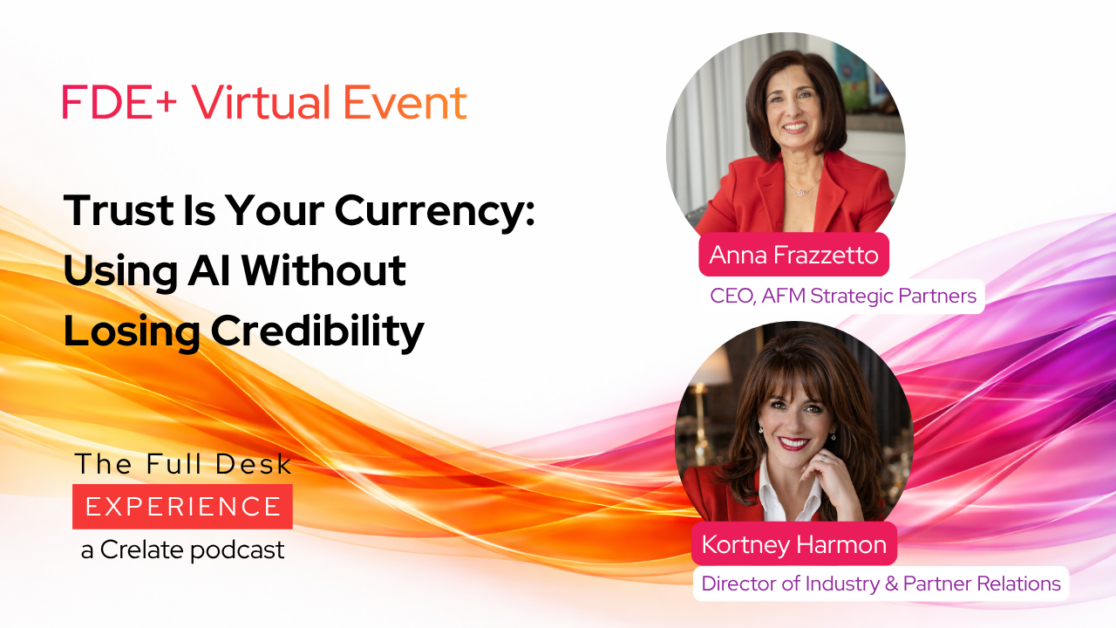
Trust Is Your Currency: Using AI Without Losing Credibility with Anna Frazzetto, CEO – AFM Strategic Partners
Show notes
How can staffing firms use AI to drive more revenue without losing the trust that wins business? Kortney Harmon sits down with Anna Frazzetto, founder and CEO of AFM Strategic Partners, to explore why AI is most powerful when it’s built on strong sales fundamentals—not used as a shortcut.
Anna shares practical strategies for integrating AI into every stage of the sales cycle, from prospecting and discovery to forecasting and follow-up. She explains why disciplined processes, clean data, and human judgment remain essential, and offers clear guardrails for adopting AI in ways that improve efficiency while protecting client relationships.
Learn how today’s top sales leaders are using AI to scale smarter—without sacrificing the credibility and trust that drive lasting success.
Transcription
Anna Frazzetto [00:00:00]:
I’m going to be a little direct here, right? If your sales process is sloppy, guess what? AI will scale sloppy, just like you have been. It just does it exponentially for you. If your qualification is weak, AI will just help you send even better back emails out because you haven’t qualified the prospects that you’re going after.
Kortney Harmon [00:00:21]:
Hey, guys. Kortney Harmon, host of fde. In case you missed it, we recently hosted a live virtual event and it was one for the books. We brought together some of the best thought leaders in the recruiting and staffing industry for two full days of real, no fluff conversations. And what’s actually working right now, from building trust with clients to using AI without losing your edge, to growing revenue through relationships. These sessions were absolutely incredible and we didn’t want you to miss out. So we turned every single session into its own episode. And over the coming weeks, we’re dropping them one by one right here.
Kortney Harmon [00:01:01]:
Each episode is a standalone session from the event. So whether you’re tuning in for the first time or you were there live and you want to revisit all of your favorites, there’s something for you. Stay tuned. You’re going to want to hear from every single one of our speakers. Trust me. Enjoy. For those of you who do not know, I added Anna’s LinkedIn profile. She is one of the most recognizable names in the sales strategy across the staffing and technology industries.
Kortney Harmon [00:01:33]:
She’s the founder and CEO of AFM Strategic Partners. It’s a firm built to help sales teams grow revenue, transform their portfolios, and compete at the highest level. She has been named to SIA’s Global Power of 150 Women in Staffing list, I think seven consecutive years in a row. Amazing Anna. And recently published her own book. So she was talking about that Sales Leadership in Action, A Hundred Practical Tips for Coaching Culture and closing. And her session today really is tackling. One of the biggest tensions in our industry right now is using AI to accelerate revenue without trading away any trust.
Kortney Harmon [00:02:11]:
So, Anna, I’m going to jump off stage. I am going to leave it to you to talk to this group. You have till the top of the hour, the next hour. So if you go through this, if there’s any questions, I will jump back on stage and chime in. Otherwise, the floor is yours.
Anna Frazzetto [00:02:28]:
Thank you so much, Kortney. Really appreciate it. Well, thank you everyone for participating in this session. As Kortney mentioned, I’m Anna Frazetto. I run an organization called AFM Strategic Partners. And what I’m most excited is to talk about AI, which is Such a controversial topic today. There’s a fear out there which is a legitimate fear as far as how is it going to impact our future either from an employment perspective or even from a day to day tactical perspective how we do our jobs. So today I’m going to talk a little bit about how sales teams use AI to drive revenue without losing trust.
Anna Frazzetto [00:03:06]:
As we know, for any of us that touch or have anything to do with sales, trust is such a key ingredient in being able to secure that client relationship and therefore you can’t jeopardize it. But how do you use AI to kind of help move things forward for you? So let me start and I’m going to be a little direct here, right? If your sales process is sloppy, guess what? AI will scale sloppy just like you have been. It just does it exponentially for you. If your qualification is weak, AI will just help you send even better bad emails out because you haven’t qualified the prospects that you’re going after. And last but not least, if I talk about CRMs, I am such a believer in the health and the well being of your CRM and as soon as you do not maintain it or to track of the information that’s in it, if it becomes fiction, AI will do a great job at producing intelligent fiction for you. So what we’re talking about is when we talk about AI, it does not fix fundamentals, right? It exposes them and exposes them exponentially. So it’s not just another tool that’s out there, but it’s about of how can you use it to help predict revenue, have disciplined execution and protect the trust. As I mentioned earlier, trust is a key indicator of what works really well with a client.
Anna Frazzetto [00:04:30]:
As soon as you lose the trust, guess what, you wind up in a really bad situation and it takes a significant amount period of time to be able to gain that trust back from a client. I had read a stat this goes back a few years ago that basically for one wrong misstep, it takes 17 correct new steps forward before the client actually starts to regain that trust with you. So I don’t know 17 is accurate, but the indication there is clearly it’s not a one for one and you have to be aware of that. I want to share an example before moving forward. I called the 2000 email expert. This is a client that I worked with after they had done this experiment and what they did was they used AI to create a 2000 email campaign and I have to tell you, the open rates were fantastic. When they shared with me the information and it was just spot on. But the sad reality was it did not fit their ICP right.
Anna Frazzetto [00:05:35]:
So when salespeople were going after figuring out who they were going to call after, it did not fit their ideal client profile. So it turned out as much as you had tremendous success on the win rate, you did not have any success as far as it turning into potential business opportunity. So it was a matter of you lost credibility as far as pinging organizations did not fit the mold of who you were trying to go after. Just something to kind of keep in mind. You can use AI to build the actual templates to do these email campaigns, but you have to make sure that it’s married to your icp. And this is where marketing can do a great job in being able to work hand in hand with sales and, and making sure that they’re lockstep with each other. So AI, as I’ve been describing it kind of amplifies what is working and accelerates what’s broken. This is where you can use AI to really help remove friction.
Anna Frazzetto [00:06:35]:
I have to tell you, research, it’s incredible because it can scan information across the planet and get it to you. Which means for any client meeting out there, you can be 100% prepared because you’re going to know everything about that organization that’s out there on the web. You’re going to learn everything about the individual you’re meeting with. If they’ve been quoted, if they’re writers, if they are speakers at events, you’re going to know all that. It’s also a great tool in being able to draft emails for you. Again, it needs the human interaction to make sure that it’s accurate to do summaries. For those of you out there that are used to using meeting note takers, I’m a huge fan. I currently use Otter AI, but there are so many out there, fireflies and so on and so forth.
Anna Frazzetto [00:07:25]:
And they do a great job at being able to craft what the next steps are. You can actually use those cut and paste with some human interaction and be able to use them as your follow up with clients. So what you want to do is you want to separate the human accountability for the strategy, the buyer trust, trust, as I mentioned before, and judgment. I’ll share an example with you. If a rep reclaims two to three hours per week for an administrative work, because now, for example, instead of taking notes that they hand wrote and they have to now put them in the correct format and then call out what the summary and action items are, that’s A lot of administrative work for a salesperson. So if you have a team of 10 people, you can easily save 20 to 30 additional selling hours, which is incredible, right? If you think about it, that is all revenue capacity that you are putting back on the table. So okay, so as far as today, I know we’ve kind of jumped in here, but I want to be able to make sure that the audience can kind of walk away with a little bit more clarity as far as how AI can creatively work across the sales cycle and what it can and cannot do when it comes to relationship based selling. Also, I want to make sure that you have some clear case studies and examples that you can use for prospecting, discovery or how a deal is put together or forecasting.
Anna Frazzetto [00:08:54]:
And last but not least, I’m going to leave you with some guardrails and a 30 day start small, learn fast adoption plan that you can go back and take a look at some tasks that you’re currently doing that you can use AI to make your life easier. So let’s jump into what the sales cycle looks like. I broke it up into five categories. Prospecting, messaging, discovery, deal work and forecasting. So when we talk about prospecting and actually I just used the example of the three hour reclaim that I shared with you because if a salesperson can go into an account with all the proper research and the making sure that it matches the icp, you can create your target list, you can create your go to market strategy with using AI and how to be able to tackle those new prospects that you have on your list. Again, it requires the human interaction. I have to mention marketing. I’m a big proponent of marketing and sales interact with each other and they need to be in lockstep with each other and therefore you can walk away well armed to be able to come up with your prospecting list.
Anna Frazzetto [00:10:10]:
On the messaging side, you want to make sure if you utilize AI and AI does a good job of being able to come up with some objection hooks that you can add to your messages. But make sure that it’s got the personal component to that messaging and it’s in lockstep. Lockstep again with what marketing has out there from a website perspective and what the company mission and vision is. Now when we move to discovery, this is where I think AI can help you prepare for the actual first call and also do a great job with the notes and the summaries like I had mentioned a few and then the action plan as far as how to what’s next to Sharon. It also Discovery, I find to be the pinnacle part of the sales cycle. Because this is what’s going to determine for you. Yes, this is a real deal that you’re going after. Full guns, ablazing or not exactly 100% fit.
Anna Frazzetto [00:11:09]:
And what do I have to do to shift the perspective and to shift exactly what I’m crafting for a possible solution, then that kind of moves us to building the deal. And here you want to be able to use AI to be able to help identify if there’s any risks, any red flags, any concerns that come up for both parties. And you want to make sure that you have an accurate representation of what the action plan is again for both parties and what the follow up action items are again. All tremendous prep and polish work that can be done by AI, but again requires the AI that it requires the human interaction. And last but not least, my personal favorite, forecasting. Forecasting is so critical and this is where I find, working with many organizations that it’s a big challenge maintaining that pipeline hygiene. It is difficult because sales, and I can say this, I’ve been a Salesperson for over 25 years. It’s an emotional ride, right? It can be an emotional roller coaster ride at times.
Anna Frazzetto [00:12:16]:
And a lot of times you go on gut feel as to what’s working and what’s not working. And often there’s the sentiment that they really like me, they really want to work with me. And so therefore I think there’s going to be a deal. What’s missing there is making sure that you have validation at each stage of your sales cycle to make sure that you’re spot on. And it’s not just a gut feel that they like you. This will also help share trends that are happening. For example, one industry is doing better than another industry that you target. Why is that? Is it something that’s topical, that’s happening right now that you can maximize, or is this just the way how the finance industry shops and therefore you’re more aligned with finance than you are with healthcare or pharmaceutical? Again, it gives you some insights in how to be able to navigate those waters.
Anna Frazzetto [00:13:10]:
Now, as I mentioned, AI helps to highlight the flags, but it’s definitely not the decision. There needs to be a strategy at each step of your sales cycle that basically gives you the exit criteria. As I mentioned discovery in the previous slide, this is where you kind of determine is this real or not? Not real. Making sure that your action plans actually represent and must remain buyer focused, right? So you want to make sure the buyer is well represented and of Course, it does not jeopardize you as the vendor. And forecasting must be explainable, not hopeful. I use the example of they like us. Well, that’s not strong enough. This happens to me so many times in talking to salespeople and I can so appreciate it because I have been there where I am talking to my boss about an opportunity and saying, I know it’s going to happen because they really love working with me.
Anna Frazzetto [00:14:08]:
But that’s not the right answer. You need to have the facts and figures that back that up. So now what can AI not replace? Right? So I mentioned truth. Trust is a huge component, especially in the staffing industry. It’s all about trust. But there are certain areas when you take a look at like empathy, credibility. In the high stake conversations, you can’t have AI be the one that’s going to craft that conversation for you. You need to be able to think about what is going to win this client over.
Anna Frazzetto [00:14:38]:
When you’re negotiating, when you’re trying to navigate a political climate within an organization, you need to make sure that you can read the room right and make sure you understand what are some unspoken objections. So authentic relationships that create repeat business, that is the key there. Let me give you another example of another organization that I work with and they had used AI, which I thought was an excellent idea to do the candidate summaries. Now they came out with a very structured, impressive format to be able to do the candidate summaries and the consistency. Right, it gave you that consistency. All the candidate summaries look the same coming out of your organization. The one challenge is that one hiring manager wound up calling them and saying, gee, on a second, this reads too much like a marketing document. I want to know more about the nuances of this person.
Anna Frazzetto [00:15:38]:
Tell me more. What wound up getting lost in the transition of moving to this structured format was the nuances that a recruiter adds in regards to a particular individual. So it was an easy fix by making sure that the recruiters maintained that personalized touch into the document and therefore it becomes a win win. And you establish that credibility that you’re looking to establish. And you want to make sure that if there was any jeopardy of trust going away because they thought that you were too structured, you can easily gain that back again by making that modification. Okay, so let me leave you with a simple guardrail playbook. Now this might seem straightforward, but this kind of helps you. And a rule of thumb that I typically use is if it would damage trust when discovered, don’t do it.
Anna Frazzetto [00:16:32]:
Even if you think it’s going to work, right? So key Item is, number one, transparency. You want to make sure that you are 100% transparent. You can use AI to draft whatever information you’re going to be sharing with a client or a prospect. So just for those of you who know me, I call everybody a client, even if they’re a prospect, because I’m a firm believer that if you work hard enough that you can change them into being a prospect. So just a little bit of food for thought, but make sure that it’s true and specific. Also with data, there’s a lot of sensitivity around data, making sure that you protect client and candidate data. You define what can’t be pasted into the tool. So you got to be sensitive because once you put in an AI, it’s out there for good.
Anna Frazzetto [00:17:22]:
Thirdly, you want to make sure that you verify and validate the facts. We’ve heard about AI having the ability to hallucinate and make things up. So you need to pressure test it, validate it, make sure that they’re giving you accurate information, quotable sources. So therefore, especially if you’re asking for stats on how a certain industry is operating, you want to make sure you have the right facts and figures, voice and brand, keeping the message consistent with your value proposition. This is where often it becomes a little bit lost in translation. With AI, what winds up happening is you need to educate AI that they understand what your voice and your brand is. They need to understand what your messaging is so like that it can properly propagate across any of the emails or the messages or campaigns that you’re to going looking to perform with. Having that in mind.
Anna Frazzetto [00:18:21]:
And again, marketing just pushing that one more time here, this is where marketing can play a key role in making sure that you have properly represented the organization. And accountability, again, I can’t stress enough. Accountability is all about making sure that the humans are involved every step of the way and that there’s no possibility where this is all 100% AI generated. So let me give you an example. I call it did you actually read this? And this comes from another client that I have worked on and what had happened was a client responded to a message and that basically said, did you bother to look at my website? Because the information you spewed out was actually wrong. So therefore you lose credibility, which is the component that I mentioned to. So AI might have come up with some assumption that a company worked a certain way and in reality that might have been old data and how they worked in the past. But they haven’t worked like that in the last decade.
Anna Frazzetto [00:19:29]:
So you lose credibility, which as I mentioned earlier on, that’s a difficult thing to regain and therefore you have to make sure that you represent accurate control information going forward. It’s got the human blessing at the end of the day. So staffing specific, this is where AI I think helps the most. It helps speed things up, it helps elevate client conversations because it gives you background information that you were seeking for and you might not have been able to find it the traditional ways. I think when you look at job recs and turning messy intake notes into clear requirements, that is a tremendous asset to the staffing industry. Making sure that you understand the right mapping of the organization, either organizational changes, what leadership has moved and who are the hiring managers and what are some of the hiring signals for that company and it keeps track of it for you so that you can modify it. I’m a big fan. I’ve often talked about like doing the SWOT analysis when you, you’re looking at applying what are your strengths, your weaknesses, your obstacles and your threats.
Anna Frazzetto [00:20:41]:
Or for those of you that are familiar with Miller Hyman or blue sheeting. Blue sheeting. If you don’t know blue sheeting, I think the key takeaway from that is it combines doing SWOT analysis with also highlighting who your influencers are, who your blockers are, who your coach is, who the real decision maker is. Because often you think it’s the CEO and it’s not. And you need to make sure that you’re prepared that there could be an incredible influencer in the organization that has the CEO’s ear and therefore plays a significant part in determining what products, what services, what staffing companies they go after. I think AI does a great job in helping you with QBRs. Right. I think it can draft a great format template for you and it could also help you with doing hiring manager follow ups and status updates.
Anna Frazzetto [00:21:35]:
The candidate storytelling as I have mentioned. Yes, great to have consistent profiles and make sure it’s got the human component to it and you want to make sure, most importantly is that with any AI tool that you use internally that you have fast handoff between sales and recreation. About when is it the right time? When does recruiting get involved? When does your subject matter expert get involved? Depending on the client opportunity. Because if you think about it, time is money and if things go wrong, it’s going to go wrong quickly and you lose that opportunity with that particular client because guess what, competition is right there and is going to be chomping at the bit to be able to gain your client so tool before inspection. This is an example, another client interaction that I had that I wanted to share. So this is where one firm adopted AI and was all in super celebration, executive hype. And this is what we’re doing and this is our mission going forward. Guess what? Three months later usage dropped and it became like optional.
Anna Frazzetto [00:22:46]:
People were not using the tools as necessary. And this is a recruiting AI tool. And when asked the question, when I had gotten involved, what happened? How did it just fall apart? And the biggest challenge was management just dropped the ball. There was no follow up from leadership where they said, we’re using this tool. What’s working, what’s not working? What training do we need to do internally? How do we get the teams up to speed? Make sure that you not only have adoption and adoption consistently across the board. An expression that I use often over and over again is inspect what you expect. As a leader. I think there is nothing worse than when I have a conversation with the leader and they say, well, I told them to do it, I don’t know why they’re not doing it.
Anna Frazzetto [00:23:36]:
That’s not a valid excuse. The excuse should not exist. And what should happen is that you as a leader are able to have the conversations with the team and understand, are we trying to shoehorn a tool that doesn’t make sense to fit into the organization or did you get buy in from the teams before implementing the tool? That’s the other question that I have. You want to make sure it’s not just a matter of having management get excited about implementing a new AI tool, but it’s a matter of making sure you get buy in from the organization before actually implementing it. All right, let me leave you with a 30 day disciplines rollout and this is fairly straightforward. You want to be able to choose one workflow that eats your time and then define what good actually means. How can AI actually help you eliminate some of the tasks or some of the iterations that you go through in regards to this particular task? Then you want to be able to create a prompt template, brand standards, non negotiable data boundaries. You want to be able to create the template that you’re going to use to be able to handle this particular workflow.
Anna Frazzetto [00:24:48]:
Then you want to be able to manage and inspect output weekly. You want to coach through it and make sure that it is relevant as far as the task that you looked to use AI to help you better perform it. And last but not least, you’re going to measure this in each of your meetings, you’re going to take a look, is there a stage progression and is it helping your forecasting integrity? So you expand only when trust is intact. So there’s no such thing as team wide rollouts without manager inspection cadence. First you want to make sure that there’s full buy in and it’s a fairly straightforward way for you to be able to roll those out. And then what you do is once this is successful, you roll out the next thing. So before you roll out AI, you have to ask yourself a few questions. Do we have a defined stage exit criteria that managers actually enforce? You want to make sure when I talk about the five phases of the sales cycle that you have an exit criterion for each phase of that cycle to make sure that, yes, it’s a go, we continue, or no, we’re going to cut cord now and move on to the next opportunity.
Anna Frazzetto [00:26:05]:
This will also ensure your forecasting credibility and your pipeline hygiene. Do we inspect deals weekly with evidence, not optimism? And this goes back to they’re going to buy from me because they like me. You want to make sure that you have the facts and figures that the problem the client has is easily fixable with the solution that you’re proposing. And would our clients respect how we’re using AI if they saw behind the curtain? Now that’s a big ask is you want to make sure, as I mentioned, protecting their data is a significant component to that and making sure you have the guardrails around that. Now, if you answer no to any of these questions, it’s not a big deal. It just gives you the time to be able to fix it and pause and reflect upon it. Lastly, let me leave you with just some summary notes here. Discipline is the advantage.
Anna Frazzetto [00:27:04]:
AI is not the competitive advantage. Even though you hear this over and over again out there where they talk about AI is your competitive advantage. Discipline is. And how you use it. Discipline is if you have a sloppy process, guess what? AI is going to scale that sloppiness. Technology is not going to fix the fundamentals, it just exposes them and exposes them faster and more severely. So you need to be cautious of that. In staffing, trust is your currency, as we’ve talked about throughout this entire session.
Anna Frazzetto [00:27:39]:
If AI speeds you up, but it erodes credibility, that is a liability and you will jeopardize your revenue stream. So AI amplifies your culture, discipline, scales, precision, and that choice is leadership and how you plan to roll it out and manage it. This completes our session. I am going to get out of presentation mode and see if there are any questions.
Kortney Harmon [00:28:07]:
I don’t see any as of yet. Anna, does anybody have any questions and anything that Anna said today or want to dive a little bit deeper? We’ll give them some time.
Anna Frazzetto [00:28:18]:
Sure.
Kortney Harmon [00:28:19]:
I love Otter. You mentioned Otter Note Taker. That’s my favorite one. I use Otter as well.
Anna Frazzetto [00:28:25]:
Oh, I love Otter. And it does such a great job. It does such a great. It should be royal to give me. It does such a great job. I love the fact that it’s got all the action items spelled out for you.
Kortney Harmon [00:28:38]:
Yeah.
Anna Frazzetto [00:28:38]:
Right.
Kortney Harmon [00:28:39]:
Before you even have to do anything else. Like, it’s already there.
Anna Frazzetto [00:28:42]:
Exactly. And it saves me so much time. And it’s also, if you think about it, you never have undivided attention to the client if you’re taking notes and it’s so distracting. I find if a client is on a roll and talking about something and you’re writing and not making that eye contact, I really do feel it kind of jeopardizes the conversation somewhat, as opposed to having Otter AI that just does in the background for you.
Kortney Harmon [00:29:08]:
I love that. I learned a hack before Otter came around for, like, you know, whenever you’re taking notes for a candidate in the system. And one of our guys here, he said, just if you’re on a Windows computer, push Windows H and then start talking. Like, so you know how you have, like, their candidate summary. You, like, just talk to them. And then you could literally just push Control or Windows H and talk everything you just heard about the candidate into. And it’ll, like, automatically update into your notes section, like, so you can talk through it. I have a hack for those that don’t have an AI note taker, but I would recommend AI note takers.
Anna Frazzetto [00:29:43]:
Yes. Yes. It’s minimal cost in comparison to the benefit that you get, you know, that you get from it. But this is a lot of fun having this session. It’s hard not to be able to see the audience, but I know that’s the way it normally works.
Kortney Harmon [00:29:58]:
Anna, do me a favor. Before we let you go, tell us a little bit more about your book. Maybe we can highlight that and kind of everything that you. Obviously, we talked a smidge about it in the beginning, but tell us a little bit more about that for anybody who may be interested in buying that book.
Anna Frazzetto [00:30:12]:
Sure. So it’s called Sales Leadership in Action, and you can find it on Amazon. And the book is a culmination of 100 sales tips that, when I first started my business, it was actually kind of funny. I thought it would be helpful to do a sales tip of the day. And I would do these little videos on LinkedIn and every day I would have a LinkedIn video. And I had a colleague of mine say, these are great. Do you have them documented any? And I said, no, I don’t. I just literally have been with my phone doing videos and having fun with it.
Anna Frazzetto [00:30:50]:
And that made me think I should really document this. So what made me do this was document it into manageable nuggets that salespeople. I know I could say it speaking firsthand. We like our information and process it in golden nuggets. Right? Like little nuggets that you can digest. So the sales tip of the day actually works. So what I did was I put it in the book format, but then I organized it into sections depending on what you want to focus on. So if you want to focus on your pitch or your pipeline or you want to focus on prospecting or targeting, it kind of gives you ideas of how.
Anna Frazzetto [00:31:29]:
Objection. Handling. How to go about doing that. So, yeah, so that’s the book and thank you for allowing me to share it. I love that.
Kortney Harmon [00:31:37]:
That’s amazing. Thank you so much for sharing it with us. You know, I don’t see any other questions. Anna, we have gotten inundated with information and our pens were furious or our note takers have been furious in this whole process. So I don’t see anything right now. If you have not again connected with Anna, please make sure you do that on LinkedIn. I’ll put her LinkedIn profile in one more time so you can follow her, see more about the book. Just connect with her and reach out if there’s anything direct.
Kortney Harmon [00:32:05]:
And I think that is it. Anna, thank you so much for all of your wisdom and your nuggets and everything that you have to share. That’s a wrap on this episode. If this one got you thinking, just wait until you hear what’s coming next. We’re dropping a new session from the FDE Q1 event every week. Each one a different speaker, a different topic, and a different angle on what really takes to build relationship driven revenue in this industry right now. Make sure you’re subscribed so you don’t miss the next one. We’ll see you there.