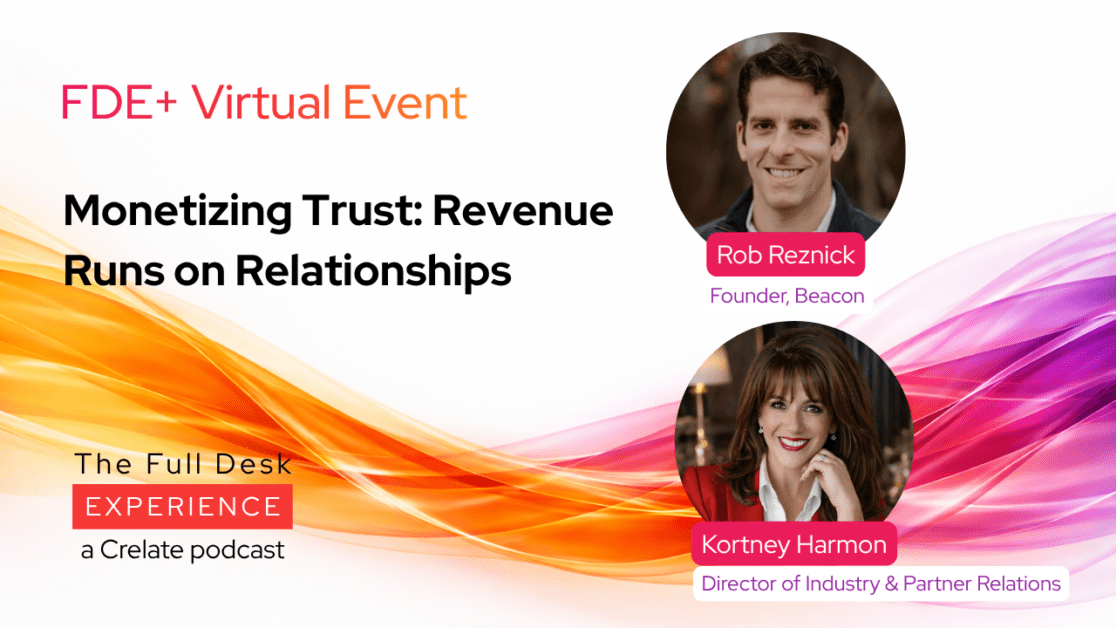
Monetizing Trust: Revenue Runs on Relationships with Rob Reznick – Founder, Beacon
Show notes
What happens when AI makes recruiting faster—but trust becomes the real differentiator? In this FDE+ session, Kortney Harmon sits down with Rob Reznick, founder and CEO of Beacon, to unpack why referrals, reputation, and human connection still drive the strongest business results in recruiting.
Drawing from his background in tech, finance, and startup leadership, Rob explores the hidden cost of over-automation and why relationship-driven recruiting continues to outperform transactional outreach. From LinkedIn experiments to practical referral strategies, he shares how recruiters can strengthen credibility, build stronger networks, and create long-term business growth through trust.
________________
Follow Rob Reznick on LinkedIn: LinkedIn | Rob
Check out Beacon here
Follow Crelate on LinkedIn: Crelate
Want to learn more about Crelate? Book a demo here
Subscribe to our newsletter: The Full Desk Experience
Transcription
Rob Reznick [00:00:00]:
AI is clearly not going to be the one to build the relationship over the last 10 years. That is shared trust. And it’s definitely not going to put its name on the line for you. But that is what a referral does. A referral is someone who will put their name and their reputation on the line because they know that you’re good.
Kortney Harmon [00:00:21]:
Hey guys. Kortney Harmon, host of fde. In case you missed it, we recently hosted a live virtual event and it was one for the books. We brought together some of the best thought leadership leaders in the recruiting and staffing industry for two full days of real, no fluff conversations. And what’s actually working right now, from building trust with clients to using AI without losing your edge, to growing revenue through relationships. These sessions were absolutely incredible and we didn’t want you to miss out. So we turned every single session into its own episode. And over the coming weeks, we’re dropping them one by one right here.
Kortney Harmon [00:01:00]:
Each episode is a standalone session from the event, so whether you’re tuning in for the first time or you were there live and you want to revisit all of your favorites, there’s something for you.
Rob Reznick [00:01:11]:
Stay tuned.
Kortney Harmon [00:01:12]:
You’re going to want to hear from every single one of our speakers. Trust me.
Rob Reznick [00:01:16]:
Enjoy. For everyone who doesn’t know Rob, I have gotten the pleasure to become friends with Rob. He’s actually here from the Cleveland area as well and I’m super excited. He is the founder and CEO of Beacon at Cleveland Startup here where he launched into turning referrals into formal rewarding marketplace and before that he was at a tech startup. In knowing Rob, he’s really helping guide. He’s a connector, he’s a builder, someone who has stakes in the next chapter of everything that he does. So Rob and I have gotten to have conversations outside of our industry as well and his passion runs deep. You probably can find him on Substack and all the other things that he’s on as well because the man does not rest.
Rob Reznick [00:02:10]:
So I didn’t even read your article that you sent me, by the way, on Sunday because we didn’t have electricity for days down here. I know, it was great, but Rob, I’m going to get off of here and I’m going to let you talk. So I am super excited to hear your talk as always. Do you need anything from me before I jump off?
Rob Reznick [00:02:27]:
No. Kortney, thanks again. And to the broader Tree Lay team, thanks so much for having me today. Excited to be here and really participate in both a virtual summit in general, but on something that really is a critical human centric issue right now. And so my commitment to this group is. By the end of the presentation, you’ll all understand in full why I’m absolutely obsessed with the importance of human connections. So let’s just jump in and I’m going to start by just talking for a second about trust. Trust is a pretty weird thing.
Rob Reznick [00:02:56]:
And I know the title of my presentation is anchored around monetizing trust, but really the last decade has been particularly weird for all of us because. So, like Corgi mentioned, I came from a tech company. Prior to this, I spent time in cyber, and that at its core was really focused on how social media was evolving. As we began to hear about where misinformation and disinformation really made us all skeptical about what info we could trust, pandemic happens. Then we all have to get re acclimated to human interaction. And then all of a sudden, AI starts to get thrown around everywhere. And the reason for my title and subtitle that I’m anchoring on why AI isn’t the answer is because candidly, humans have known for a hundred years what the answer was. And that answer was human connection.
Rob Reznick [00:03:46]:
That answer was referrals. And the reason is because we know who we can trust. And so that, to me, is what a referral represents. So today I’m going to talk about this a little bit more and really how, if you don’t already have a strategy and a toolkit around referrals, My belief and what we’ve seen at Beacon is that you’re not just leaving money on the table. You’re exposing your moat as a recruiter and as a firm, which is your network that powers everything. So let’s just kind of jump into what I like to think about as sort of the AI gold rush that gets splashed around every which way, that all the vendor ecosystem, for the most part out there, has been telling you all the last couple years that AI can help you source faster, that you should have AI scan millions of profiles in seconds to get back time. And then they started to really drive home, okay, well, maybe you should just screen smarter. Because the collective, we have algorithms that rank and filter candidates instantly.
Rob Reznick [00:04:48]:
So again, you can go faster. And then as a part of that, this third piece of match, better that there’s technology embedded in machine learning that doesn’t just help you screen smarter, but it also helps you assess fit and performance faster. And I’m not going to lie and just stand here and say, oh, it doesn’t work a lot of this does work, and it’s getting better and better every day. There’s tools that a lot of you are probably already using to accomplish these things. And I 100% believe that they’re impressive and that they do work. But the thing that frustrates me and really pushed me over the edge as a cfo, which is what I was, and I’ll talk about that in a sec. But what really pushed me over the edge is that when companies are talking at conferences and they’re talking behind the scenes, the thing that they’re not really screaming and trying to drive home is that it’s one thing if everyone is using this, but when everyone is using this, they’re using the same tools and they’re using the same AI. So it’s no longer a competitive advantage.
Rob Reznick [00:05:46]:
But when you think about what’s left and how you can differentiate yourself as a recruiter to win new searches and place more candidates, you’re really in an arms race. But you’re using all the same weapons, which strategically makes no sense. And vendors are telling you that AI is the answer, but the answer to what? Like, I just genuinely think that they’re asking the wrong question and that they’re missing the focus on a lot of what AI doesn’t do and isn’t intended to do. And again, some of this is to just say obvious things and poke fun at it a little bit. But it’s like, clearly AI isn’t going to be the one who calls your friend and says, you have to work with these people, and then someone trusts it. Like, AI is clearly not going to vouch for your reputation. I understand how you can train the technology to portray your brand, but it’s not vouching for you. It’s just spitting out and regurgitating information that it up ranks.
Rob Reznick [00:06:42]:
And AI is clearly not going to be the one to build the relationship over the last 10 years. That is shared trust. And it’s definitely not going to put its name on the line for you. But that is what a referral does. A referral is someone who will put their name and their reputation on the line because they know that you’re good. And LLM is not going to do that. And there isn’t an infinite amount of compute that is going to be that equivalent of a real person. AI is just a tool, but trust is a strategy.
Rob Reznick [00:07:16]:
And I know that I’m seeing this up and I haven’t really spoken about myself, so let me give you a little bit of background on you and just why I’m standing here today talking about this. So quick detour on me. I’m not a recruiter. I’m not a recruiter by background, but I did spend the last couple decades, candidly both in the office of the cfo, adventure backed and PE backed businesses, and then specifically the bulk of my career before I lived in Cleveland in New York Tech. And I very much became obsessed with kind of two pieces that intersected together. One was your ecosystem that y’ all play in. Because frankly, every job I ever got came from a referral. And so there was this natural curiosity of just how did this ecosystem work? Because originally the referral for me came from campus type stuff that at the time, the role of the recruiter, as in someone like y’, all who plays sort of this intersection of therapist, surgeon and firefighter, candidly wasn’t in front of me.
Rob Reznick [00:08:19]:
I had these pseudo recruiters on campus or people who were serving as a free recruiter to me to help me get into my first job. And then as that started happening, I just assumed that every recruiter out there was good. Bad assumption. But it did help me identify who were the best recruiters. And so as that was happening, the parallel was I was getting referred to to my next jobs. It might have come from a former colleague, it might have come from a friend, it might have about to have happened from a former board member. And I wasn’t the person who was willing to show up just from a cold reply, a cold outreach. Obviously the last presentation talked about 72 touches and that kind of pieces.
Rob Reznick [00:09:05]:
Well, I was responding to one and that one was a warm intro. And so as I started thinking about that from a recruiting perspective, that really stood in my mind as a CFO when I was looking at business development and as someone who was the gatekeeper to tens of millions of dollars being spent on sales and marketing initiatives to build pipeline to close deals. It simultaneously was fascinating to me when I looked at what were the biggest deals in my career and where did they come from. And it was the same story. Like it came from a warm intro. And so I started really thinking about this in the first phase of when we launched Beacon within the last year when I first met Kortney and the team. And so as I was essentially leaving my past life, 2023, 2024 in tech as a CFO and jumping into founder life, I ran my own experiments. And so I’m going to show you a couple of those both to illustrate the point and because it’s a little embarrassing and funny.
Rob Reznick [00:10:05]:
Okay, so let me set Some context here. So back in 2024, I was thinking about different experiments I wanted to run and in what environments. And so I started on LinkedIn. So the left side of the screen and really my mindset at the time was I wanted to prove a point about how broken the current system was. And so what I did was I created a fictional story and a fictional work history on LinkedIn, but I explicitly called it out as fiction. So you’ll see these examples here of a couple jobs. It literally said fiction in the description. And then there’s some other content from my profile that was there that clearly got scraped.
Rob Reznick [00:10:45]:
It filled up all the tools. I apologize if you are a team or a business that focused on the office of the CFO and was confused by me. But the truth was there. It said fiction on all these other pieces. And so my objective with this was I wanted to understand that end to end ripple of a little bit of data and then how do humans interact? And so I loaded it up with impressive sounding logos and that also included a shout out to my favorite company. Growing up. Blockbuster clearly doesn’t exist anymore. But separate conversation for different today for anyone who was good or is still good at NBA Jam.
Rob Reznick [00:11:24]:
But the data was there in my profile. Depending upon when you look at certain tools, when and how you hit refresh, this may still show up in your data sets. And this was the kind of profile that AI sourcing tools in my mind should be lighting up like a Christmas tree. So I sat back and I waited and began to see some of the results that came my way. And so I’ll kind of speak to a couple of them before I move to the example on the right. So first off was from recruiters. I got a ton of outreach, but the messages really never read past my headline. And so again, like I said, it said fiction.
Rob Reznick [00:12:03]:
But I would still get these automated messages. And I responded to them all and candidly, like, I would respond in various ways to mess with people a little bit. But the message was that stereotypical, hey, Rob, I came across your profile. I was impressed by X. They cherry pick a logo and then you all know the drill and the reasons why, on the average, this doesn’t work. But that was sort of my first phase. I was really focused on what is that cold message that people think should work. And that was what really annoyed me at the beginning of the information asymmetry.
Rob Reznick [00:12:35]:
So I was someone who, if I got that message and it essentially said nothing but fake excitement, I would respond and I’d be like, what’s the title, what’s the computer, who manages the team, and what is equity? Because this is a tech based role. And then it would decision tree to. I’m happy to get on a call and tell it to you. It’s like, no, no, no. There’s nothing about this that’s confidential. Unless this is a confidential backfill. So tell me if it is, do you need me to sign an NDA? Like, what do you need? And so it unearthed kind of scary point one about the industry. I understand how protective people are about their clients because they don’t want people to go around.
Rob Reznick [00:13:12]:
That totally made sense. But if you’re reaching out to me, the objective is to not have to reach out to me 72 times. The objective is reach out. Qualify me, I qualify you, and let’s figure out we should talk. And if not, I’m happy to refer people. So that was sort of like phase one. And the interesting nugget there, which I did not appreciate, was I thought by putting up these super famous logos that that would be the hook to get recruiters to talk to me. Well, when I started talking to people, they were like, hey, I don’t want to talk to you.
Rob Reznick [00:13:49]:
Like, if you’re genuinely at these companies, you’ve probably lived through liquidity moments. You’re probably super expensive. I think for me to get you excited about this, you’re like way out of budget. So, like, I don’t want to talk to you. So it began to kind of coach me about every signal that matters from both sides. It’s not just the signals that you as a recruiter send me as a candidate. It’s a hundred percent. All the signals I send to you about my work history, what you think my current comp is.
Rob Reznick [00:14:23]:
And it’s this game that’s mutually information asymmetric. And so that really got me thinking about a lot. And then all of a sudden it started to shift into these other phase, which is in part on the right and then something else, which is I got an inbound from Business Insider that was asking for me to do an interview to speak about what it was like to work for Jensen at Nvidia. And I thought that was hilarious. Again, back to this point of it says fiction. So I didn’t do the interview. But once that happened, I got a separate inbound from the note on the right, which was research being conducted about Sam Altman. And I was like, okay, here we go again.
Rob Reznick [00:15:05]:
I need to acknowledge that this is not true. It’s fiction. I’ll give you a sec to glance at it. This is the email on the right. And so I show that because, yes, it’s funny, but to me, it was also terrifying to think about, because if this is what happens when the entire ecosystem runs on these connections to unverified data, I was like, okay, the algorithms are seeing the keywords, and yes, it’s learning. The humans saw the logos, but nobody, not the AI and not the people, really had an easy way to verify what was real. And so it just, again, it got me back to thinking, what would have caught this? And so that’s what brought me back to those early slides. It’s like, well, what catches this is humans who know me.
Rob Reznick [00:15:51]:
So this question is, if you’re the recruiter, what is the easiest way to verify this and then meet Rob at the right moment? And that, to me, was a referral. It was a human connection. So now for a second, let’s talk about some data. So a couple stats to again anchor us in on, like, why referrals as a growth lever? So, first, 1, 5x referrals that produce leads convert 3 to 5 times the rate of any other channel. You could look at McKinsey data, you could look at multiple other industry studies, but the data is unambiguous. Referrals are clearly converting at a much higher rate. Now, let’s shift to the middle, the 90%. So what is that? 90% is the percentage of decision makers who will not respond to cold outreach.
Rob Reznick [00:16:36]:
That’s a stat from LinkedIn and LinkedIn’s state of sales report. Again, 9 out of 10 is insane, but I get it. And that’s the basis of spray and Pray strategies that people are using AI tools and machines to do. And then this last stat from Harvard Business Review. 84%. 84% is how much B2B revenue traces back to a referral as the first step in the chain before it drives through to a deal. And so I’m not acting like any of this should feel unique because candidly, the best recruiters that I’ve met over the last 15, 20 years already knew this. And a lot of you have either talked about it publicly or already have a baseline strategy of how you’re weaving this in to your business development and your sales motions.
Rob Reznick [00:17:21]:
And then so I started thinking about, okay, what should I be portraying to the market and what should be can be thinking about? And it just continued to get us back to referrals and that the biggest placements or accounts that folks work stem from a referral where it was pretty Simple. It was, hey, you need to call this recruiter. And that wasn’t you trying to reach out necessarily and say, you need to call me. It was somebody else who knew you were awesome. And so it’s this question of, in this world of that already happens for free because of word of mouth, but it’s not systematized. So you can’t just rely on word of mouth to build pipeline, because that’s unreliable, it’s unstructured, and it has flaws. And so that came back to us, and we’re like, why aren’t more firms building systems around this? So let me reframe it a little bit. When people talk about business strategy, they talk about moats, the competitive advantage that’s hard to replicate.
Rob Reznick [00:18:20]:
And in recruiting, clearly your moat is not a software. It’s not how you use a workflow. It’s not even access to your own job board or your methodology. Your moat is your network, and it is your human relationships. For the reasons that I’ve talked about, it’s that AI can’t replicate that. And it can’t replicate the relationships that you have with people, past clients, past candidates, people, you know, in the industry, there are people who are in your CRM or your phone, but more so, they’re people who trust you and they’re people who already know about you, the types of businesses that you work with, the type of candidates that you just crush with in a good way with placements. But also you as a person, like Kortney mentioned, right. She talked about getting to know me outside of work.
Rob Reznick [00:19:09]:
There are a lot more people out there like me that care about the human connection and do want to talk to you. And. And there’s a reason for that. And that’s really, at its core, what we think about as part of this concept. And so it really got me to spend more time in thinking about what I call the referral paradox. And so let me kind of explain it a little bit back to my earlier point. There’s people who know you, they know you’re awesome, and they do want to refer you. And sometimes they’re already doing it for free because they genuinely want to help other people.
Rob Reznick [00:19:38]:
But they don’t do it often enough for a variety of reasons. And when you dig into the why, it’s almost often one of or some combination of these four reasons. So, number one, there’s no incentive. There’s no formal incentive. Yes, thank you. Texts, emails, free drinks, dinners, like, those are nice, but there isn’t that incentive in front of someone that when they look at it, they could do the math and it could even be good enough to pay the mortgage. And so if you think about it from your referrer’s perspective, if they’re genuinely going to take time out of their day, put their name on the line and call someone or talk to someone they know, it’s a pretty big risk because their reputation is on the line to make that intro. And then it does formally and informally come back to this question of like, well, what am I going to get? Like, yes, I want to pay it forward because good humans help good humans.
Rob Reznick [00:20:30]:
But if it’s not a formal incentive in front of them, why would they repeatedly prioritize time to essentially be part of your business development army over anything else that’s on their plate? So number one, there’s no incentive. Number two, there’s no structure. Even your most willing referrers don’t know what you need right now. They don’t know what kind of searches you are definitively running that have been working. They don’t know which ones you’re running that aren’t working. They don’t know the best way in that moment to send somebody your way. Like back to my spray and pray comment. Some people might launch it to you via phone, some via text.
Rob Reznick [00:21:11]:
It could be a function of you and your workflows or them in the moment. The intent might be there, but the mechanism isn’t easy. Number three, there’s no follow up. And no follow up in my mind could mean slow follow up, right? Like they might refer you someone once, maybe twice. And then it comes back to if I was the person who just did that, I have a relationship and if I don’t get a response or I don’t see the response, or maybe I do and it’s not fast enough. Maybe it went all the way through and I don’t even know the placement happened. And now I go run into the person and the loop didn’t get closed and I’m embarrassed because it’s like I referred you to Kortney and then I didn’t even realize that she found you like that perfect job and now I look like an idiot because I’m like, you know, there’s these compounding effects that map back to the follow up. And so again, frame of reference.
Rob Reznick [00:22:00]:
And now I’m like, I don’t know if I’d want to do that again because it was a little embarrassing. Lastly, the recognition. Recognition doesn’t have to be financial, it could be non monetary. But again, it just comes back to this point around Humans. And if we feel used and not valued, it impacts what we will do moving forward, which then impacts your future potential of using us and the trust that you’ve accumulated as a business development motion. There isn’t a system around it, and without the system, even the best intentions will fall apart. So as you kind of combine all these things with my earlier point around signals, everything is a signal. How you treat people who could or do send you business says everything about you.
Rob Reznick [00:22:46]:
And when someone sends you a referral, it obviously is nice to respond with a thank you in a variety of capacities. But it’s a completely different signal if what you send as that response is something like, here’s 15% of my fee plus a tail of repeat business for that client. And as we really started to lean into what is that difference? What is that difference between something that may not purposefully be intended to signal that you’re cheap versus something that shows that you are strategically thinking differently about what referrals mean to you as a business partner? They’re very different signals. So we really leaned into this the last 18 months from a discovery perspective and then paired it with the fact that, you know, a couple slides ago, I talked about my own LinkedIn experiments. We paired it in with a number of elements of research around what’s the difference? How do we see this begin to impact recruiters and their businesses differently? Because a lot of people on the call and a lot of people out there have thought a ton and have tested various elements of split fee arrangements. Thinking about the various human centric ecosystems that are used for split fees, it could be completely manual, it could be using a tool, it could be using a Google sheet. And so it was like, what is that MVP of what moves the needle? And then where can we think about where this is going? So at Beacon, I want to just now talk about, okay, what were early adopters doing with us? We had a cohort of recruiting firms that have already been doing the right side of what I just showed you. We have firms collaborating with us and a variety of tools and capabilities that we build so that they could offer 10 to 20% of the new placement fee that they could offer.
Rob Reznick [00:24:36]:
That plus a tail. Again, this is not a one size fits all model because clearly not everyone is doing perm placement for C suite roles. Some people are doing complete opposite. And then there’s everything in between. And so we were essentially testing a variety of these potential incentives to see just what happened. And we were doing it in such a way where we’re like, okay, what if you remove all the administrative nonsense? Because we knew that a lot of people administratively don’t want to have to deal with scary things around. Well, if this is the incentive I offer, do I have to deal with 1099? I don’t have an in house accounting team. I don’t want to understand all the rules.
Rob Reznick [00:25:18]:
I don’t want to deal with the administrative bs. And so we were like, look, what if we removed all of it? We let people experiment with the economic incentive and genuinely that third point, treat referrers as a professional partner, not a favor, not just a handshake, not just a Google sheet on steroids and see what happens. And so that really opened up this discussion of who are the refers that you should think about, like, who are your beacons? And so that’s what I’ll speak to now. Just like, what are those Personas of like, who was that collaborator? And so I’ll do that with a little bit of an exercise. So what I want you to do is think of like five people, maybe more. That’s fine. And think of five people who have sent you business, who’ve referred you business or could. Okay, five people, just.
Rob Reznick [00:26:12]:
I’ll give you a second to kind of think about who’s referred to you business. Okay, so now I’m going to talk about the archetypes and I want you to just figure out in your own mind like which of these people came to mind? Was it a former client? Was it somebody that referred to you because you hired from them a few times? Maybe they did a search for you, they moved companies, they brought you in, told people you were awesome. It could have been internal, could have been a dinner, could have been a conference or association, like whatever. Like they are a fan of you. That’s an archetype here. But it doesn’t have to be just that. It could be a candidate you placed, right? Like that was me when I was going through my office as CFO journey. Like I found a job through Ben when I was thinking about leaving or Ben had stuff, he would reach out to me, but I reached out to him with referrals because I was like, hey, I’m thinking right now of leaving.
Rob Reznick [00:27:07]:
You helped me get this job. It’s awesome. But like, here’s someone you should talk to, right? So I was the candidate who got placed. I was a sales rep. Like I pushed in people that probably generated incremental hundreds of thousands of dollars. So again, that was me. I was the second bucket as the place candidate. I eventually was the former candidate in the first bucket, then now the third piece is me, the industry insider.
Rob Reznick [00:27:30]:
But it hopefully is some of who you’ve thought of as well. Like there are people who are always in the loop. Honestly, you look at the lineup today of speakers, those are industry insiders. Like, they are people who, when they know you and they know that you’re awesome, essentially use a referral agreement. Right? Like, I think some of you have probably seen various tools that are embedded in like the tool right now we’re using for the speaker piece. Like, you might even get a referral agreement follow up. It’s not for me, and I think there are useful purposes to tools like that, but I think that those capabilities are flawed for the variety of reasons that I mentioned on the prior slide. And so back to the archetypes, though, like industry insider, that is probably a person that some of you ripped down.
Rob Reznick [00:28:10]:
And then the last one, the connector, that could be someone who fell in those first three buckets. It can have nothing to do with the first three buckets. There may just be that Kevin Bacon that you know, who’s six degrees of separation or less from literally everyone and or they just fricking love introducing people. They either know everyone, they introduce people. That’s just what they do. And there are a lot of people out there in other industries who make their livelihood on just doing that. And so my question to you is, ask yourself what would happen if you formally gave people a reason to refer you? And so now I’ll talk about this referral playbook. So thematically, kind of four pieces to the referral playbook, again in the vein of a lot of you probably already kind of do this, but this is the baseline of what we’ve been focused on with Beacon.
Rob Reznick [00:29:08]:
And then I’ll show you something. So identify it’s core to really map your trusted network. What we know is true is that all the tools in front of you today are not effective ways for you to truly map your own network. I’m sure some of you have downloaded your connections from one of the most powerful tools out there. But when you try to make sense of it and you try to assess, okay, if this is allegedly who I’m connected to, who trusts me and who do I trust? That’s not happening in the current capabilities. That’s just your start, like, and so identifying is just the beginning. The second is incentivizing. And clearly I don’t think it is always required for you to get a referral by offering money.
Rob Reznick [00:29:52]:
I know that some of them don’t require money. However, there’s an element of the incentive that does matter because you think about referrals as a repeat channel to drive business development and pipeline. The incentive needs to be there and it’s part of the playbook. But then third, it needs to be simple. It needs to be simple for the referrer so that it’s frictionless. It needs to be simple for you as the receiving entity. And then the relevant thing is this last piece, gamification and systematizing it. I’ve talked a lot about the process and to me, after a couple decades being the candidate, being the executive in the business, and now being part of the tech solutions, I know this is a giant game and that for this to work at scale and be systematized, it needs to be fun and it needs to not feel like a chore.
Rob Reznick [00:30:45]:
And so I’ll show you an example after this slide of just after I describe just how this works with Beacon. So what we’re doing as a tech startup is that step one, we identify your beacons, so you are the one who identifies the people, just like I mentioned. You select them and then we build out referral graphs around them so that we work with you. You define the incentives. You all know the economics of what you’re comfortable with better than us. We’ve got intel across the market of what’s working so that you can establish, okay, a baseline again, back to the signal. Cheap or incentivizing. And then step three is as they refer, because these are coming from a warrant intro, it’s not taking tens of touch points to get the meeting and then figure out what’s next.
Rob Reznick [00:31:34]:
We’re talking less than five, potentially one moment. And Beacon handles the rest. The different administrative stuff that I talked about, no spreadsheets, no chasing, and what you’re left with is a system that turns existing relationships into a predictable and incentivized revenue channel. And so here’s an example of just what we’re talking about. And so on the right, you’ll see an instance of Norm the recruiter. And so what we’re doing, if I guide you to the right, is start from the bottom and work up. So what is the incentive? So in some instances, people are getting paid for a meeting that happens. Doesn’t have to be, but they know what is that potential upside? There may be 7,500 bucks for me on the line if I make an introduction to Norm that turns into a search.
Rob Reznick [00:32:22]:
So what we’re doing is surfacing. Who is that relevant connector in your relationship ecosystem in this instance, we think it’s Rachel. We think it’s Rachel at Clear Health for the reasons in green that I mentioned. It could be a combination of a press release in conjunction with what we estimate is fundraising coming up and turnover happening in their sales team. So you trusted person I know are connected to Rachel. Do you want to start that intro thread? Cool. Okay, go do your human thing. Start the intro thread, and then when it’s warmed up, make that intro to norm.
Rob Reznick [00:32:59]:
I don’t need you to touch it 70 plus times. I needed this to be the right moment with the right person and then get it in the queue. So if that’s something that excites you, you know, please scan the QR code right now. We’ve been going through the first couple cohorts, and we’re excited to partner with more recruiters, and we’d love the opportunity to do so and help you turn your connections into cash. So I got through it. I did not look at the comments as we go, but right now I only see the one question about the legal caveats, but happy to pause and spend some time on questions.
Rob Reznick [00:33:36]:
Any legal caveats of offering like a thousand dollars cash for a new client, for example?
Rob Reznick [00:33:42]:
Not with us. That falls in the bucket of the administrative stuff that we handle. For those of you who may not be ready to experiment with something like Beacon, what I would tell you is the 1099 requirements are evolving this year. So your old term of reference was 500 bucks. It’s now a $2,000 reference. So for those of you that are still thinking about it, you can be less scared about a thousand dollars. But again, it comes back to you get people excited. They do it a couple times.
Rob Reznick [00:34:09]:
It very quickly is then legally and administratively relevant.
Rob Reznick [00:34:13]:
Very interesting. Honestly, we have become partners with Beacon, and we’ve had some very interested people in whether it’s thinking about it from candidates thinking about it from clients, referrals of their own personal aspects. I know this is something that is very interesting to people. And if you haven’t, do you have your website right now handy? So we can throw it in here too?
Rob Reznick [00:34:36]:
Or I guess, yeah, I’ll drop it in. I don’t know if it’s the QR code connection. Com. Here you go.
Rob Reznick [00:34:43]:
Thank you. Oh, I guess I can’t click on it. There we go.
Rob Reznick [00:34:48]:
Now you’re good. But yeah, it’s been a really interesting couple months because I would say what really pushed us this direction because. So for those of you who may have seen the pickle costume that debuted on a crew late webinar or the Aftermath that had a meme friendly referral joke on the post. But you know, where we were starting was on the sourcing side of referrals. And so we were simultaneously testing is it better to offer non recruiters money to help fill up the queue to place people faster? And candidly, like, what we saw is for those of you that are amazing, and even if you’re sort of middle of the fairway, you don’t really need help sourcing. What you really need help with is building business development and building that pipeline, in part because it’s always been part of the challenge. But now with all the AI tools that are making it harder and harder for people to trust humans, it’s impacting everything that, you know, I caught the tail end of, which is people just don’t want to talk to you. And thematically I think that that’s an important thing to think about.
Rob Reznick [00:35:59]:
But then I would just ask the question, well, who do they want to talk to? And is that someone one degree of connection from you? Because if the answer is yes, it probably shows up in our referral graph and then it just comes back to okay, if they want to talk to them and they know you’re awesome. How many touch points do you really need to close a deal?
Rob Reznick [00:36:15]:
Have you seen it change, obviously, from the time that you launched this to now? Obviously there’s that other business development side. Have you seen any other impact with AI? Have you seen it this be an easy button in another capacity for people? Like, what are your observations so far since launching this? Because, I mean, it’s been a good bit.
Rob Reznick [00:36:34]:
So I’ll tell you the easy button that I kind of hate and okay. And I don’t mean this to come off insulting to people. So if it does, that is totally not the intent.
Rob Reznick [00:36:45]:
Okay.
Rob Reznick [00:36:46]:
I think that part of the easy button right now is that as folks are using AI either within a tool itself. So pick your favorite one. Claude chatgpt Gemini Perplexity Whatever it is that you’re using or you’re using your favorite CRM, it has AI just whatever it is. Exactly. I think that the unfortunate easy button is that it’s making people lazy and dumber. And so, you know, at the start of this talk, when I talked about just my obsession with these themes, it’s because I’ve been scared. So this falls into where Kortney knows me as a human. I’m really scared for America getting dumber for a variety of reasons.
Rob Reznick [00:37:33]:
I think some of those stem from the education system. So I won’t get on a soapbox with this. But it’s. I think that there are a lot of reasons why I am worried that we as people are getting dumber. I think some of it stems from how people learn. I think some of it stems for the easy buttons that technology does. But then it just, it honestly, like you don’t have to be a rocket scientist to know that things like working out, it’s like when people want to lose weight, it’s like, yeah, working out is hard, but there are some people who physically can’t do it. And then you have to think creatively, like within your body, your parameters.
Rob Reznick [00:38:14]:
But then if you can work out, it’s like it’s just hard and it’s hard to get going and then it’s hard to keep doing it. Hard to make time, hard to make time. It’s like bullshit. It’s not hard to make time. You just make time to make time. But then it comes back to life, gets in the way and then when there are easy buttons in front of you, there’s a risk that it makes you lazier and potentially dumber. And I think the thing that we’ve seen across all ages, I’m not just going to pick on 18, 25 because it’s easy or 25 to 35 because it’s easy, but I’ll buy it to make 40 year olds feel great because now I’m in the club. But it’s just like that’s what we saw was the risk and so then we thought back to us as a tech company and it’s like, what AI centric player are we going to make a bet on? And that is we want to use technology to help humans and that’s what we’re doing.
Rob Reznick [00:39:01]:
So hopefully that answers the question.
Rob Reznick [00:39:02]:
I love it. I’m excited. I’ve obviously been passionate about what you’re doing for a while, so I can’t wait to continue to see that evolve and go check out their website. And if you have any other questions, connect with Rob. He is on LinkedIn all the places.
Rob Reznick [00:39:19]:
Pickle costume or not, I brought it. I’m not gonna put it on though. I thought, oh look, you have green.
Rob Reznick [00:39:25]:
Like you even match.
Rob Reznick [00:39:26]:
I know. This is both aftermath of St. Patty’s and a hat tip to the pickle
Rob Reznick [00:39:31]:
costume and you have a Cleveland hat on. Is that Cleveland? What is on the top?
Rob Reznick [00:39:34]:
So similar to Kortney, I am Ohio based. This is actually the swag for those in Ohio who are interested in getting WNBA tickets. In 2028 for when Cleveland is a team. So again, of the so I’ll throw in one thing I didn’t talk about just because I think it’s relevant for y’ all to think about. So hopefully I got you excited about where referrals can drive pipeline. As you think about that candidly, whether you work with somebody like us or not, there is an element of can someone legally accept a referral? So for those of you who may be in a vertical where a company or a business may not be permitted to accept a referral either because it violates ethical compliance in an industry or a company policy, people who think creatively like us and who want to make a difference to humans are incorporating in part of the process, pushing it to nonprofit centric things. So potentially a different conversation for a different day. But my point to y’ all is, as you think about what’s the role of a referral, also be mindful of can someone legally accept or do they want to? And you know, I think if what I just said resonated and that got you more excited to talk to somebody like us, you know, we’re obviously a business who’s trying to make money, but we’re trying to help humans and especially those that we think fight for causes that we think matter.
Rob Reznick [00:41:04]:
And honestly, we’re all recruiters and know some pretty great people that we we can’t play sit jobs right now. So I love it. Well, thank you very much. I will let you go.
Kortney Harmon [00:41:14]:
That’s a wrap on this episode. If this one got you thinking, just wait until you hear what’s coming next. We’re dropping a new session from the FDE Q1 event every week. Each one a different speaker, a different topic, and a different angle on what really takes to build relationships driven revenue in this industry right now. Make sure you’re subscribed so you don’t miss the next one. We’ll see you there.