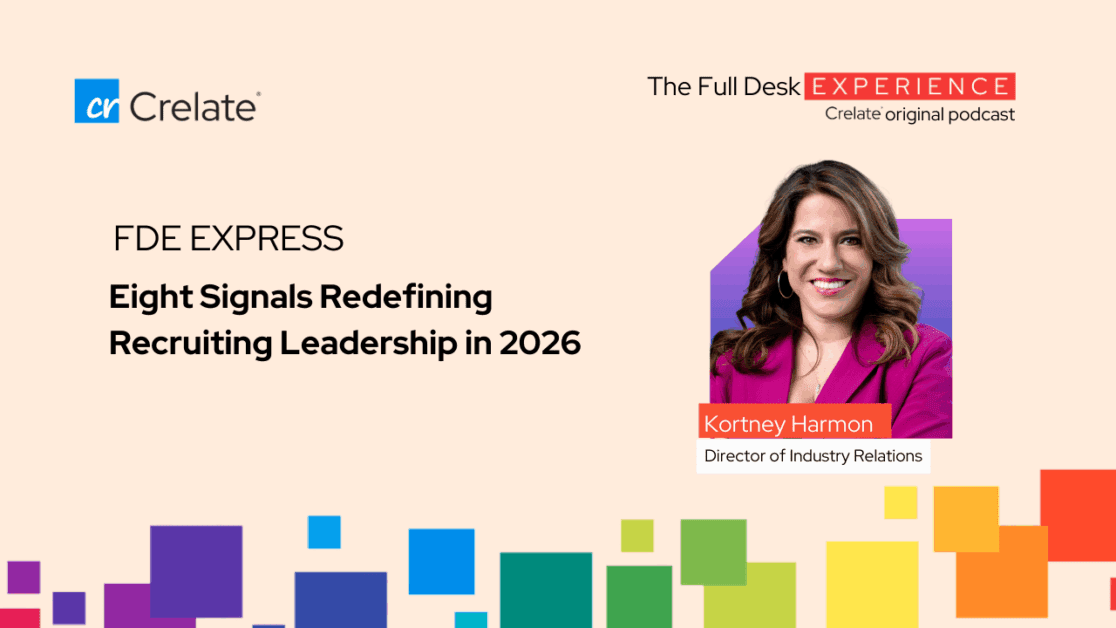
Eight Signals Redefining Recruiting Leadership in 2026
Show notes
Is the recruiting industry actually changing—or simply recalibrating? Kortney Harmon cuts through the noise to examine what’s really shaping recruiting leadership as firms look toward 2026. Rather than chasing headlines or hyped predictions, this Express episode outlines eight quiet but powerful signals emerging from real conversations with owners, operators, and executives. Kortney explores why relationships are becoming strategic again, how discipline is replacing tech accumulation, and why AI is shifting from competitive advantage to expected infrastructure. The conversation reframes growth around sustainability, trust, and clarity—highlighting the rise of operator-strategists, the redefinition of candidate experience, and the identity questions firms can no longer avoid.
Grab a coffee and tune in for quick, practical inspiration to help you lead and grow your talent business—with less chaos and more purpose.
______________________
Follow Crelate on LinkedIn: Crelate
Want to learn more about Crelate? Book a demo here
Subscribe to our newsletter: https://www.crelate.com/blog/full-desk-experience
Transcription
Kortney Harmon [00:00:00]:
AI becomes an expectation, not an advantage. AI has moved fast. Let’s face it. In 2026, the question isn’t should we be using AI? It’s where does it belong? Where does it not belong? How does it impact the human experience? Our business development process. AI really is going to become an infrastructure. What differentiates firms isn’t whether they believe they should use it, it’s how intentional. They combined AI with with a human in the loop.
Kortney Harmon [00:00:28]:
Hi, I’m Kortney Harmon, Director of Industry Relations at Crelate.
Kortney Harmon [00:00:31]:
Welcome to FDE Express, a short, sweet.
Kortney Harmon [00:00:34]:
Format of the Full Desk Experience Crelate Original podcast. We’ll be diving into specific topics to show you how you grow your firm within 10 minutes or less. Each episode will cover quick hit topics to give you inspiration and food for thought for your talent businesses.
Kortney Harmon [00:00:58]:
If you’re paying attention to the recruiting industry right now, it probably feels like there’s a lot of noise. At least I’m seeing it and hearing it from a lot of folks. There’s a lot of talk about new platforms, new tools, new predictions, new opinions everywhere. Honestly, everyone has a take, everyone has a framework, everyone has a solution. And yet that’s different. It’s different from what I am hearing when I talk to leaders behind the scenes. As I talk to those owners and operators and executives for the podcast, the conversation sounds very different. They’re quieter, they’re more thoughtful and more grounded.
Kortney Harmon [00:01:33]:
It’s less about what’s new and more about what’s necessary. Because right now, leaders aren’t asking what’s the next big thing? They’re asking, what do we keep? What do we keep doing? What do we keep, technology wise, what do we stop? What do we stop in our processes? What do we stop using in our tech? What actually overlaps? And that’s what actually moves the business forward without creating chaos. And that’s the lens I’m going to bring to today’s conversation. Today isn’t about the headlines. It’s not about the hype cycles and not about predictions designed to get clicks. So today, what I’m really seeing as we look towards 2026 is the undercurrents, the soft spoken, the signals, the shifts that leaders already are responding to. But they’re often very quiet but very intentional. In 2026, it’s not shaping up to be the year of disruption.
Kortney Harmon [00:02:25]:
We’re not moving and shaking. It’s really shaping up to be the year of intentional recalibration. A year where leaders pause, they reassess, they make smarter, more disciplined decisions about how they lead and grow and build their teams. As I’ve spent time talking with leaders in our industry over the past few years for the podcast, I keep seeing the same theme pop up the last few months, and it comes up time and time again. It’s not framed as a trend, it’s not packaged as a prediction, but more as a real time signal about how decisions are being made right now. And when I finally stepped back and I thought about them and I looked at all of my conversations, I went back to and mapped them out and it really came down to eight clear signals that I think that are going to really define 2026. And those signals don’t exist in isolation. Together, they tell a very clear story about where recruiting is headed and where leadership is going and what it looks like in this next chapter.
Kortney Harmon [00:03:26]:
So let’s talk about them. The first signal is relationships. I know that sounds crazy, but relationships are becoming strategic again. So I want to start here because this is where everything else connects. In 2026, relationships aren’t a soft skill, they’re your strategic advantage. As automation increases AI and technology becomes more embedded in our workflows, relationships are going to be your differentiator between your leaders and teams, between your recruiters and candidates, between your clients and business development leaders, and between partners and platforms. Here at the podcast, we’re intentionally leading Q1 with a focus on relationships. That’s what you’re going to hear from us most.
Kortney Harmon [00:04:09]:
Because before you can scale a system, a team, adopt a new technology, or even chase growth, trust has to exist. It has to exist with your candidates, it has to exist with your clients. It has to exist with your team and your tech. But this isn’t just about networking. It’s about how relationships are built, how they’re maintained, and how they scale in the modern recruiting organizations. In today’s society, signal number two is tech. And I know there’s a lot of that. But tech intentionally replaces tech accumulation.
Kortney Harmon [00:04:44]:
Now, when you think about this, leaders aren’t anti tech. I’m not hearing that. They’re anti chaos in 2026. It’s actually more about asking the question, what are we actually using? What integrates well? What simplifies our work? Instead of complicating it, the signal shows up as consolidation, better adoption, a clearer return on your investments and expectations. Technology isn’t going to go away in 2026, but discipline replaces impulse in 2026. Signal number three is AI becomes an expectation, not an advantage. AI has moved fast. Let’s face it, in 2026, the question isn’t should we be using AI, it’s where does it belong? Where does it not belong? How does it impact the human experience, our business development process.
Kortney Harmon [00:05:33]:
AI really is going to become an infrastructure. What differentiates firms isn’t whether they believe they should use it, it’s how intentional. They combine AI with a human in the loop. So this becomes actually our core of our quarter two conversation around innovation. How are you using the tech more intentionally to get that flow, return on investment? Because let’s face it, our workflows are going to change in 2026. It’s no longer the same way we’ve been doing business for years and years. It’s already changed, frankly. Signal number four, breaking through the noise becomes a leadership skill and sounds crazy as that comes out of my mouth.
Kortney Harmon [00:06:12]:
There is more data, more content and more reporting than ever. And yet clarity feels harder to find in 2026. Strong leaders aren’t necessarily going to become louder, they’re clearer. They can filter signal from noise, they can interpret data and not just report it. They can make decisions without overreacting. And this is where innovation stops being about tools and starts being about thinking differently. So super excited for number four. Signal number five, the rise of the operator strategist.
Kortney Harmon [00:06:46]:
I have talked about this at a few of my talks across the country and it’s really about how our industry’s changing. This industry is moving away from extremes. Less pure vision, less pure execution, and more about leaders who sit in the middle. Really they’re the operator strategist who the leaders who really understand the systems, the processes, the people, why the decisions are made, what tech is, is moving. How are we understanding what people are spending their days on, their time on, and how do we get time back to do things differently? So Q3, as we think about this, really becomes crucial about growth. This role is going to become more critical in organizations that don’t have an operations person. But growth without operational leaders purely doesn’t scale. The ones that I’m seeing be most successful has that person in the middle that really sees everything from a different level.
Kortney Harmon [00:07:42]:
Signal number six, growth without chaos becomes a goal. So for years, growth was the headline metric. Now the question is, can we grow without breaking our people or our systems? 2026 growth conversations are about readiness, sustainability, intentional pacing, fewer yet better aligned hires and goals. So that impacts your clients and what they’re doing. Their mindset shift is changing and it shows maturity in leadership. Signal number seven is candidate experience gets reframed around trust. So candidate experience used to be about speed. Now it’s about consistency and trust.
Kortney Harmon [00:08:28]:
Candidates, let’s face it, they understand automations exist, they understand bots exist, that they’re speaking to somebody, but what they’re evaluating is, is the process, does it feel intentional or transactional? So leaders are going to look to become more operationally designed. How does the systems support us in trust? How do the teams show consistency at scale? So this is very much about intentionality and not making it transactional to make your candidates and clients just feel like they’re a number signal. Number eight, I think, becomes about a strategic question with a firm’s identity. This is the quietest signal probably, but maybe the most important leaders are asking, who are we actually for? What do we actually want to be known for? What kind of firm are we building for today, but more unlikely for the future? So 2026 is an identity year for a lot of organizations, and identity thrives on things like technology decisions, hiring decisions, growth strategy, partner alignment. And this really comes down to, are you having those same conversations with your clients? So these eight signals don’t again, exist in isolation. Together they shape how our leaders are thinking, how they’re structuring conversations. Throughout 2026, is it about relationships and trust? Eventually you get to in innovation, intention, growth and discipline and operations. And this is the arc of our year.
Kortney Harmon [00:10:06]:
So in closing, 2026 is going to feel hopefully less frantic, more thoughtful. If you’re asking better questions instead of faster ones, you’re not behind. You’re evolving. And you’re going to hear more about that from us as well, because we know that you are evolving. The industry is evolving and so is our podcast, and we’re going to have those conversations all year long. So thank you so much for being a part of where we’re going, where the industry is going, and really looking forward to what 2026 brings us. Think about how you can be more thoughtful in your modern recruiting business and be more intentional about what you’re driving to your organization. Can’t wait to see more of this until next time, have a wonderful day.
Kortney Harmon [00:10:54]:
And I can’t wait to see what 2026 brings us for dates and topics and all the wonderful things. So stay tuned till the next episode.
Kortney Harmon [00:11:03]:
That’s all for today’s episode of FDE Express. I’m Kortney Harmon with Crelate. If you have any questions or topics you’d like from us to cover in future episodes, please feel free to submit them to [email protected] or ask us live next session. And don’t forget to subscribe to our podcast wherever you listen and sign up for our monthly events to keep learning and growing your business. Thanks for tuning in to FDE Express, a short and sweet format of the full desk experience. We’ll see you next time.
Kortney Harmon [00:11:37]:
Sam.Kortney Harmon [00:00:00]:
Now for the harsh truth about technology. If your recruiting tech stack isn’t built on a living platform that continuously evolves with AI, it’s not an asset, it’s dragging you into irrelevance. So what exactly is a living platform? It’s the difference between survival and extinction. In recruiting, it evolves without you having to push it. Traditional systems require you to upgrade them. Living platforms upgrade themselves. It’s putting something in the box. And while you put it in the box, it’s getting sunlight, it’s getting water, it’s getting nutrition.
Kortney Harmon [00:00:35]:
To grow and thrive and be bigger every day. It gets smarter every day. Hi, I’m Kortney Harmon, Director of Industry Relations at Crelate. Welcome to FDE Express, a short, sweet format of the Full Desk Experience, a Crelate original podcast. We’ll be diving into specific topics to show you how you grow your firm within 10 minutes or less. Each episode will cover quick hit topics to give you inspiration and food for thought for your talent businesses. Welcome back to the Fulldesk Experience where we talk about growth blockers across your people, process and tech. I’m your host, Kortney Harmon, Director of Industry Relations here at Crelate, and today we’re tackling the brutal truth that many in our industry do not want to hear.
Kortney Harmon [00:01:29]:
The traditional way you’ve been doing business in recruiting for decades is dead in a post AI world. That’s right, I said it dead. Let’s be completely transparent. If you’re still counting calls, submissions, interviews the same way you did five years ago, you’re not just falling behind, you’re already irrelevant. In an industry becoming transformed by AI. Those traditional metrics aren’t just failing to drive growth, they’re actually killing your business. So in this recruiting world, we’ve all been accustomed to certain metrics, me included the number of calls, your number of submissions, your number of interviews, and even placements. The uncomfortable truth is recruiting isn’t about filling seats.
Kortney Harmon [00:02:16]:
It’s actually about driving different business results. And your outdated KPIs are actually missing the point entirely. I had a call with a recruiting company last year. Each person on their team was actually making 50 calls daily, sending hundreds of LinkedIn messages weekly, submitting dozens of candidates. Their activity metrics looked incredible on paper, but as we dug deeper, their placement rates has actually dropped 15% and consultation retention was at an all time low. Our teams often get stuck in this hamster wheel of manual data. Essentially, it’s like a chore and almost never get to the point of actually producing meaningful results. Does that sound familiar? This is the death spiral of recruiting metrics and it is evolving drastically in this post AI world.
Kortney Harmon [00:03:08]:
Now let me be brutally honest, if you’re not leveraging AI in your recruiting workflows, you might as well close up shop now because your competitors who are will probably bury you in the next 18 months. Tech is evolving so fast it’s hard to keep up with. If you didn’t get a chance to listen to one of our previous episodes with Aaron Elder, the CEO here at Crelate, I encourage you to do so. He talked about that post AI world and what that means. The recruiting landscape has changed with the rise of AI technology. We’ve talked about it and and some conservative estimates show that AI driven changes will replace about 25% of jobs worldwide by 2026. And if we think recruiters or part of recruiting is immune, we probably need to think again. So let’s talk about some warning signs to show that you’re stuck on this KPI hamster wheel in the AI era.
Kortney Harmon [00:04:04]:
Number one, if you’re still doing the work AI could and should handle, that’s your first warning sign. Your team possibly is spending hours on tasks that AI systems could complete in minutes. It isn’t just efficient, it’s actually professional malpractice. In 2025, you’re falling behind by the minute. Number two warning sign is that your data lives in silos, your metrics live in different systems. And it happens. But the problem is that those systems don’t communicate. They’re preventing you from seeing the complete picture.
Kortney Harmon [00:04:40]:
In an AI era, isolated data just limits you and it actually is active sabotage towards your data and your growth of your firms. And number three, you’re looking backwards, not forwards. If you’re measuring what happened yesterday instead of what AI can predict tomorrow, you’re driving your business looking only in the review mirror. How’s that working out for you? The transition from startup to scale up is a big leap with unexpected hurdles. The same applies to transitioning from traditional recruiting to AI powered recruiting. Many aren’t going to make it, but for those who will, they’re going to thrive. So now that we’ve confronted the harsh reality, let’s talk solutions. I don’t care if it makes you uncomfortable.
Kortney Harmon [00:05:29]:
Your comfort zone is potentially what could be killing your business. We’re done being on this hamster wheel of trying to solve problems ourselves. It’s time to pull up the help chain. The help is AI and it’s non negotiable. It’s on like electricity in the background. So when you’re assessing your current recruiting KPIs through a lens of AI. You need to ask yourself, why are humans doing the work that AI should handle? If your recruiters are manually searching on LinkedIn, are you wasting human capital? Are you predicting or reporting? If your metrics can’t tell you which candidates will succeed before you hire them, your metrics might be a little dated. Can your platform learn or is it brain dead? A static system in a dynamic world isn’t just limiting, it’s suicide.
Kortney Harmon [00:06:21]:
So here’s the hard truth. If you’re still measuring the number of calls recruiters are making, instead of measuring AI powered engagement quality, the quality, not the quantity, you don’t just have a metrics problem, you potentially have a leadership problem. So let’s talk about how well functioning recruiting operations can deteriorate into exhausting cycles without the right technology foundation. This decline isn’t gradual anymore. It’s about acceleration towards being obsolete again. Did you see the episode with Aaron? He talked about the evolution of AI in the last six months. And what was being talked about last week. In this world where AI can source screen engage candidates around the clock, running your recruiting desk with purely human effort isn’t just efficient, it can be negligent.
Kortney Harmon [00:07:14]:
Here’s the warning signs. Your recruiting operations has shifted from a well oiled machine to the hamster wheel in the AI era. Number one, your recruiters are doing robot work. If your team is spending hours researching candidates when AI could be doing this automatically, we’re probably paying humans a premium rate to do the work that machines could do much better. Number two, your tech stack is a disconnected mess. We talked about those data silos. If your tools don’t talk to each other, you don’t have a technology ecosystem. It’s the junkyard.
Kortney Harmon [00:07:49]:
It’s not a platform to help your teams scale. And maybe, just maybe, your teams actually hate their jobs. When recruiters spend all day on repetitive tasks instead of building relationships, they’re very unhappy. It’s trying to keep up with all the things that happen in our work days that we just can’t keep up with. And the most dangerous thing about this KPI hamster wheel is that it feels like work. It’s just motion without progress. Your 60 hour work week means nothing if an AI system can’t produce better results in shorter time. Your expectations, your metrics, your output is going to change drastically in the next few months and even year.
Kortney Harmon [00:08:36]:
So let’s talk about seven steps to better recruiting metrics in this AI era. So let’s get Practical. I’m not here to coddle you. I’m here to save your business. The foundational success of AI integration isn’t a gentle evolution. It’s truly a radical transformation. The first thing you have to do in step one is you have to first stop measuring busy work. If you’re celebrating how many calls your recruiters are making, you’re measuring effort, not results.
Kortney Harmon [00:09:06]:
It’s like praising someone for how much they sweat instead of how far they ran. Step number two, we need to embrace AI specific outcomes. So in this AI era, if your human is handling a task that AI could. You’re not running a recruiting business, you’re running museum potentially of obsolete practices. We need to change how we think. Step number three, implement radical workflow automations. And many of you are doing this already. AI doesn’t just speed things up, it fundamentally transform what’s possible.
Kortney Harmon [00:09:40]:
If you’re just using AI to do old things faster, you can put a rocket engine on a horse cart. So hopefully you have those automations set up to help you move faster. Step number four, build a digital living platform, not a digital coffin. Most ATS systems aren’t just platforms. They’re where good data goes to die. A living platform evolves. Traditional systems just age. We don’t want to put things in a box just to have them in a box.
Kortney Harmon [00:10:13]:
Step number five, we have to deploy AI agents aggressively. Every hour your recruiter spends on research, initial outreach, or scheduling, an hour is wasted time. AI could handle those tasks for you. Step number six, redefine what actually recruiters do. And this is going to change so much in the next six months. The recruiter of 2025, who isn’t an AI wrangler, relationship builder and strategic advisor, isn’t a modern recruiter. We have to evolve how we’re handling our businesses and what a recruiter looks like in this day and age. So now step number seven is evolve or die.
Kortney Harmon [00:10:55]:
There’s no middle ground anymore. You’re either committed to continuous AI evolvement and evolution, or you’re preparing for your business’s obituary. So we’ve talked about the people and the process aspect of getting the KPI hamster wheel. Now for the harsh truth about technology. If your recruiting tech stack isn’t built on a living platform that continuously evolves with AI, it’s not an asset, it’s dragging you into irrelevance. So what exactly is a living platform? It’s the difference between survival and extinction. In recruiting, it evolves without you having to push it. Traditional systems require you to Upgrade them.
Kortney Harmon [00:11:36]:
Living platforms upgrade themselves. It’s putting something in the box. And while you put it in the box, it’s getting sunlight, it’s getting water, it’s getting nutrition. To grow and thrive and be bigger every day. It gets smarter every day. Your platform isn’t measurably more intelligent this month than last month. If it’s not alive, it’s decaying. It connects everything.
Kortney Harmon [00:12:00]:
Without human intervention, manual Data entry in 2025 isn’t just efficient, it’s something that shouldn’t happen anymore, alone, on its own. And a living platform doesn’t just store data for you, it activates it. Data sitting unused in your system isn’t an asset, it’s a wasted opportunity. We’ve all heard if it’s not in the system, it didn’t happen. So let me share a vision of what recruitment looks like with a living platform as your foundation. Imagine starting your day not with a to do list of manual tasks, but with a strategic briefing from your AI agent that you’ve already completed yesterday’s to do list while you slept. Your sourcing agent has already identified and Pre qualified 25 candidates overnight. Your outreach agent has personalized and sent communication with 40% response rate.
Kortney Harmon [00:12:50]:
Your analytics agent alerts you potential issues before they even become problems. This isn’t science fiction. It’s happening now. And if it’s not happening in your business, you’re already behind. So as we wrap up today’s episode, let me be crystal clear. The future of recruiting doesn’t belong to the hardest working or the most experienced any longer. It belongs to those who harness AI most effectively. Human effort without AI amplification is just becoming inefficient.
Kortney Harmon [00:13:19]:
The recruiters who thrive won’t be those working harder on the hamster wheel, but those who will leverage AI agents to handle routine tasks while focusing on their human talents is where it’s going to make the most impact. So if you want to continue to learn from experts on time management, networking, career development, overcoming burnout, that’s commendable. But if you’re not simultaneously implementing AI through your recruiting practices, then you’re arranging deck chairs on the Titanic. So I would encourage you to start by assessing your current technology foundation. Is it a static system that requires consistent manual updates, or is it a living platform that evolves with the rapidly changing recruiting landscape that we are in today? The future isn’t just coming, it’s already here. Dividing our industry into two groups. Those who embrace AI and those who will work for them. Thank you so much for your time today.
Kortney Harmon [00:14:16]:
This is an ever changing topic that we will continue to discuss and bring to the forefront of our industry. So stay tuned as we continue to talk about the recruiting world. In a post AI era, evolution isn’t just optional, it’s existential. That’s all for today’s episode of FDE Express. I’m Kortney Harmon with Crelate. If you have any questions or topics you’d like for us to cover in future episodes, please feel free to submit them to [email protected] or ask us live next session. And don’t forget to subscribe to our podcast. Wherever you listen and see, sign up for our monthly events to keep learning and growing your business.
Kortney Harmon [00:15:01]:
Thanks for tuning in to FDE Express, a short and sweet format of the full desk experience. We’ll see you next time.