

Sign up for The Full Desk Experience updates!
Show notes
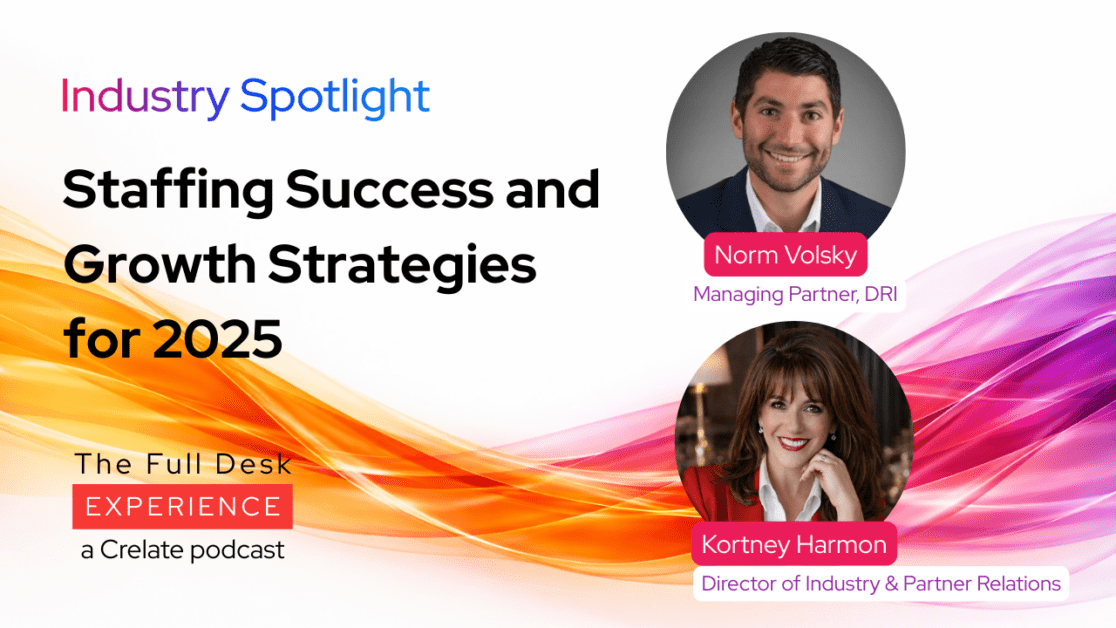
What builds a recruiting firm that lasts? In this Industry Spotlight, Kortney Harmon sits down with Norm Volsky, Managing Partner at DRI and leader within the Pinnacle Society, to explore why long-term success comes down to relationships—not shortcuts.
Norm shares how top firms balance technology with trust, invest in operations to protect the client experience, and why reputation and delegation matter more than any single placement.
______________________
Transcription
Norm Volsky [00:00:00]:
Very few people can be experts in persuasion and recruiting and experts in operations and admin. And even if you are top tier in all three of those things, I would argue you could probably replace yourself in one or two of admin or operations where you can find someone just as good that makes less on an hourly rate than you do. So it’s all about efficiency. It’s not about this is your weakness. You can’t do it. It’s more that you just shouldn’t because your time is incredibly valuable. And what’s the best investment you can possibly make? One in yourself where you have full control over. You are essentially saying, hey, I’m buying myself time to focus on what I’m best at.
Kortney Harmon [00:00:45]:
Hi, I’m Kortney Harmon, Director of Industry Relations at Crelate. This is the Industry Spotlight, a series of The Full Desk Experience, a Crelate original podcast. In this series, we will talk with with top leaders and influencers who are shaping the talent industry, shining a light on popular trends, the latest news, and the stories that laid the groundwork for their success. Welcome back to another episode of The Full Desk Experience Industry Spotlight.
Kortney Harmon [00:01:17]:
Welcome back to another episode of The Full Desk Experience. Today’s conversation is one that I’ve really been looking forward to because it sits right at the intersection of leadership, clarity, but what’s actually happening inside of recruiting firms right now. I am joined by Norm. It says Norm here, but I have your LinkedIn profile says Norman Volsky.
Norm Volsky [00:01:37]:
Oh, please call me Norm. Only my mom and sisters call me Norman, and, uh, it’s not under good circumstances, but it actually doesn’t happen very often. So, you know, I guess it’s a good thing.
Kortney Harmon [00:01:48]:
Well, that’s wonderful. Uh, Norm is actually a managing partner of DRI. And also stepped into a leadership role in Pinnacle Association this year, which I’m really excited. I think it gives him a rare real-time view into what firm owners and leadership teams are navigating behind the scenes. So, Norm, thank you for taking your time out of your very, very busy day to spend with us.
Norm Volsky [00:02:08]:
Oh, I love this. Thank you for having me. I’m really, really excited to join and honored to be a part.
Kortney Harmon [00:02:14]:
Well, I love it. So, Norm, for our listeners, do me a favor. Tell them a little bit about you, Norm, and your career, and then we’ll get into DRI and Pinnacle as well.
Norm Volsky [00:02:23]:
Yeah, absolutely. So I’ve been recruiting for a little over 14 years now. Right out of college, I joined DRI within the hospital software practice, did that for a couple years, and then about 12 and a half years ago, I transitioned and built out our area focused on technology within healthcare, but sold to self-insured employers and health plans. So very much focused on preventative health and just population health in general.
Kortney Harmon [00:02:52]:
I love it. That makes you very busy. And DRI is here in Ohio?
Norm Volsky [00:02:55]:
Yes. So we, um, again, when I joined, we were probably about 12, 15 people. As of about 3 years ago, we were right around 100 people. And then we merged with Cape Asman down in Dallas, created Starfish Partners. So now I’d say in Starfish, we’re probably between like 250 and 300 full-time within like the Starfish brand. But we also, uh, manage Sanford Rosen Associates, which has over 2,000 executive recruiters, you know, within our ecosystems. So when anything is shared, it’s kind of at the, uh, 10,000-foot view of over 2,500, you know, exec recruiters that we have like access to the data and like seeing what trends, you know, look like.
Kortney Harmon [00:03:42]:
I love it. And now you’ve added Pinnacle because you didn’t have enough stuff on your plate. You’re saying, what’s one more? So tell us a little bit more about Pinnacle and Associates.
Norm Volsky [00:03:50]:
Yeah, so I was lucky enough about 4 or 5 years ago, you know, to be, um, asked to be applying to the Pinnacle Society, which is a boutique of about 80, 85 of the top boutique recruiters in the US that are focused on, you know, very niche search and, you know, mostly in the non-fully retained level. So we don’t have any, like, you know, Spencer Stewart, Russell Reynolds, you know, folks, it’s all kind of like smaller, um, boutique firms that punch above their weight class and are seen as experts in their niche areas. And maybe, you know, as firms in general.
Kortney Harmon [00:04:30]:
I love it. I love all the perspectives that you’re going to bring today. So amazing.
Norm Volsky [00:04:34]:
We focus on continuing education and the goal is like, let’s get a lot of the top practitioners all in one room. Learn from each other, bring in guest speakers from outside the industry to really— the goal of the organization is to elevate the recruiting function and profession as a whole. So we try to practice what we preach, continue to educate ourselves, continue to refine our own skills so that we can inspire hopefully the next generation of recruiters to continue to make recruiting as an industry one that, you know, more and more people seek as an awesome, you know, really rewarding career path.
Kortney Harmon [00:05:12]:
And you both, you all meet in person twice a year.
Norm Volsky [00:05:15]:
That’s right. So, we have our conference coming up in April in Miami, and then in October, we’ll be down in Denver. So, if you’re a recruiter and you, you know, are interested in potentially being a Pinnacle member at some point, might make sense to reach out to some of us and, you know, see if we might be able to have you sit into a couple sessions and get a feel for what we do.
Kortney Harmon [00:05:35]:
I think that’s amazing. We’ll put all the links in the show notes to all of your things that you mentioned as well. So, thank you. Obviously with your leadership role, not only at DRI, within Knowing SRA, and now helping Pinnacle this year, how has that lens, that dual lens, changed the way you think about what firm leaders actually need right now? Because there’s a lot of talk about new, but there’s a lot of talk about it’s the same as it used to be. Yeah. So I’m curious your opinion.
Norm Volsky [00:06:03]:
Yeah, I think like there’s obviously areas of technology that can be leveraged to make us more efficient in our day-to-day. No doubt about that. What I would also argue is the job is extremely similar to how it’s been for at least the 14 years I’ve been doing it. And of talking to, you know, mentors and people have been doing this a hell of a lot longer that taught me the business. I think a lot of the core competencies of the best recruiters are the same as they were in the ’80s and ’90s as well. So I think again, there’s a couple better ways to skin the cat than there were back then. With that being said, like a lot of the core skills haven’t changed and I don’t think will change, you know, for the next decade either.
Kortney Harmon [00:06:48]:
With all the tech coming in, what do you think the role tech plays in our world now? Because there’s probably some differing opinions about that.
Norm Volsky [00:06:55]:
Yeah, I just believe that, you know, persuasion will always be name of the game in executive recruiting. So what can technology do? It can allow us to spend more of our time when we’re working focused on persuasion and anything that doesn’t focus on persuasion, I would argue, can be outsourced to tech. Anything that requires persuasion, I believe, still has to be done at a person-to-person level. And that’s why I believe there’s a little bit of a misnomer that like, oh, recruiting can be completely made obsolete by tech. I think humans still want to trust and make career decisions based on other humans and not just an AI chatbot telling them Hey, this seems like a good career move based on our algorithm.
Kortney Harmon [00:07:41]:
Yeah, no, I love that. I think it has its time and its place. And you, I love that you said it’s about persuasion because tech can help us do a lot of things. It can help us move faster, which it’s doing right now with a lot of offices, but it really comes down to trust.
Norm Volsky [00:07:56]:
And again, like you can use technology to identify who you want to talk to a hell of a lot quicker and use technology to draft, emails and draft LinkedIn messages and help with scheduling and like all of the administrative tasks that an executive recruiter would have been forced to do 15 years ago. And I was one of those people and, you know, I’ve kind of learned how to use tech to, you know, make my day to day more efficient. And I keep trying to do that. But again, like, I don’t see my phone calls being any different today than they were 10 years ago.
Kortney Harmon [00:08:34]:
That’s reassuring. And I think you’re saying what a lot of people feel. Do you think there’s anything fundamentally different about conversations now compared to even 18 to 24 months ago?
Norm Volsky [00:08:47]:
I think people have a lot more access to information than they had, you know, in years past. So what I would say is people come into the conversations more informed and have a lot more scope of their industries than they had in the past. But I would almost argue a niche executive recruiter is more helpful to like the average contact they’ve had for many years in kind of separating the noise from the reality. Like, hey, I’m seeing all these things in my LinkedIn feed or at conferences. What actually is working right now in our industries? Like, what’s real and what’s fluff? You know, I think that’s where we can really be the voice of truth because we’re the ones who actually have thousands or tens of thousands of data points because we’re talking to people at all different areas of the industry, at all, you know, different companies all year long. So we can really help educate. All right. You know, there’s a lot of companies that say they can do these things, but who’s actually delivering, you know, real value to the client? That is only able to be accessed right now by good old-fashioned networking, live connect time, and person-to-person confirmation and interaction.
Kortney Harmon [00:10:08]:
Gosh, it’s like pick up the phone and talk to people, which sometimes we forget to do. Okay. If you, as you talk to your leaders, SRA, all the things that they may be admitting that they can’t keep doing the same way, even though it’s worked for years, because Oftentimes we get into this business and it’s like set in its status quo. We maybe forget about stuff. Is there anything that maybe it’s like, okay, we can’t keep doing it this way?
Norm Volsky [00:10:30]:
That’s a good question. I would say usually if you’re doing the same things you were doing, you know, even 2, 3 years ago and you don’t adjust anything, you’re going to get left behind. You know, you always need to be, hey, how do I keep improving my service? And now it’s a lot easier to service clients at even high level because a lot of the things you had to do manually before could be automated. So again, yeah, like I would argue maybe 10 years ago you had to spend 20% of your time on administrative tasks because there was no way to outsource it outside of just hiring someone to do it. And if you didn’t have the financial flexibility to do that, like you’re on the hook, you know, to spend about 20% of your time on admin. That’s just, you know, again, an estimate. I’m sure there’s more and less. Sure.
Norm Volsky [00:11:21]:
But now it’s like, okay, now if I can spend 90% of my time on persuasion, like how much does that free me up to offer better service to my client? So I would just, again, like, I don’t think there’s any like specific things where I’m like, well, if you’re doing, you were doing this exact thing a handful of years ago, it won’t work today. But I would say like, if you haven’t improved the client experience, then someone else probably has worked on that and might have even caught up or leapfrogged you if you’ve just been content to continue doing the same things you’ve always done.
Kortney Harmon [00:11:54]:
Is there anything that stands out from the client servicing your client that maybe you guys have changed or you’ve seen people be successful in, in the past 6 months?
Norm Volsky [00:12:03]:
I think again, it’s asking the second and third questions and not just going surface level, like now. Someone can look at anyone’s LinkedIn profile and have a pretty good idea of what they’ve been doing. Like, the resume isn’t as important as it used to be. Like, there’s other ways to identify, like, hey, does this person have, like, table stakes experience that makes us believe that they’ll probably be able to do the job, you know, and they’re, you know, at least qualified for the role? With that being said, like, context is more important than ever because getting information is not an issue. It’s synthesizing and condensing that information. That’s the real time saver. So again, I think it’s saving your client’s time by going deeper, understanding your candidates at a better level, explaining how they’re truly differentiated from their competition for that particular job can be really, really important. So it’s like, hey, what creative things do you do in your role that set you apart from your peers? What are some innovative things that you’re doing? What are some technological things that you’re doing that you think give you a leg up, you know, on other people doing this job, you know, within our industry? Like, it’s almost like, all right, now that AI is here, not only how are we personally leveraging it to make ourselves better, but also understanding our candidates.
Norm Volsky [00:13:29]:
How are they using it to make themselves better than the pack?
Kortney Harmon [00:13:33]:
Yeah. Have you seen that from your candidates, that they’re using AI to make themselves better? I think again, has it shown up yet?
Norm Volsky [00:13:41]:
Putting of the results, right? If they’re a salesperson, if they’re hitting numbers that no one else is, I would guess they’re leveraging technology in a smarter way than the average. If there are certain people in marketing or product or client services or finance that are getting results no one else is getting, It’s either they’re better at the job, they’re more efficient at the job, or they surround themselves with a great team and they’re the leader and they have a lot of people contributing to that success, or all three, or multitude of other things that could be doing that are really, really setting themselves up from the pack. But again, it’s if someone’s getting better results, they’re probably doing something a little bit more unique, a little bit different, a little bit better.
Kortney Harmon [00:14:28]:
I love it. Uh, and we’re gonna continue to probably see that continue to evolve. So you mentioned client experience. So I know a lot of people right now are focused on job orders. Let’s face it. Like, it’s like, how do I get more? What do I do different? Where am I spending my time? Are you seeing any firms shift how they define what a good client is or maybe even a worthwhile relationship? And what’s really driving that? Do you see that change? Do you— what’s driving that change? Have you seen that at all?
Norm Volsky [00:14:56]:
Yeah, I can’t speak to it at the firm level because again, like each consultant within a firm always has the autonomy to run the practice the way they want to run it. And especially at our firm, like it’s not a top-down, like, hey, here’s our playbook, you run it to a T. It’s like, hey, you’re your own boss. You know, you create like the business you want. We’re here for guidance. We’re here for help. There’s every educational tool known to man, like within the organization. But, you know, we’re not going to force it down your throats.
Norm Volsky [00:15:27]:
Like, it’s totally opt-in whenever, you know, you want that level of attention and guidance. But what I would say is, you know, I’ve always been a big fan of niche recruiting. I think a good client is a company in your niche that you know well, or a niche that you’re trying to build a reputation in and learn more about. So I think number one is the company in your intended niche. Like, that is first and foremost. Second is realism in what level of candidate they can attract. Not every company you work with has to be the coolest, most innovative company that has the opportunity to IPO for billions of dollars. Like, that’s just not realistic.
Norm Volsky [00:16:11]:
Like, there’s only going to be a handful of those in any space. So again, you don’t have to be a company that has aspirations of like taking over the world for, you know, them to be necessarily a good client. But if you have a realistic view of here’s where we want to go as a company, here’s what we’re looking for, here’s what we’re looking to pay. And the executive search consultant that you’re working with, that’s a niche expert, is in agreement that what they’re saying they’re looking for and what they’re willing to pay and where their company trajectory is, is in line with their expectations of what they’re going to get, you know, in terms of someone to work for them. Then it can be a very, very good client. The challenge is when companies that don’t have massive potential, just have solid potential, want talent that has unlimited potential. And it’s like, well, there’s a gap here. You know, there’s an issue between, you know, what you’re offering and, you know, what you’re expecting getting.
Norm Volsky [00:17:11]:
So I think expectations, you know, is really, really important there. And again, I’m just a big believer in customer service being our job is to save the client time. And that is sending them qualified people, sending them people that can realistically join their company within the next 90 days and understanding like what may or may not prohibit them from doing that. And I also think it’s getting the information they need to make really smart decisions, you know, and do it quickly, and also us being realistic. I think a lot of recruiters struggle because they become the girl or boy who cried wolf. Every candidate, they put them in the best light possible. So when they’re like, oh, I found this rockstar candidate and you need to talk to them, and you’re like, well, you told me about the last 5 and none of them got to the second interview, so like, why should I clear my schedule to talk to number 6 Were you lying to me on the first 5 or is this 6? Like, so we’re really big on like, hey, every single person on our team within our company is encouraged to tell a realistic picture and story. Here are the people’s strengths, here are their weaknesses, here’s the environments I think they’ll do really well in, here’s what they’re actually not really well suited for, and just give like a real SWOT analysis on the company.
Norm Volsky [00:18:34]:
I think a lot of especially early stage recruiters want to, again, like hear what they want to hear and aren’t as much sizing up the candidate on like their true quality and are just like hoping they are the person, you know, that their client is looking for. And they do a little bit more hoping and praying than vetting and sharing.
Kortney Harmon [00:18:58]:
Just want the placement so bad.
Norm Volsky [00:19:00]:
Again, what is the best way to get clients? And a lot of them Good word of mouth, happy current clients will help you find more happy clients. And what causes a happy client? They feel like they’re getting great value. They feel like whatever they’re paying you is worth it. They’re getting more benefit than they’re, you know, giving, you know, in terms of cost out and that you’re saving them time, energy, and effort. And for them, getting them the result they want quicker, easier, and in theory it is cheaper because again, if like that position being open is costing them money, a fee, as opposed to an open search for 6, 8, 12 months is a strong return on investment.
Kortney Harmon [00:19:47]:
I love that.
Norm Volsky [00:19:48]:
Company is only as strong as the people that work for them.
Kortney Harmon [00:19:52]:
Absolutely. But it also puts it in a different perspective. You’re not just filling a hole. You’re costing, I mean, it’s costing them money, so. I love that. That’s wonderful. I’m going to ask this and you might not have think this. So think about operationally, what’s one operational decision maybe that you see firms they’re making right now could look a little risky on paper, but maybe it’s creating some stability because right now this is where, you know, this is the time that people shake things up based on economy or downtime.
Kortney Harmon [00:20:22]:
So is there anything you see that people are like, you see some take some moves or maybe something that’s questionable?
Norm Volsky [00:20:28]:
I don’t know about questionable. I tend to be a risk-taker by nature. I’m an investor in my space. So, you know, investing in very early-stage companies is not for the faint of heart. Um, because, you know, many of them can go to zero, but we found the exceptions, which is really exciting, you know, in our market and has, you know, been a game changer for us. But, you know, something I think has been a game changer for me and I would recommend it to others is Investing in operations. Again, I’m most efficient when I can spend most of my day persuasion, persuading, talking about the market and being persuasive, you know, on advocating for my clients that are doing great things or advocating for companies we invest in that are driving like real awesome value and savings, you know, for their customers and, you know, just building great relationships. You know, that’s what my time is best spent doing.
Norm Volsky [00:21:21]:
I would argue same thing with recruiters on my team, like they should be spending the majority of their day connecting with people, learning, sharing, teaching, you know, information, you know, all the above. So I don’t know, maybe 4 years ago, every time I would try to grow my team, it’s okay, just add another recruiter. Like, that is the way to grow a recruiting practice, and that’s logical. But, you know, as I started to go from a team of 3 to a team of 6 to a team of 10, I realized, all right, I could keep hiring recruiters or I could hire ops and by them handling some of the administrative tasks, maybe be subject matter expert and guinea pig on some of the new tech that’s coming into the world. How about we outsource administration, outsource leveraging AI and leveraging technology and allowing them, you know, to do some of those things for the recruitment team. It’s opened them up, you know, to again, be more efficient, spend more of their time, you know, connecting., you know, live with real people, real candidates in the, in the market. So I would say, I wouldn’t call it risky, but invest in maybe high base salary, like high, let’s just say fixed cost assets within your business that can amplify your revenue producers so they can do what they do best. I would argue having executive recruiters spend more than 10% of their time on administrative And let’s just say operational functions, I would argue drains a recruiter because that’s not necessarily what they’re going to gravitate towards.
Norm Volsky [00:23:03]:
So not only is it a waste of their time, it makes them less efficient and effective in the other time they’re spending when they are in persuasion mode.
Kortney Harmon [00:23:13]:
I love that that was your answer because literally last 6 months plus, that’s literally been a lot of the conversations. It’s not a role that’s been in. A lot of firms because of maybe not wanting to spend the money. But with all the tech that’s coming in, it’s like, this is the year of the operations leader. And that has been to the forefront of a lot of organizations that I’m speaking with. So, I love that that was your answer.
Norm Volsky [00:23:37]:
And not only has it freed me up mentally, emotionally, stress-wise, like it’s, I would say decreased tenfold because Again, like organization and admin and, you know, some of those operations were not my strengths. And when you’re focused on things that you don’t feel comfortable doing and you’re not great at and you don’t naturally do well, you know, with those things and they are weaknesses of yours. Yeah. You know, it, that creates anxiety, stress, and, you know, a level of, uh, clutteredness that avoiding that has made my day-to-day a hell of a lot more enjoyable, and it happens to also directly tie to, you know, better numbers.
Kortney Harmon [00:24:22]:
So is there anything that you can tell someone that is on the fence of thinking if they need to add operations, like where you were, to say, if this, this, and this is happening, or this is why you should invest, give them a word of advice beyond what you just said, because I think there’s a lot of leaders that were probably where you were a few years ago that are like, I just don’t know.
Norm Volsky [00:24:43]:
Yeah. You know, again, everyone should make decisions that they feel are best for them. And I never would want to say like the way I do it is the way for everyone. With that being said, yeah, a lot of people don’t think at a certain point of their life it makes sense for them to shovel their driveway if it’s snowing outside and they get a snowplow service for the winter. So a lot of people, you know, when it’s summer, like, hey, I think I should have someone cut my grass. That’s not like an efficient use of my time. A lot of people don’t do their own taxes. They have an accountant, you know, do them for them because it saves them a lot of time.
Norm Volsky [00:25:17]:
And there’s a lot of things they probably are going to miss because they’re not an expert in accounting. And yes, the cost of doing the taxes was zero, but all the tax savings they didn’t get, you know, in terms of structuring and, you know, certain loopholes, like they saved a couple hundred bucks to not Save themselves thousands, you know, on the backend of tax savings. So I would just say like, you can only be an expert in so many things. And if you try to be the master of everything, you’re actually the jack of all trades, master of none. So I would argue very few people can be experts in persuasion and recruiting and experts in operations and admin. And even if you are top tier in all three of those things, I would argue you could probably replace yourself in one or two of admin or operations where you can find someone just as good that makes less on an hourly rate than you do. So it’s all about efficiency. It’s not about this is your weakness, you can’t do it.
Norm Volsky [00:26:18]:
It’s more that you just shouldn’t because your time is incredibly valuable. And what’s the best investment you can possibly make? One in yourself where you have full control over. You are essentially saying, hey, I’m buying myself time to focus on what I’m best at. And do I think in an extra 5 or 10 or 15 or even 20 hours a week, I can outpace what I’m spending in the amount of revenue I’d be able to generate saving myself that time? Very, very few people I’ve ever seen make this jump don’t end up driving more revenue and becoming more profitable as a result.
Kortney Harmon [00:26:56]:
I love it. Great advice. Since we’re still, we’re talking about leadership, in your opinion, what separates those good leaders who maybe feel grounded and in control from those who might feel behind or not caught up or in a hole?
Norm Volsky [00:27:14]:
I think the first thing is being comfortable delegating, and I know that is very unnatural for executive recruiters who got to where they are by being control freaks and trying to control every single single variable that is a common theme of top producers. Like if you go into Pinnacle, you find a lot of control freaks and it’s not by accident, but it’s almost the control freak that can start picking their battles and over time really decide like, all right, what am I willing to be a stickler on? And for 90%, what can I just let go of and be like, hey, that’s not a battle worth fighting. So the greatest leaders I’ve known, and I respect, you know, the Matt Walsh’s, the Gail Audubon’s, the Jen Myers, the Alan Fishers, you know, there’s so many great people in Pinnacle, you know, that I just, you know, Andy Cannabella, you know, love, respect, are the ones who know where to pick their battles and also know, hey, if I’m not empowering my team and I’m not increasing their own confidence partially by letting them do things the way they want to do them and giving them the creative, you know, opportunity to break a couple of things and try new things and iterate and constantly try to customize how they’re doing, you know, what they’re doing. You know, you don’t have a sense of ownership over the process. Thus, you feel like you’re running someone else’s playbook and it’s hard to do your best when you feel kind of shackled, you know, by your environment. So it’s, it’s just a masterclass in balancing what to dig your heels on and also what to, uh, kind of let go, even if it’s not done the exact way you want it done, or it’s not exactly the way you would do it.
Kortney Harmon [00:29:13]:
A few Type A personalities in that room, I’m going to guess.
Norm Volsky [00:29:17]:
A lot. Yeah, a lot. Very talkative group, and that’s why we love it. Uh, I love it, but it’s coming from a Taipei strong conviction, and, uh, you don’t mind, you know, interjecting. There are times where it’s hard to get a word in.
Kortney Harmon [00:29:34]:
Well, that’s amazing. It’s, uh, you mentioned a few. Jen has actually been on the podcast. I know Jen for a while. There’s a lot of other Great humans in that room.
Norm Volsky [00:29:45]:
So, um, hope, hope it must be the best and that people respect everyone.
Kortney Harmon [00:29:48]:
I love it. As you look, I know I wanna say like the rest of the year, we’re literally only at February, but as you look for the rest of the year, whether it’s with Pinnacle or anyone else that you’re kind of following with leadership, what’s a leadership muscle firm owners must build to stay healthy, not just profitable?
Norm Volsky [00:30:06]:
It’s a really Really good question. Honestly, I think a lot of it’s lead by example. You gotta lead from the front. You gotta show your team what work ethic it takes to be successful in this business. You have to make sure you lead from the front in showing how every detail matters and that we’ve gotta be very detail-oriented in this business. I think Again, you have to lead from the front on there are no shortcuts and you got to show that the relationship with the client and the candidate is more important than the deal in front of you. And like all of those— and generosity, right? Like, how do you expect your team to do the right thing, do the right thing for your clients and, you know, go out of their way, you know, to provide service if you’re not generous with them or you don’t treat them with trust or respect. So it’s like treat your employees how you want them to treat your customers.
Norm Volsky [00:31:09]:
And it just happens by the transitive property. I think that’s a Richard Branson, you know, from Virgin, you know, that’s his motto is treat your employees great, they’ll treat your customers great. So, you know, I think those are big. And also the most important of all is admit you’re wrong when you’re wrong, and don’t be scared to show when you’ve made mistakes. When you made the wrong decision, you own it. When you’ve done something that requires an apology, be effusive in your apology. No buts, no ands, no also. And whenever there’s a sacrifice to be made, you gotta look in the mirror and be like, hey, are you the first one to raise your hand to sacrifice? Because if you’re not willing to do it for your clients and your team, why should they?
Kortney Harmon [00:31:58]:
That’s some pretty impactful stuff. Vulnerability is very hard.
Norm Volsky [00:32:02]:
It is. And like making it comfortable for people on your team to coach you up in that, like, hey, here’s what I need from you. Here’s where you put me in a tough spot and let’s talk about it so we can avoid that happening again. Almost every review I have, which we do on a quarterly basis, And we have plenty of powwows in between, but every quarter I’m like, hey, what can I be doing better? How can I be better supporting you? What do you need from us to help you get to the next level? Because again, if we’re like, we need to do this and that and this, and here’s where you’re messing up, like that’s not the way to productively build someone’s confidence and incentivize them to continue to work at their craft. You gotta be willing to be like, hey, like what do I need to be learning? What can I be doing better? Like what do I do in a, you know, monthly, quarterly basis that demotivates you, that makes it harder for you to do your job, you know, you gotta open yourself up to, you know, hearing some things you might not wanna hear because fact is no one’s perfect and we all have our strengths and weaknesses. We gotta do the best we can with, you know, what we have in terms of natural ability and, you know, how we’re wired.
Kortney Harmon [00:33:18]:
It’s a true two-way street, not just here’s what we need from you. But very vulnerable on the other side. So that’s wonderful. I’m only gonna ask you a few more questions and I kind of wanna put it around AI and maybe what you guys— let me start there. With all the AI that’s happening, where is it embedded in your business or where have you seen it embedded in businesses that are successful? Because let’s face it, we got into this business to help people and talk to people and not lose that human element. So what have you seen work?
Norm Volsky [00:33:49]:
I love the AI note takers. The fact that myself and my team can have a conversation with a human where we don’t have to be typing, we don’t have to be focused on getting all the notes down because it’s auto-populating into our CRM, is allowing us to build much more authentic and stronger relationships with our clients and candidates, full stop. So like, game changer, that in and of itself.
Kortney Harmon [00:34:13]:
What’s your favorite note taker?
Norm Volsky [00:34:14]:
I don’t even know what it’s called.
Kortney Harmon [00:34:16]:
Yeah, that’s fine.
Norm Volsky [00:34:18]:
Again, delegate, right? Like, that is not my core competency. I trust my team is going to pick the best one and, you know, get us all set up with the right things. Like operations, perfect job of that. Certainly helping with candidate sourcing and finding phone numbers and emails and contact information, you know, fantastic. Help build client, like, update live links where they can click in and like see where the search is. See what candidates have already been presented, see which ones have been talked to, who are waiting on resumes, seeing who we’re already scheduled with so they can kind of see like which candidates might be in the pipeline, who’s turned us down, who’s left that we’re still chasing, like so that they can make real decisions of, okay, like this is what the candidate pool looks like. And also be communicating with us and be like, hey, why aren’t people from these companies on this list? Why isn’t this friend of mine that I think is fantastic on this list? Like, again, allows for really good collaboration. That has helped a ton.
Norm Volsky [00:35:17]:
I think using AI to help us present candidates in a very structured, simple, you know, easy to consume way for our clients has been fantastic. You know, I think that’s a really, really good use of AI. And then also my, you know, operations leader, you know, Randy Price, He set up a program that identifies us whenever our clients post a new position and it auto-updates him. And, you know, he knows, oh, that’s in our wheelhouse. Like we should, you know, reach out to them and tell them we have plenty of candidates, you know, that are really strong already, you know, that could, you know, help fill that quickly if it was an urgent hire. So there’s just all many things you can use AI and tech to automate and make more efficient and quicker so that again, we can spend our day doing what our clients need us to do the most, which is persuading the best candidates to at least give them a shot to talk to them about, you know, maybe being the next great place, you know, to spend their career and making it as least cumbersome on all parties as possible so that, you know, they can spend the time getting to know each other. And not herding cats, you know, trying to get something scheduled even.
Kortney Harmon [00:36:35]:
I did. Whenever I spoke out at Colorado Staffing Association, we were talking about the sourcing concept of the tools and agents that are helping along the way. And I kind of, I mean, I used to run a desk. I don’t anymore, but even training, and I asked the question, I’m like, how many hours do you spend sourcing? And literally, I, you know, I said what I thought it was. For what people were doing and they’re like, it’s under, you are, you’re, you undershot that and this is what it’s saving. So like when you are saving your team 10 hours a week, what can they, what amazing conversations can they have because they got to the end goal quicker? So that’s only part of that.
Norm Volsky [00:37:14]:
And just think about this, right? Not only does this operations or operations hires, like if you do multiple, which now I have 3, we’re maybe adding a 4th. So we’re going to have almost like a 2-to-1 ratio, 2 recruiters for every 1, you know, ops people. Because again, we think 2 recruiters, 1 ops is better than 3 recruiters in terms of production. And like, I truly believe that. I wouldn’t have believed it even a year ago, let alone now. But again, by you doing that, it’s increasing their profitability for you as the leader. But guess what? They’re making more money. They’re enjoying their day to day because they’re not doing things that don’t naturally come to them.
Norm Volsky [00:37:56]:
Like, people persons don’t typically love doing admin work. That’s just not geared towards their skill sets in most cases. So you’re taking something off their plate they probably hated, and they’re like, oh my God, like, my leader is investing in me, invested in my success, and giving me resources and paying for resources to make me more efficient and more successful. Like, that builds such a stronger bond and relationship with your team as opposed to, well, your job’s everything, you should be doing it.
Kortney Harmon [00:38:29]:
Yeah. And, and what a strong case for retention for your office to keep people because they feel heard, they feel seen. It’s a win-win all around.
Norm Volsky [00:38:38]:
I love it.
Kortney Harmon [00:38:39]:
Unbelievable. Do you see any leaders getting distracted by tech? Maybe they’re using it. Okay, so tell me an example.
Norm Volsky [00:38:46]:
I wouldn’t say an example because again, I don’t see their like day-to-day desk. Yeah. But there’s a new tech company that comes out every 3 minutes. So if you’re constantly searching for the best tech, how much time are you spending on that search? I personally do not love being the guinea pig, so I like having other people try new things. And then talking to them every couple months, being like, hey, what’s working and not working? And what, you know, could I, you know, adopt that’s already working, you know, for you? So again, you know, tech can make us a hell of a lot more efficient, but I think it’s way too far when it’s like, oh, like, I just talked to the clients and then like I created this AI program to reach out to candidates and then write them up and then automatically— and it’s like Okay, well, if you’re using tech to water down your service, I wouldn’t argue that’s a good long-term strategy. It might increase profitability in a very short period, but at some point, especially if the client ever learns like, oh, most of what they’re doing is AI, it’s not even human interaction, it starts to become a watered-down client experience, watered-down quality. And thus watered down results. So again, our job as executive recruiters and fiduciaries of our clients is to constantly pressure test and check that the tech is doing what we want them to do while at the same time being the quality control.
Norm Volsky [00:40:22]:
Like nothing goes out until we confirm that, oh yeah, if I did the manual process, this person would still be someone I would send, someone I would recommend, someone I would vouch for.
Kortney Harmon [00:40:35]:
Yeah. And sometimes we think it’ll make our lives easier. I run partnerships at Crellate here, so like I literally see all the submissions for all of the new tech companies coming out every week. And it’s like, okay, there’s the 52nd note taker, or, oh, there’s a new tool and there’s an interview and look at this. And it’s like, That’s a, I mean, some of it is really cool. I’m blown away by it, but it’s like, that’s a sacred part of my process that I’m not willing to give up because if you’re talking, I mean, heck, I don’t know about you. Whenever I call anything automated, I’m like pushing zero to get to like talk to somebody.
Norm Volsky [00:41:10]:
I’ll use a good example. Yeah. There are great training programs and even prerecorded Advice for a candidate prior to resigning, explaining why taking a counteroffer is not a great long-term career move. Right. I would argue, congrats on accepting. I’m going to send you a video about resignation process and how to do it effectively. Why it’s not a good idea to take counteroffer. Watch that and, uh, let me know how your first day is, you know, first week is after.
Norm Volsky [00:41:45]:
I would say, okay, yeah, like you’ve automated something, but like you need to have that conversation because you really need to understand, all right, why did the person originally even take the conversation first to even consider another job? How would they react if their current boss is like, oh, you’re resigning? I have a promotion or raise for you right away. Again, like you could say, oh, well, it’s, I’ve spent 50 hours last year prepping candidates for resignation. Now I have an automated tool and I just saved myself 50 hours. But if that costs you 5 deals and that was a third of your billings, maybe that wasn’t a good thing to outsource. And maybe tech can shrink it to 20 hours. But like, you need to have that person-to-person conversation in such a volatile time. Of their job interview process journey. So again, just a small example.
Norm Volsky [00:42:43]:
There’s a million other things, you know, we could use, but that’s a good example of like, hey, sometimes there’s certain things you should not outsource because it will bite you and your client in the tush. And again, what would frustrate a client more than anything? A candidate they’re in love with that they can’t wait to start, can’t start because you half-assed a part of the process. And they’re like, did you even talk to this person? You’re like, no, I sent them an AI video or I prerecorded my, you know, resignation prep. And that gets 98% of what I would have said otherwise. It’s like, okay, but they didn’t show up on day one and there’s really no place to point the finger other than you.
Kortney Harmon [00:43:24]:
Yeah. It’ll show up one way or another if we’re taking shortcuts.
Norm Volsky [00:43:27]:
There are no shortcuts in this game. And again, like, again, you ask like, all right, how do you practice what you preach? How do you as a leader be a great leader for your team? I think one of the most impactful things you can do as a recruiting leader, and I’m not saying like blow up a great deal, like just prove a point, but like I want in my first 6 months of a new recruiter working for me, that there is a company wanting to make an offer with a candidate. And I’m like, I don’t think it’s a good idea. I think there’s better people in the process. I think you’re missing something, whatever it is where like, they’re like, are you crazy? I worked my ass off and like, they’re about to make an offer. Like I’m feeling the commission. And it’s like our job is not to make commissions. Our job is to create the best fit for our clients.
Norm Volsky [00:44:11]:
And when they’re like, wait, Norm’s willing to sacrifice short-term immediate revenue for like client relationship and our reputation, they’re like, okay, I’m starting to learn how we became as successful as we did. Like it wasn’t by going for low-hanging fruit and just forcing matches in and, you know, fitting square pegs in rectangle holes where it’s like, well, it’s close enough. And like, let’s just throw shit against the wall and see what happens. Like, hopefully it works. Hopefully I don’t hear from our client or our candidate in the first 90 days or past the guarantee period. And you know, then we’re in the clear. Like, no, no, no. Like our job is to ensure successful placement and be willing to go to lengths our competitors would not.
Norm Volsky [00:44:59]:
Especially when things don’t go well. Building a relationship with a client you really want to work with for a long period of time sometimes is, my guarantee is 90 days. This person flamed out in 5 months. I’ll still replace them for free.
Kortney Harmon [00:45:11]:
That speaks volumes and brings that, that client back to you time and time again. Yeah. Well, Norm, you are amazing. Is there any other advice you would give to operations leaders, managers, uh, anything, C-levels, and staffing or recruiting firms that are looking to this year? Any other words of advice before we close?
Norm Volsky [00:45:31]:
Treat your clients, treat your candidates, treat your team and employees how you would want to be treated. You do that and you do the right thing. Karma is a real thing, especially in this business. I’ve seen it time and time again. So, just try to add more value than anyone, you know, they’ve ever worked with, you know, on the recruitment side. And you can differentiate yourself a lot. Just from how the client feels. And again, we’re in the people business.
Norm Volsky [00:46:00]:
There’s no 100% success rate. It doesn’t exist. Mm-hmm. So it’s more about what you do when things go wrong than what you do when things go right.
Kortney Harmon [00:46:09]:
I love it. And I appreciate such an honest and grounded conversation.
Norm Volsky [00:46:13]:
Thank you for having me. I just think it’s the best profession in the world. I think it can make as big of an impact as about any other profession when done right. Yeah. It also can be a career that can be lucrative and completely hollow if done the wrong way.
Kortney Harmon [00:46:34]:
Absolutely. Well, all of your success attests to how you are as a leader and what you do. So all of the wonderful places that you guys are, I will put Pinnacle, SRA, Starfish, DRI, all the things, your LinkedIn profile also in the show notes, but thank you so much for joining us today.
Norm Volsky [00:46:52]:
Thank you. Thank you. Thank you. Thank you. And, uh, you know, for any people in search that are interested in moving into, hey, how do I invest in the space I’m in where I can leverage relationships, leverage knowledge, and really create even more alignment with my future clients? Um, you know, that’s what I’m incredibly proud of and, you know, passionate about. I want, you know, to show a lot of people in this profession that like just becoming the top recruiter in your market is just the start. Like there’s so many other opportunities that can, you know, you can create, you know, once you get there. So anyone who’s interested in like, hey, how can I transition from recruiter in my niche to just connector in my niche? You know, I’d love to discuss, you know, that could be a whole different episode.
Kortney Harmon [00:47:43]:
I love it. Amazing.
Kortney Harmon [00:47:47]:
I’m Kortney Harmon with Crelate. Thanks for joining us for this episode of Industry Spotlight, a new series from the Full Desk Experience. New episodes will be dropping monthly. Be sure you’re subscribed to our podcast so you can catch the next Industry Spotlight episode and all episodes of the Full Desk Experience here or wherever you listen.Kortney Harmon [00:00:00]:
Now for the harsh truth about technology. If your recruiting tech stack isn’t built on a living platform that continuously evolves with AI, it’s not an asset, it’s dragging you into irrelevance. So what exactly is a living platform? It’s the difference between survival and extinction. In recruiting, it evolves without you having to push it. Traditional systems require you to upgrade them. Living platforms upgrade themselves. It’s putting something in the box. And while you put it in the box, it’s getting sunlight, it’s getting water, it’s getting nutrition.
Kortney Harmon [00:00:35]:
To grow and thrive and be bigger every day. It gets smarter every day. Hi, I’m Kortney Harmon, Director of Industry Relations at crelate. Welcome to FDE Express, a short, sweet format of the Full Desk Experience, a Crelate original podcast. We’ll be diving into specific topics to show you how you grow your firm within 10 minutes or less. Each episode will cover quick hit topics to give you inspiration and food for thought for your talent businesses. Welcome back to the Fulldesk Experience where we talk about growth blockers across your people, process and tech. I’m your host, Kortney Harmon, Director of Industry Relations here at Crelate, and today we’re tackling the brutal truth that many in our industry do not want to hear.
Kortney Harmon [00:01:29]:
The traditional way you’ve been doing business in recruiting for decades is dead in a post AI world. That’s right, I said it dead. Let’s be completely transparent. If you’re still counting calls, submissions, interviews the same way you did five years ago, you’re not just falling behind, you’re already irrelevant. In an industry becoming transformed by AI. Those traditional metrics aren’t just failing to drive growth, they’re actually killing your business. So in this recruiting world, we’ve all been accustomed to certain metrics, me included the number of calls, your number of submissions, your number of interviews, and even placements. The uncomfortable truth is recruiting isn’t about filling seats.
Kortney Harmon [00:02:16]:
It’s actually about driving different business results. And your outdated KPIs are actually missing the point entirely. I had a call with a recruiting company last year. Each person on their team was actually making 50 calls daily, sending hundreds of LinkedIn messages weekly, submitting dozens of candidates. Their activity metrics looked incredible on paper, but as we dug deeper, their placement rates has actually dropped 15% and consultation retention was at an all time low. Our teams often get stuck in this hamster wheel of manual data. Essentially, it’s like a chore and almost never get to the point of actually producing meaningful results. Does that sound familiar? This is the death spiral of recruiting metrics and it is evolving drastically in this post AI world.
Kortney Harmon [00:03:08]:
Now let me be brutally honest, if you’re not leveraging AI in your recruiting workflows, you might as well close up shop now because your competitors who are will probably bury you in the next 18 months. Tech is evolving so fast it’s hard to keep up with. If you didn’t get a chance to listen to one of our previous episodes with Aaron Elder, the CEO here at Crelate, I encourage you to do so. He talked about that post AI world and what that means. The recruiting landscape has changed with the rise of AI technology. We’ve talked about it and and some conservative estimates show that AI driven changes will replace about 25% of jobs worldwide by 2026. And if we think recruiters or part of recruiting is immune, we probably need to think again. So let’s talk about some warning signs to show that you’re stuck on this KPI hamster wheel in the AI era.
Kortney Harmon [00:04:04]:
Number one, if you’re still doing the work AI could and should handle, that’s your first warning sign. Your team possibly is spending hours on tasks that AI systems could complete in minutes. It isn’t just efficient, it’s actually professional malpractice. In 2025, you’re falling behind by the minute. Number two warning sign is that your data lives in silos, your metrics live in different systems. And it happens. But the problem is that those systems don’t communicate. They’re preventing you from seeing the complete picture.
Kortney Harmon [00:04:40]:
In an AI era, isolated data just limits you and it actually is active sabotage towards your data and your growth of your firms. And number three, you’re looking backwards, not forwards. If you’re measuring what happened yesterday instead of what AI can predict tomorrow, you’re driving your business looking only in the review mirror. How’s that working out for you? The transition from startup to scale up is a big leap with unexpected hurdles. The same applies to transitioning from traditional recruiting to AI powered recruiting. Many aren’t going to make it, but for those who will, they’re going to thrive. So now that we’ve confronted the harsh reality, let’s talk solutions. I don’t care if it makes you uncomfortable.
Kortney Harmon [00:05:29]:
Your comfort zone is potentially what could be killing your business. We’re done being on this hamster wheel of trying to solve problems ourselves. It’s time to pull up the help chain. The help is AI and it’s non negotiable. It’s on like electricity in the background. So when you’re assessing your current recruiting KPIs through a lens of AI. You need to ask yourself, why are humans doing the work that AI should handle? If your recruiters are manually searching on LinkedIn, are you wasting human capital? Are you predicting or reporting? If your metrics can’t tell you which candidates will succeed before you hire them, your metrics might be a little dated. Can your platform learn or is it brain dead? A static system in a dynamic world isn’t just limiting, it’s suicide.
Kortney Harmon [00:06:21]:
So here’s the hard truth. If you’re still measuring the number of calls recruiters are making, instead of measuring AI powered engagement quality, the quality, not the quantity, you don’t just have a metrics problem, you potentially have a leadership problem. So let’s talk about how well functioning recruiting operations can deteriorate into exhausting cycles without the right technology foundation. This decline isn’t gradual anymore. It’s about acceleration towards being obsolete again. Did you see the episode with Aaron? He talked about the evolution of AI in the last six months. And what was being talked about last week. In this world where AI can source screen engage candidates around the clock, running your recruiting desk with purely human effort isn’t just efficient, it can be negligent.
Kortney Harmon [00:07:14]:
Here’s the warning signs. Your recruiting operations has shifted from a well oiled machine to the hamster wheel in the AI era. Number one, your recruiters are doing robot work. If your team is spending hours researching candidates when AI could be doing this automatically, we’re probably paying humans a premium rate to do the work that machines could do much better. Number two, your tech stack is a disconnected mess. We talked about those data silos. If your tools don’t talk to each other, you don’t have a technology ecosystem. It’s the junkyard.
Kortney Harmon [00:07:49]:
It’s not a platform to help your teams scale. And maybe, just maybe, your teams actually hate their jobs. When recruiters spend all day on repetitive tasks instead of building relationships, they’re very unhappy. It’s trying to keep up with all the things that happen in our work days that we just can’t keep up with. And the most dangerous thing about this KPI hamster wheel is that it feels like work. It’s just motion without progress. Your 60 hour work week means nothing if an AI system can’t produce better results in shorter time. Your expectations, your metrics, your output is going to change drastically in the next few months and even year.
Kortney Harmon [00:08:36]:
So let’s talk about seven steps to better recruiting metrics in this AI era. So let’s get Practical. I’m not here to coddle you. I’m here to save your business. The foundational success of AI integration isn’t a gentle evolution. It’s truly a radical transformation. The first thing you have to do in step one is you have to first stop measuring busy work. If you’re celebrating how many calls your recruiters are making, you’re measuring effort, not results.
Kortney Harmon [00:09:06]:
It’s like praising someone for how much they sweat instead of how far they ran. Step number two, we need to embrace AI specific outcomes. So in this AI era, if your human is handling a task that AI could. You’re not running a recruiting business, you’re running museum potentially of obsolete practices. We need to change how we think. Step number three, implement radical workflow automations. And many of you are doing this already. AI doesn’t just speed things up, it fundamentally transform what’s possible.
Kortney Harmon [00:09:40]:
If you’re just using AI to do old things faster, you can put a rocket engine on a horse cart. So hopefully you have those automations set up to help you move faster. Step number four, build a digital living platform, not a digital coffin. Most ATS systems aren’t just platforms. They’re where good data goes to die. A living platform evolves. Traditional systems just age. We don’t want to put things in a box just to have them in a box.
Kortney Harmon [00:10:13]:
Step number five, we have to deploy AI agents aggressively. Every hour your recruiter spends on research, initial outreach, or scheduling, an hour is wasted time. AI could handle those tasks for you. Step number six, redefine what actually recruiters do. And this is going to change so much in the next six months. The recruiter of 2025, who isn’t an AI wrangler, relationship builder and strategic advisor, isn’t a modern recruiter. We have to evolve how we’re handling our businesses and what a recruiter looks like in this day and age. So now step number seven is evolve or die.
Kortney Harmon [00:10:55]:
There’s no middle ground anymore. You’re either committed to continuous AI evolvement and evolution, or you’re preparing for your business’s obituary. So we’ve talked about the people and the process aspect of getting the KPI hamster wheel. Now for the harsh truth about technology. If your recruiting tech stack isn’t built on a living platform that continuously evolves with AI, it’s not an asset, it’s dragging you into irrelevance. So what exactly is a living platform? It’s the difference between survival and extinction. In recruiting, it evolves without you having to push it. Traditional systems require you to Upgrade them.
Kortney Harmon [00:11:36]:
Living platforms upgrade themselves. It’s putting something in the box. And while you put it in the box, it’s getting sunlight, it’s getting water, it’s getting nutrition. To grow and thrive and be bigger every day. It gets smarter every day. Your platform isn’t measurably more intelligent this month than last month. If it’s not alive, it’s decaying. It connects everything.
Kortney Harmon [00:12:00]:
Without human intervention, manual Data entry in 2025 isn’t just efficient, it’s something that shouldn’t happen anymore, alone, on its own. And a living platform doesn’t just store data for you, it activates it. Data sitting unused in your system isn’t an asset, it’s a wasted opportunity. We’ve all heard if it’s not in the system, it didn’t happen. So let me share a vision of what recruitment looks like with a living platform as your foundation. Imagine starting your day not with a to do list of manual tasks, but with a strategic briefing from your AI agent that you’ve already completed yesterday’s to do list while you slept. Your sourcing agent has already identified and Pre qualified 25 candidates overnight. Your outreach agent has personalized and sent communication with 40% response rate.
Kortney Harmon [00:12:50]:
Your analytics agent alerts you potential issues before they even become problems. This isn’t science fiction. It’s happening now. And if it’s not happening in your business, you’re already behind. So as we wrap up today’s episode, let me be crystal clear. The future of recruiting doesn’t belong to the hardest working or the most experienced any longer. It belongs to those who harness AI most effectively. Human effort without AI amplification is just becoming inefficient.
Kortney Harmon [00:13:19]:
The recruiters who thrive won’t be those working harder on the hamster wheel, but those who will leverage AI agents to handle routine tasks while focusing on their human talents is where it’s going to make the most impact. So if you want to continue to learn from experts on time management, networking, career development, overcoming burnout, that’s commendable. But if you’re not simultaneously implementing AI through your recruiting practices, then you’re arranging deck chairs on the Titanic. So I would encourage you to start by assessing your current technology foundation. Is it a static system that requires consistent manual updates, or is it a living platform that evolves with the rapidly changing recruiting landscape that we are in today? The future isn’t just coming, it’s already here. Dividing our industry into two groups. Those who embrace AI and those who will work for them. Thank you so much for your time today.
Kortney Harmon [00:14:16]:
This is an ever changing topic that we will continue to discuss and bring to the forefront of our industry. So stay tuned as we continue to talk about the recruiting world. In a post AI era, evolution isn’t just optional, it’s existential. That’s all for today’s episode of FDE Express. I’m Kortney Harmon with Crelate. If you have any questions or topics you’d like for us to cover in future episodes, please feel free to submit them to [email protected] or ask us live next session. And don’t forget to subscribe to our podcast. Wherever you listen and see, sign up for our monthly events to keep learning and growing your business.
Kortney Harmon [00:15:01]:
Thanks for tuning in to FDE Express, a short and sweet format of the full desk experience. We’ll see you next time.