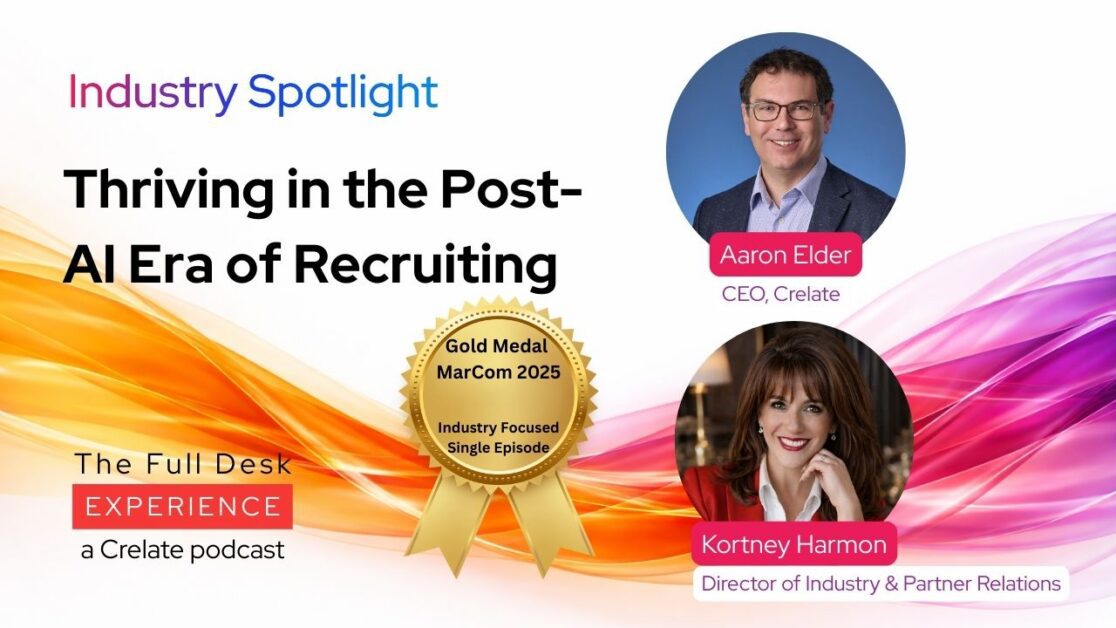
Thriving in the Post-AI Era of Recruiting with Aaron Elder, CEO – Crelate
Show notes
This Best of FDE episode is a rebroadcast of one of our MarCom Gold Award winners—and honestly, it’s even more relevant now than when we first recorded it.
In this episode of The Full Desk Experience, Crelate CEO Aaron Elder joins host Kortney Harmon to break down what it actually looks like to operate in a post-AI world—and what that means for owners, directors, and executive-level leaders.
In this episode, we cover:
- What “post-AI” really means: Why AI isn’t coming—it’s already here, and how it’s quietly becoming as essential as electricity
- Where firms are actually winning: How top teams are using targeted AI (not hype) to create real value and stronger client relationships
- The shift to “living platforms”: Moving beyond static systems to tech that actively works for you, not just stores your data
- Where humans still matter most: In high-trust work like executive search, where AI supports—and where it can’t replace—the human element
- What’s about to change operationally: From sourcing to back office, every part of your business is on the table
Do you know if the roles you’re filling today will even exist in two years?
As AI and automation accelerate client expectations and reshape work itself, the firms asking better questions now are the ones that stay ahead.
Hit play to hear how leading firms are thinking about this shift—and what you should be doing next.
___________________
Follow Crelate on LinkedIn: https://www.linkedin.com/company/crelate/
Subscribe to our newsletter: https://www.crelate.com/blog/full-desk-experience
Transcription
Kortney Harmon [00:00:00]:
Welcome to The Full Desk Experience, your ultimate resource for insights and expertise in the staffing and recruiting industry. I’m your host, Kortney Harmon, and I am thrilled to introduce our special Best of Episodes series. In this curated collection, we’re revisiting the most impactful and thought-provoking conversations from our archives. Whether you’re a seasoned listener or new to our community, these episodes offered invaluable knowledge and inspiration for professionals in the talent industry. Join us on this journey through the Full Desk Experience Greatest Hits. Every episode promises to deliver actionable advice, fresh perspectives, and the latest trends in staffing or recruiting. Get ready to rediscover or experience for the first time the conversations that have made a lasting impact on our listeners and the industry at large. Tune in weekly as we unlock treasures from our podcast vault.
Kortney Harmon [00:00:57]:
And bring them to you, our valued audience. Enjoy.
Aaron Elder [00:01:01]:
Everyone who is going to survive this is already working on it. So if you’re not already working on it, you’re definitely behind. They are looking at it across their business. And keep in mind, it doesn’t have to be just production, right? Delivery, right? Like it’s, it’s how you do accounting. It’s how you do billing. It’s, it’s how you do your own sales, right? Every part of your business can be transformed. Don’t expect it to do everything. Focus on really targeted scenarios where you can apply it and get value now, right? And I think that’s what’s happening is you’re, you’re seeing these agents be sort of expertified along these different lines.
Aaron Elder [00:01:37]:
And then which ones work for you, I, I think depends.
Kortney Harmon [00:01:40]:
Hi, I’m Kortney Harmon, Director of Industry Relations at Crelate. This is the Industry Spotlight, a series of The Full Desk Experience, a Crelate original podcast. In this series, we will We talk with top leaders and influencers who are shaping the talent industry, shining a light on popular trends, the latest news, and the stories that laid the groundwork for their success. Welcome back to another episode of The Full Desk Experience Industry Spotlight. Welcome back to The Full Desk Experience, where we tackle growth blockers across your people, processes, and tech that really keep recruiting firms from reaching their full potential. I’m your host, Kortney Harman, and today we’re diving deep into what might be the most significant shift our industry has seen in decades. We’re really at this pivotal point, this pivotal moment in our industry where intelligent technology is becoming as invisible and essential as electricity. A year ago, everyone was really debating LLMs and AI as the future, but today we’re already moving into a post-AI era.
Kortney Harmon [00:02:51]:
Which is where we’re gonna go spend the majority of our time today, a post-AI era. And what does that mean? Where are you and are you left behind? Today, Crelate CEO and founder Aaron Elder is joining us. He’s been at the forefront of this transformation, quietly building what he calls a living platform, technology that evolves and adapts rather than simply automating some static process. Aaron really brings this unique perspective, not just as a technology leader, but as someone who’s worked with thousands of talent professionals navigating this transition. So today, we’re going to explore how Crelate’s approach is helping firms escape those disconnected systems that I am always ranting about. We’ll also examine how AI is reshaping everything from executive search relationships to the very nature of work itself and what separates those firms that capture real value from those caught in that hype cycle that we talk about. All right, Erin, thanks so much for joining me today. A year ago, we were sitting in this same place, same virtual conference room, and we were discussing LLMs.
Kortney Harmon [00:04:01]:
But now, and hearing you talk and how we’re positioning Crelate itself for like a post-AI era, talk to me about what fundamental shifts have really occurred in recruiting technology and what that looks like. So let’s first talk about that post-AI era. What does that mean and what kind of things have happened? Because last year to this year, there’s a big shift.
Aaron Elder [00:04:22]:
Certainly. And, uh, thanks for having me again. And let’s just dive right in. So this post-AI era concept, I’ve been intentionally trying to use this language because I think it invokes the right emotion, which is that it’s a foregone conclusion that AI is here and it’s affecting everything. And it’s not really a debate about if it’s going to affect my business, should it affect my business? How is it going to change? It already is, whether you realize it or not. And this sea change is occurring. And unless you’re on top of it, you’re going to be behind it. And so that’s what the idea is, is that we are now living in a post-AI world.
Aaron Elder [00:04:57]:
It is everywhere and it is becoming more and more pervasive. How are we responding to that? And how are we taking advantage of it? And how are we ensuring that our business is going to be on the winning side of AI?
Kortney Harmon [00:05:07]:
Okay. I love that. It’s here. It’s static. It’s kind of like electricity. It just is. While we’re working. Talk to me about those shifts.
Kortney Harmon [00:05:16]:
What maybe occurred in recruiting technology, but maybe not even just in recruiting? How is this evolving work itself overall?
Aaron Elder [00:05:26]:
Great question. I think for me, what was interesting about this is that I’ve been watching this thing grow for years, and like many things in history, it starts off slowly and then all at once, right? AI started off as sort of cute and interesting and, and little quirks and neat little experiments, and then next thing you know, it’s everywhere. All of a sudden. And I think what caught maybe me off guard the most was the rate of improvement. The rate of improvement seems to have accelerated exponentially just in the last year. It crossed the uncanny valley pretty quick and never looked back. And so I think you were scrambling to react to that. How has it changed things? I think the first thing is that The quality crossed this valley and then all of a sudden it was just, it went from a toy to essential and great, like overnight.
Aaron Elder [00:06:21]:
That’s a huge change. It went from something that maybe you’d use occasionally to like, I use it every single day. And so does, you know, the entire team. That’s crazy, right? When you think about that sort of overnight shift. Now, that’s going to have a lot of impacts, which we can talk about, but I think that’s the first thing that I noticed as the big change.
Kortney Harmon [00:06:39]:
I don’t think you’re wrong. We went from talking about how to use ChatGPT better to now this thing called AI is more embedded in our workflows. When we think about recruiting, I know a stance that you had, uh, as we talk about this piece is humans are still involved in this process. So talk to me about maybe the principles or philosophies that really guide your thinking to ensure alignment with human interaction or human intent, especially in high-trust fields like executive search and the places that we play.
Aaron Elder [00:07:13]:
Keeping the human element. And so it’s interesting with, as you watch each generation of LLM evolve, and it’s okay, let’s maybe step back a little bit here. So there was sort of the first gen, second gen, which was really all about crossing that uncanny valley. Can this machine produce something, you know, given a prompt that resembles what a human might produce, right? Like the third gen and wait, I’m talking generations, but this is all like within the last 9 months, right? And so the third gen was when reasoning machines really kicked in and DeepSeq kind of kicked off that wave, caught a lot of people by surprise. And the secret that it, it sort of, its approach was to create this within the LLM to have these series of experts. That are individually trained on different areas. And so then when you ask a question via the prompt, the first thing it does is figure out which experts need to be involved in the response. And then it has a mechanism for focusing on the reasoning and double-checking of its work to produce a response.
Aaron Elder [00:08:14]:
And so reasoning really became it. What I’m seeing now, and this is like literally last week, is they seem to be trying to push that boundary that you’re talking right now of where is the line on human interaction. And so I’m reading about these sort of controlled experiments where they’re trying to lock AI in a box and you give it sort of existential rules around how to operate in order to see how much of a human-like sentient response. And it’s kind of crazy what they’re trying to do. Like, will it blackmail you into creating a response? Will it lie to you? Will it try to protect itself? Like, these are the experiments that are happening in the last week. I mean, I’m sure it happened before, but now they’re publicly talking about it. So man, like crazy in all this. I guess my thought on the human response, that the human side of things first is, is that there’s naturally going to be laws that are put in place to protect and to try to put some ring fences around this.
Aaron Elder [00:09:16]:
That’s already happening last week. I think the federal government or in the new budget bill, they’re trying to centralize and not let states have individual rules and like, like there’s gonna be like a master rule to like make sure that like, whatever they’re going to do with it, but presumably what they’re going to do with it is if it directly impacts a human life, a human’s got to be involved somewhere in the process. I think the next interesting thing is that the quality and the speed and all that stuff is there. It’s no big deal now to have the AI generate a sequence for you and to spam people with creative, witty responses. It’s gotten way, way, way better than it’s ever been before. And so that’s all just like table stakes. And again, I go back to this race to the bottom. It’s just noise.
Aaron Elder [00:09:59]:
And so I think the differentiator has to come in your ability to connect and create relationships around a future recruiting challenge or problem that you’re trying to solve, right? Like you are a great fit for this opportunity and these people are gonna work well with you, which I, which I think has to be like the, some of the only place where, where humans can add the most value in the equation and where people will want the humans to add the value.
Kortney Harmon [00:10:25]:
I love that. And ultimately, Crelate is about creating relationships. I need to put that forefront in your mind because I mean, that was your vision of this whole thing from the beginning. So, I love that. You were speaking of these things that were the experts that obviously we have to put in a box. I’m gonna assume those experts and what were functioning on the backend were things like agents and things that were doing work. Am I wrong?
Aaron Elder [00:10:51]:
Well, the idea of the group of experts is that within the LLM, if you have a language model that is trained on like all human words, yeah, let’s train a submodel just on math and one just on code and one on just on medical stuff. And so then that becomes, you know, I think DeepSeq has 12 experts internally trained on these different areas. And so it allows two things. One, it allows for deeper training around that one topic area. But the coolest thing is that allows for much faster what’s called inference because it doesn’t need to go through 770 billion parameters to answer your question. It can answer within 7 billion. It could be much more efficient and how fast it can do a response. And so then as the efficiency of responses goes up, right, it becomes, you know, you can have it on your phone before too long.
Aaron Elder [00:11:41]:
So the experts, the so-called experts are within the LLMs to respond to the prompt.
Kortney Harmon [00:11:46]:
Amazing. I want to kind of shift gears a little bit. We’ve been hearing you say the words a lot, living platform. Crelate’s living platform really positions itself as a dynamic in contrast to maybe those static systems. So do me a favor as we start into this, can you tell us more about this living platform and really what makes it living?
Aaron Elder [00:12:08]:
Great question. I’ve been doing CRM systems my entire life, like since I was 18, I was, I was basically working on databases in the cloud, although back then we called them application service providers. It was just someone else’s computer. But at the end of the day, these systems were sort of classic forms and grids. Show me a list of things, give me a form to be able to put new things in it. And if you really think about it, CRMs, applicant tracking systems, you know, all kinds of systems like this, at the end of the day, are kind of a box that puts your stuff, right? You know, it’s a digital box that puts your stuff, keep it safe. And that’s of limited utility. Oh, you know, it was certainly now.
Aaron Elder [00:12:51]:
And I think we talked earlier about AI is going to create winners and losers. I think the boxes to put your stuff are definitely going to be on the losing side of that. I can’t predict the future, but I’m pretty confident in that one. And what the Living Platform is, is it’s a commitment from us to sort of reinvent every aspect of our thinking to be on the winning side of AI. So what does it take to have a to have your ATS or your platform for solving recruiting problems go beyond from just being a place to put your stuff. And what, like, what we think that looks like is specialized agents focused on every workflow. But, but again, there’s lots to unpack there. It’s a specialized agent.
Aaron Elder [00:13:34]:
It is very targeted and built and trained and optimized for that scenario. It is an agent and an assistant and, and, and Maybe it’s some assistant, maybe it’s more agent, a little bit of both. We can call it the difference there, but it’s just sort of these specialized workers within each work stream that take the data you put in and then take it to the next step. This is the next step or next steps. I think the other thing that it is, is those agents should be working to constantly clean, enrich, enhance, augment the data once it’s in there, right? You put something in and the data should just come alive. It’s got new data you didn’t have before. It’s got insights you didn’t have before. It’s been enhanced with data from all over the internet or whatever we can go grab.
Aaron Elder [00:14:16]:
So again, while it’s in the box, it’s, it’s growing. It’s more like a, an incubator, if you will. That’s what the LID platform is to us.
Kortney Harmon [00:14:23]:
We’re feeding it, we’re giving it sunlight, we’re getting it all those things that it needs to grow. I love that. You just made a comment, agents versus assistants. Do you wanna elaborate on that, Emmy?
Aaron Elder [00:14:33]:
Sure. It’s funny, I feel like you can get lost in the quagmire of the vernacular, and I, I’ve seen that like agentic assistance, right? I mean, you can kind of mix the whole thing. I think at the highest level, the idea is that where is a human necessary in the process, right? And so at a high level, AI is really good at doing sort of automated analytics analysis, right? You don’t really need humans involved in that portion. Then there’s pure automation, right? Where you don’t want humans involved. And then there’s a portion where you want humans involved. And different machines can be trained and built for each one of those things. Generally speaking, at the highest level, assistants are designed to work in flow with you. They might use agents behind the scenes to generate the next response, but ultimately, the experience you’re having, the user experience, is an assistant that’s keeping you in control and supporting you.
Aaron Elder [00:15:26]:
An agent, on the other hand, is a user experience where you expect it to do the next thing automatically. And that’s probably the, the highest level.
Kortney Harmon [00:15:34]:
I love it. Thank you for breaking that down. Now, let’s talk about maybe some unexpected impacts that AI has had in the recruiting world that maybe we didn’t really predict when we first started seeing LLMs emerge.
Aaron Elder [00:15:48]:
Um, in the recruiting world, and I’d love to hear too, you know, what you’ve been seeing. I think where my brain first goes is the more macro question of what AI is doing. So we went from 6 months ago, AI being, you know, a browser-based thing, you type in some stuff and maybe get some help, et cetera, to I’ll use the product team, for example, every single dev uses AI every single day to actually help them write code or to write code for them. I mean, that’s transformational. And when you think about that, you know, and these tools aren’t inexpensive, right? I mean, they’re expensive tools and, um, The expectation is, and let’s just talk sort of macro again, it’s great you have these tools, now what? Right? Because, you know, I recently used Claude 3.7 to write a tool that would have taken easily, easily taken, you know, me a day or two, you know, a couple days of code, a junior developer a week or two. And this thing did it frigging perfectly zero shot, which means like the first prompt right out of the gate. In 30 seconds. I mean, like, how do you compete with that if you’re not using it? You gotta be using it.
Aaron Elder [00:16:59]:
And so now if you are using it as a business, my expectation is that your output would increase. And I think other businesses, you know, CEOs and leaders and boards are thinking the same thing. Your output should increase. And so I think what’s more interesting is the expectations that are changing within the workforce. And I don’t know if anyone really knows quite what to do with that yet. Um, but you can sort of see the seeds for it, right? One thing I have seen, and this is probably happening within recruiting agencies too, is your first thought shouldn’t be, who am I going to hire next? It’s going to be, how can we do more with AI with our current team, right? And you read about this with, you know, Microsoft, Facebook, like, we’re not going to hire junior devs anymore. We’re only going to hire, you know, experts at AI, um, or we’re going to look to, you know, How do we take our mid-levels and make them more effective with AI? And so, it’s really changing the conversation of what’s expected within the workplace. And I think that certainly applies to sourcers and BDRs and recruiters, et cetera.
Kortney Harmon [00:17:58]:
I love that you mentioned that because we talk a lot on the podcast about KPI and the hamster wheel of how we measure what successful recruiting organizations look like or what they’re doing or what metrics they’re hitting or their placements or what their ratios are. Do you think that’s going to change the way leaders evaluate their effectiveness for their strategies in an AI, post-AI world?
Aaron Elder [00:18:21]:
I do. And I think the pressure will come from, from the market in general, like customers across all the different industries are going to start to expect changes. They’re going to expect a higher quality, a faster output, faster iteration, lower cost or whatever it is. And so these pressures will be put on businesses. Businesses, and I’m talking every industry, will start to see their competitors using AI to achieve these increased expectations. And so they then will start to see that they need to change or they’re going to die. It’s going to be this actual existential threat to lots of businesses across the world. And boards and businesses are going to want to do something to respond.
Aaron Elder [00:19:03]:
And so I think Sorry, I’m not asking the exact question you had. Yeah. Okay.
Kortney Harmon [00:19:07]:
No, I like it.
Aaron Elder [00:19:08]:
But then our customers have to then, I think, transform to help businesses solve this. So, so the employers of the world are going to say, we’ve got to do something. Okay. What do we got to do? Okay. What do we got to do? Okay. So who’s going to do that? And they’re going to look around and realize no one knows how to do that. Or they’re going to need to like, we got to move manufacturing from here over here, or we got to completely robotify this process and do this, or we got to completely reinvent how we do this if we’re going to compete. They’re going to develop these strategies and then they’re going to be stuck with this problem.
Aaron Elder [00:19:41]:
How do we go build a team to go do this thing that we don’t even know how to go do, et cetera. Enter in expert agencies and consulting and staffing companies that are going to help people solve these strategic recruiting problems that emerge. And so anyway, I think that’s the big change that our customers are going to see is at least the ones that survive will be. Those that focus on solving these new problems for businesses.
Kortney Harmon [00:20:05]:
It’s a whole new set according to where you’re—
Aaron Elder [00:20:08]:
Yes.
Kortney Harmon [00:20:09]:
Well, as you think about AI and it becomes more integrated into our everyday lives, in our everyday workflows, in our everyday processes of those problems that we’re solving, what guardrails or principles should leaders prioritize? Like whether they’re building tech, adopting it because it’s ever-changing, or scaling it across a large team or society at large? What do we need to think about? I mean, because this is a new evolution.
Aaron Elder [00:20:35]:
I think the first guardrail that leadership should be thinking about is, is are we even attacking the right problem and are we building the right guardrails? And what I mean by that is, is like, if you’re hyper-focused on just making sure that Sally the Sourcer is able to spam 1,000 more candidates without saying anything offensive, That may not be the problem that you need to solve over the next 2 years. Because I use 2 years, not 5, because it’s happening quick. Because maybe that, that type of role that you’re trying to go spam people for is going away entirely in 2 years. And that’s the real thing that you should be really thinking about. So I think that’s the first guardrail is as a business, what are we even doing? And don’t confuse activity with progress. What is the real problem that we’re going to be solving over the next 5, 10 years? And when is the actual event horizon going to start hitting us in a way we got to feel? And if you look at yourself and you say, yeah, it’s actually only 2 years out, that might be a different conversation that you want to have internally. And I think people need to think beyond just AI because everyone’s really talking about AI and talking about, you know, all these things. And people are kind of taking their eye off robots.
Aaron Elder [00:21:50]:
And I’ve been digging way more into it since I’ve seen this thing. And I think the world’s going to be shocked at the rate of improvement of physical, you know, humanoid robot automation and self-driving cars kind of thing. Like I took my first Waymo from my hotel to the airport down in Phoenix and it was seamless and wonderful. And I’m, there’s got to be people who are thinking like, yeah, we’re going to have 100 million of these on the road by 2027 or whatever. Like, it’s going to be from nowhere to all of a sudden, right? And I think this goes beyond just Waymos. If it can do it for that, it can do it for deliveries. It can do it for truck driving. It can do it for flying planes.
Aaron Elder [00:22:28]:
It can do it for a lot of things. And so entire things are going to shift incredibly fast once AI becomes kinetic, right? And, and goes into these, into these working robots. And so again, if you’re not thinking about this and thinking about where your business is going to be positioned, with that wave, if you think you’re shocked now, you’re going to be super shocked then, I guess is my thought.
Kortney Harmon [00:22:51]:
No, I think that’s great. And it does, it changes everything. So, talk to me based on that thought process that you just had and the problems that we should be thinking about as staffing and recruiting firms in this era and what we should be talking about, because what you just were describing was like, we’re not there yet. We haven’t arrived yet. You need to start thinking about things differently. But like, what are the telltale signs that people should keep their eyes open about what those new problems could be?
Aaron Elder [00:23:17]:
That’s a good question. I think it probably depends on each person’s industry. So I think only they would know what’s best, but maybe pull on some threads. So if you’re seeing some things change, if you’re seeing customers asking different questions, and let me flip the script. Are you asking your customers different questions? Because if you’re not, then again, then what value are you providing besides just people in slots, right? I think you need to be helping your customers be thinking about these things. And so you start pulling on those threads and I think you’ll sort of logically sort of see what comes next down the pipe. And I don’t think every role is going to be affected at the same rate, obviously, right? But it’s going to affect a lot of roles very, very quickly. And I think where our customers have to be is they have to be helping businesses respond to whatever it is.
Aaron Elder [00:24:06]:
I mean, there might be a very real world where, you know, what does a staffing company look like in a world where maybe what you’re staffing are, are robots or AIs?
Kortney Harmon [00:24:17]:
Crazy to think about.
Aaron Elder [00:24:18]:
But you know what I’m saying? Like, maybe I’m looking for the right person or you’re, it’s the person with the AI, right? Or maybe you can highly reinvent your business, right? To be, you know, a consultancy around these things. Sorry, rabbit holing for a second there. Don’t have a good answer because I think it’s happening way too fast and I think it’s going to be very industry, if not very industry independent in ways that that’s the expertise that you bring in your industry. And so I think my challenge to you though would be just, you gotta think bigger than what I think you think you’ve been maybe thinking in the past. So, you know, it’s not like, yeah, we’ll have 3% incremental growth next year. Yeah, there’ll be a shift in the workforce from this demographic to this demographic or this age or whatever. It’s not going to be that. I think you need to be questioning, okay, well, what if this role is not even needed anymore? What if this role transforms entirely? How are we going to do that? What if this role goes entirely robotic? Right? Like, ask those questions at least, and then start thinking about how you could support your customers in that transition and help the world move forward.
Kortney Harmon [00:25:21]:
I think that’s great. And you have to start by asking different questions. If you’re asking the same questions over the past 3 years, you’re probably missing the mark.
Aaron Elder [00:25:27]:
Totally. Hopefully this wasn’t too high level.
Kortney Harmon [00:25:31]:
No, it’s good to get people thinking. Obviously, we’ve seen that there’s been a rush to add AI to everything. Have you seen, talking to thousands of professionals in our industry, have you seen any firms that maybe are seeing the real value of getting it right or doing something right when it comes to AI versus getting stuck in that hype cycle of maybe something shiny, something new? Have you seen anybody doing it right, right now, thus far?
Aaron Elder [00:25:59]:
I think it depends. Here’s what I know. I think everyone who is gonna survive this is already working on it. So if you’re not already working on it, you’re definitely behind. They are looking at it across their business. And keep in mind, it doesn’t have to be just production, right? Delivery, right? Like it’s, it’s how you do accounting. It’s how you do billing. It’s, it’s how you do your own sales, right? Every part of your business can be transformed.
Aaron Elder [00:26:23]:
This mindset was mentioned a year ago, like don’t expect it to do everything. Focus on really targeted scenarios where you can apply it and get value now, right? And I think that’s what’s happening is you’re seeing these agents be sort of expertified along these different lines. And then which ones work for you, I think depends. I have seen it work well in some cool scenarios for straight up outbound in a staffing world, like just calling people and doing basic question and answer. I’ve seen it, I’ve seen it used very well. Just some, some of these are small experiments, but you know, for a few months now I’ve heard of customers. This is actually outside of this field, but, but a friend of mine owns an audiology practices and they’re using it for getting leads and appointments, right, for hearing aids. And it’s working like freaking awesome, right? It’s like it’s, it answers questions, it does a call, it just works super, super well.
Aaron Elder [00:27:13]:
So you could definitely see that, that working for other things, depending. Again, I don’t think it’s like you’re hired, right? But as part of the funnel and part of the process, I think that’s working. I think it’s working for internal stuff as well, right? You know, operations, et cetera.
Kortney Harmon [00:27:29]:
I love it. I’m gonna end on this question for this session. I know we’re gonna have you back on. We’re gonna talk more about this here in a few weeks. So looking ahead a few years, obviously today we’re talking post-AI era, it’s here, but looking ahead, what feels inevitable to you? Like something maybe that we’re gonna take for granted in 2026, but maybe feels very aspirational.
Aaron Elder [00:27:52]:
I think it is inevitable that the market is gonna change. And that the expectations are going to change. Everyone will use AI, certainly in our industry. Everyone will use AI every day in some way and just full stop. So what does that do? I don’t know, but you’re going to use it every single day. We’re working on building a series of agents that help each portion of the business from, right, finding opportunity to finding candidates to taking the candidates to the next step to keeping your database up to date to running your business. That touches every single aspect of what you’re doing. We’re working on having Copilot go from being just a sort of a helper on the side to literally integrated into every single text box in the application.
Aaron Elder [00:28:35]:
So I think that’s inevitable is that you’re going to be using AI every day, whether you know it or not. I think what might be even scarier beyond that is as AI gets better, and the user interface changes even further in 2027, what does, what does a subsystem record look like? I mean, your primary experience may no longer be a web app. It might be, you know, a chatbot, right? Where you’re just talking with your system and it’s taking next steps. So, I think once we get past this first generation of agents that are truly used every day, the next generation might be pretty mind-blowing beyond that.
Kortney Harmon [00:29:12]:
I love it. And you talked about using it every day, but what you said was, You may not even know that you’re using it. It’s just going to be built in, and whether you realize it or not, it’s going to be happening because it is here and we’re past that first iteration. So I think it’s very exciting to hear you develop what a living platform looks like, talking about this post-AI world. So Erin, thank you so much for your time today and all the work that you’re doing behind the scenes for this exciting venture and what we’re really giving back to this industry. So thank you.
Aaron Elder [00:29:45]:
Absolutely. Thank you. Great time.
Kortney Harmon [00:29:47]:
And for our listeners, that’s our deep dive with Aaron Elder, CEO and founder of Crelate, on navigating this post-AI era. We’re so excited to get you involved, and if you wanna see this living platform in action, visit Crelate.com and keep trudging along and asking those difficult questions to change your view on this industry. And how we can help our clients solve different problems. Until next time, see you soon. I’m Kortney Harmon with Crelate. Thanks for joining us for this episode of Industry Spotlight, a new series from the Full Desk Experience. New episodes will be dropping monthly. Be sure you’re subscribed to our podcast so you can catch the next Industry Spotlight episode and all all episodes of The Full Desk Experience here or wherever you listen.