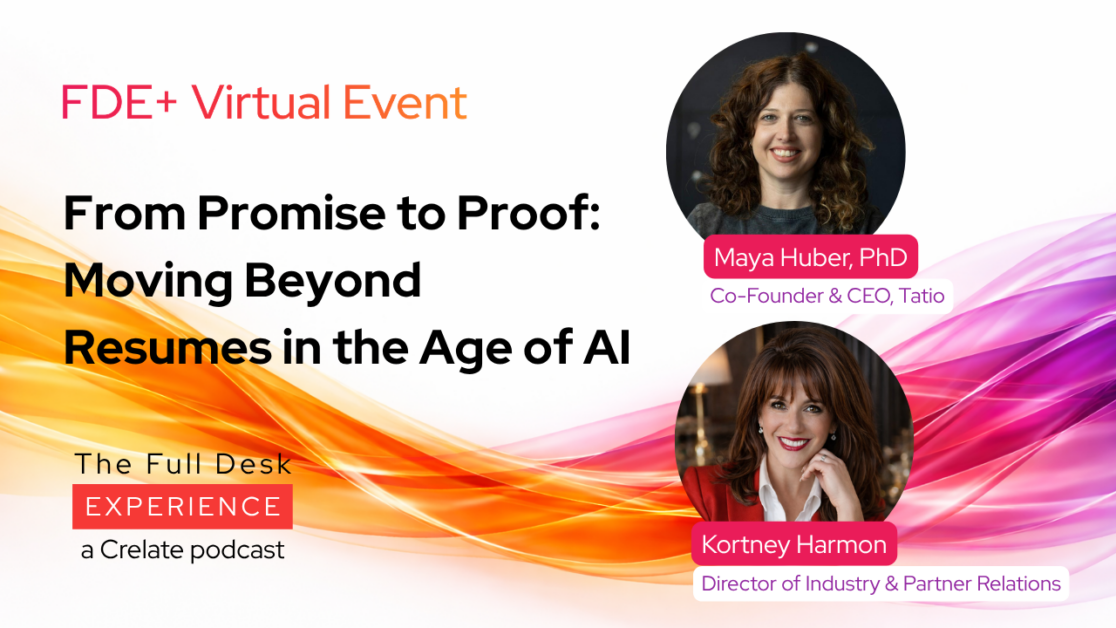
From Promise to Proof: Moving Beyond Resumes in the Age of AI with Maya Huber, PhD – Co-founder, Tatio
Show Notes
AI is changing hiring from both sides of the desk—companies are creating stronger job descriptions while candidates are creating stronger resumes, leaving recruiters with a growing blind spot between what looks good on paper and what actually predicts performance. In this FDE+ conversation, host Kortney Harmon is joined by Dr. Maya Huber, CEO and co-founder of Tatio, to explore why traditional, keyword-based hiring processes are becoming less reliable in an AI-driven market.
Maya makes the case for shifting from promise to proof by measuring actual skills, competencies, and job-specific performance. She explores how staffing and recruiting teams can define what “good” looks like, standardize qualification across recruiters, and gather more meaningful evidence through structured questions, work samples, and virtual job simulations. The goal isn’t simply greater speed or efficiency—it’s greater certainty, transparency, and trust for clients and candidates alike.
Explore how performance-based hiring can help recruiters make smarter talent decisions, strengthen client relationships, and become the performance authority their market trusts.
________________
Follow Maya Huber on LinkedIn: LinkedIn | Maya
Follow Crelate on LinkedIn: Crelate
Want to learn more about Crelate? Book a demo here
Subscribe to our newsletter: The Full Desk Experience
Transcipt
Maya Huber [00:00:00]:
companies are using AI tools to create better job descriptions and candidates using AI tools to create better resumes. And there’s, for me, it’s like fraud connecting with fraud. And both sides are not doing anything for purpose. Both sides are trying to do something that will improve the chances to find work or to find employees, but it creates a blind area. where everything looked good on paper, but eventually did not necessarily predict the day-to-day.
Kortney Harmon [00:00:32]:
Hey guys, Kortney Harmon, host of FDE. In case you missed it, we recently hosted a live virtual event and it was one for the books. We brought together some of the best thought leaders in the recruiting and staffing industry for 2 full days of real, no-fluff conversations and what’s actually working right now, from building trust with clients to using AI without losing your edge to growing revenue through These sessions were absolutely incredible, and we didn’t want you to miss out, so we turned every single session into its own episode. And over the coming weeks, we’re dropping them one by one right here. Each episode is a standalone session from the event, so whether you’re tuning in for the first time or you were there live and you wanna revisit all of your favorites, there’s something for you. Stay tuned. You’re going to want to hear from every single one of our speakers. Trust me.
Kortney Harmon [00:01:32]:
Enjoy. Maya, our next speaker, has built an entire company around a different idea. Dr. Maya.
Maya Huber [00:01:40]:
Thank you so much. On behalf of me and my mother.
Kortney Harmon [00:01:44]:
I love it. You have worked with the top 100 most influential thought leaders with a PhD, occupational therapy, 15 years of experience in HR, career development, I know the last time we talked, we talked about you do training as well, like just in general, this is who you are. So it made so much sense to have you on here. So thank you for taking time out of your busy day to join us.
Maya Huber [00:02:06]:
So first of all, thank you, Kortney, so much for inviting me. This is my first time, hopefully not the last. No, I’m highly excited about the conversation. I was already watching some of those sessions and I saw a live chat and I’m, I’m excited by that. So I hope we will get the same interaction I’m kind of anticipating.
Kortney Harmon [00:02:24]:
I love it. And hopefully, hopefully everyone’s awake and alive and depending on the minute and when they’re getting coffee, we’ve had some great conversations. So I have your PowerPoint up here. Do you need me? Because otherwise they’re not here to see me. They are here to see you. I will gladly step off stage.
Maya Huber [00:02:40]:
I always need you, but you can take some time off. Go and grab coffee.
Kortney Harmon [00:02:43]:
I’ll love it. I can’t wait to listen in and see how this goes. So amazing. Have a great session.
Maya Huber [00:02:48]:
Thank you so much. So hello, everybody. I’m excited to be here. Nice to meet you, glad to see you in person and to contact with you here. I’m highly excited about this topic. I’ve been learning and working on this for a few years already, around 10, and I think now is the best timing to speak about it more than ever since AI has just made an amazing disruption on the market. But first of all, let me introduce myself. As Kortney said, I’m the CEO and co-founder of Tatio.
Maya Huber [00:03:19]:
Tatio is a virtual job simulation platform that I will speak about at the end of my speech because I wanna speak about performance-based hiring before. I hold a PhD in career development and job analysis, and my mission from the way I’m a working person is to connect people and companies based on their skills and performance. It started from reasons that came from doing justice and make sure people are perceived in the right way, but now I believe it’s the only way you can look at talent and the only way to make decisions about careers from the first day a person is working, maybe a bit before, and until they retire and maybe a bit after. So without further speaking, I’m going to jump right into the topic. And please, please, please, I would love to see your questions, your feedback, your thoughts. Stop me. We have enough time to speak about Anything you have in mind regarding performance-based hiring and about skills. Okay, so what are we going to speak today? We’re going to speak about why AI is speeding up our decision-making.
Maya Huber [00:04:25]:
And you heard, you spoke about it today, I know, but what happened? What can you value from it? And why speed alone is not enough. And now we can limit the keyword-based searching. and to implement more and more performance-based hiring. And I want you to stay with me because I know I’m gonna speak about Tactio in the end, but not just about Tactio. And I have here some key ideas, how each one of you can implement skill-based hiring even without using a technology tomorrow, even just in their state of mind. And I wonder, people that are here, I would love to hear, are you experiencing performance-based and skill-based hiring in your organization? And if you have any barriers that you already see working on this through the years. So why are we speaking about it right now? It became very challenging in the workforce recently where there are fewer open positions than ever, and buyers and partners are selective, and the competitive edge is crucial. Not just that, we see that the contingency demand moves quickly.
Maya Huber [00:05:34]:
The confidence in the market is fragile. Prices and pressure on prices is real, and all the decision-making process on the company side of things is getting more and more complex. People are looking to validate their decisions and why they’re buying or interacting with any partner. This is relevant for staffing partners wanting to sell to hire managers and vice versa, where hiring managers and recruiting teams need to do their own recruiting. And just to make it clear, through all my conversation, I’m gonna speak both to people who hire direct and do their own sourcing and hiring and people who use staffing and recruiting firms. So I think one of the things that all of us feel is the market is adapting fast, and we know that 50%, almost 50% of HR leaders are already piloting planning, implementing AI tools. And the way I see it, AI is going to be this basic infrastructure like web. No one is saying right now I’m using web-based platform or I’m using the web to recruit.
Maya Huber [00:06:45]:
That’s how AI is gonna influence our market and our decision in a way that is gonna be so basic. And another data point that I wanna share with you is that we see that along all the tools that recruiting teams are using, 41% out of this are job description and skill data they’re trying to implement to create a more modern tooling and to reduce the risks and to defend their decision internally. And this is massive. There are many tools to influence the funnel. I think the best signal here is, and we’ll speak about it more in a minute, that the market now already that this is, first of all, that this is a basic infrastructure to implement. And at the same time, the job descriptions is not enough and we need to move forward to skill-based data. So turning the line here about everything that’s been said already, AI can reduce the time we spend on hiring on repetitive tasks. It’ll help organizations to create a more effective process, to standardize it, And to improve their responsiveness and the way they cooperate and collaborate with their partners.
Maya Huber [00:07:57]:
The administrative time will be lower, and I hear less and less cases of companies that are saying they’re doing things manually. There are still few, but it is not common anymore. And in a staffing environment where there’s high volume of applicants, and now we see even a growing number of applicants, Those gains of making the process more efficient is crucial, specifically in a time where it’s challenging in terms of business, and we see a slight improvement in the growth in the staffing industry this year, but still a way to go. And many of our partners are struggling to win more business currently. So being more efficient internally is something that everybody needs to implement. Or to try in order to improve their margins. But what also changed is that candidates can polish and change the way they showcase their skills. They can apply in minutes automatically.
Maya Huber [00:08:59]:
There’s a phenomenon that I believe that people here experience, which is bulk or blind applying, where people can apply for hundreds of dozens of positions at the same time with one click of a button without even being aware of what they applied using bots. And when AI started, we thought this is a phenomenon that we’re going to see only for, you know, tech people who are tech savvy, know how to use and manipulate the algorithms and ChatGPT and the tools. But this is everywhere and there are tools you can download easily for tech solution to apply for you. And everything you write as a candidate could be adjusted to a job application, to a position, to your readiness to work. You can do anything from really trick the system to just making your resume better. And not just that, since everybody are using the same tools and, you know, making everything look polished and better, It’s also hard to distinguish between opportunities on both sides because also companies are using AI tools to create better job descriptions and candidates using AI tools to create better resumes. And there’s, for me, it’s like fraud connecting with fraud and both sides are not doing anything for purpose. Both sides are trying to do something that will improve the chances to find work.
Maya Huber [00:10:27]:
or to find employees, but it creates a blind area where everything looks good on paper, but eventually does not necessarily predict the day-to-day. And one thing that I work with is also from the candidate perspective, you know, we have those promises on our job description about what the job is going to be, and we’re not necessarily delivering. So how can we close the gap here? And how can we use AI to use evidence and to be more concrete and specific in what we are doing with all these texts, which is one of the main things for me. So we spoke about fraud, and I want to say now in an area of AI, fraud and risks are part of the conversation on both sides. And you can see here through 2 pieces of data, one from the CNBC News and the other one from research. That both candidates and companies are tricking the system and there’s a feeling, at least, of fraud all over. And again, no one is doing anything on purpose, but everybody will want to use this tool to look better. So one of the things that I think we are starting to see, and it’s gonna increase through the years, is that safety and certainty are important as much as speed.
Maya Huber [00:11:47]:
Speed is not enough. And if we will continue looking at speed and efficiency as the only factor to use AI, we are gonna lose this game because both sides, our partners, ourselves, if you look at yourself consuming data in an era of AI, safety and certainty are starting to be a basic infrastructure that it’s not commonly there and we need to work on creating it. Another thing that we see is that candidates are not willing to go through the application process as they’ve been before. So they do not complete job applications. They are not interested in filling those questionnaires or filling forms anymore. And again, now when there’s AI tools that enable you to do things faster, why should you as a candidate fill in those data points? You can feed it to an AI, or you can just skip to the next application. When everything you see and consume information with is gamified or video-based, we see little or no text. We see music at the end, something that is fun.
Maya Huber [00:12:55]:
And at the same time, our processes look like that. And when I’m saying that, I mean words and text everywhere from the job description to the application form, to the skill assessment, conversational chat, the emails, everything is based on text and text could be easily changed with AI. So text in this area is becoming obsolete. So keywords or textual information are not enough, not just not for having a better decision-making, but not even learning from the data that you currently have. Text is not enough, and we need a new infrastructure that will be relevant to this time in the market. So one of the things that we see is that we have a signal problem. The signal that we used so far is not working. Most hiring automations depend on text, resumes, form questionnaires, screening chats, interviews.
Maya Huber [00:13:59]:
Everything is based on text. These inputs are describing candidates. They describe work or positions or opportunity, but they do not demonstrate performance. And when text becomes easier to refine and to screen and to manipulate, it’s becoming inaccurate. And there’s a risk in using just that because it could be misled. And at the end, it leads to— there’s a result in the business. When things are not, they do not meet their, you know, our promise. So we see that 40% of candidates report they use AI in job descriptions.
Maya Huber [00:14:37]:
So this is true and they use it in cover letters. Those are easy to polish. Actually, if you’re not using ChatGPT today to polish everything you do, it doesn’t even make sense, right? Everybody using it today. There’s a growing concern about interview cheating. And we hear from clients sometimes the need to have a picture of candidates during the simulation, to see them live operating because they do not trust that this is the same person behind the scene. And we also know that 80% of hiring managers say that resumes do not match their skills. And we hear that often. And if everybody can write here something about it, that will be amazing because The number of times a day I, we hear from our partners that people were hired based on their paper, but proved wrong on the day-to-day is unbelievable.
Maya Huber [00:15:33]:
And it’s becoming more and more challenging to understand if a person can really get the job done or not. And there’s another thing here where if you are working on sales, Stakeholders that involved in hiring decision, sense of this feeling of fraud and scam is bigger, and there’s more people you need to justify your tool to or your method to. So to conclude this part of the conversation, in an era of AI, the resumes are not longer enough. And Katya is here for 7 and a half years. I’m in skill-based hiring market. More than 12. We’ve been pitching about skills for years, but it was never as crucial as today to find a new infrastructure to analyze and to gather information in the market. I would love to say that we need a new blockchain.
Maya Huber [00:16:30]:
We need a new taxonomy, something else that will be more reliable than resumes. So again, to summarize this start. AI models become standard. It’s everywhere. Again, it’ll be like using websites, like using www.com. Everybody gonna use it. Everybody in a year from now, you will not see a company that did not implement any source of AI. And all the automations out there, all those tools and all technology rely on the same inputs.
Maya Huber [00:17:03]:
Those inputs that we were creating for years. CVs, application forms, questionnaire, chatbot, and text signals. Everything is text and it’s not enough anymore. It’s becoming automated. We spoke about the fraud side of it and it’s pretty much doing the same expecting for different results. So again, it’ll be faster and that’s great, but going back to basics, faster is not enough. And we need to shift our set of mind and to go from promise to proof. And what our partners everywhere, and I mean partners, I mean our hiring managers, I mean our clients and partners who work with our teams.
Maya Huber [00:17:49]:
What exactly do you measure? How do you know that a person is relevant for that particular job? Where your trust come from? How do you define qualified? What is a qualified candidate or qualified employees? What are the metrics that you measure? And are those measures consistent across your team? Everybody aligned? Why should I trust your submission? And for years it was your reputation, your experience in the market, but those are not enough because experience. And again, reputation is something that everybody needs and good connections with clients. But the basic infrastructure of the know-how of the market are now exposed to everybody and everybody can rapidly use their common chat and to learn more about the industry and the way to sell to it or communicate with it than ever. And you need to find internally, each one of you, what makes you a leader of knowledge of qualifying a certain pool of talent in a unique industry or in a unique company. To make it simple, it’s not about we have great people, we found great people that can do your job. It’s we run a defensible qualification process that we stand behind it, and this is what it covers, A, B, and C, and we measure that by using the tools that, that, and that. And it doesn’t need to be complicated. You’re completely right.
Maya Huber [00:19:19]:
It’s simple. And for me, it’s the mind shift we all need to be professionals because we need to speak about the how we are doing what we are doing and what are the facts that we use or the tools to support this idea. And I wanna speak for a minute about what is performance-based data and how you can leverage performance-based data to create better proof and more defensible processes to your partners. So in simple words, performance-based data is the know-how of a person can get a specific job in a certain context. It’s evidence of actions. It’s not claims. It’s not their stories about a particular role of what they’ve done. It’s not what they wrote.
Maya Huber [00:20:13]:
It’s structured evidence that you tested a performance and a know-how on relevant job tasks. And the context here is crucial. I can always give the example of, I could be a great picker packer, okay, in a warehouse. But if you put me in an environment where everything is freezing, where I’m working in a freezing environment, Probably my performance will be lower. If I’m a sufficient, highly sufficient expert in Excel, but I’m right now in the front desk and people interrupt me all the time with questions, my performance will be low. So how we gather this performance data as early as possible in a measurable way, and I will say another thing. Performance cannot just be measured one time. You need to measure it over time.
Maya Huber [00:21:10]:
It’s specific per client or use case, and I will explain in a minute how we do it. And it’s something that needs to be consistent within your team. And once that will happen, you will have a baseline to work with to defend your processes better. So let’s speak of different ways to assess performance. Let’s say I do wanna speak for a minute. I’m not speaking about buying any tech right now. Right now with what you have, even without budget. I had a conversation yesterday with a partner who told me that as staffing partners who hire for warehouse employees, and one of his clients wanted him to assess the ability of the employees to lift and carry heavy weight.
Maya Huber [00:21:55]:
And they told him, they expect him to bring people in, in the office, let them lift weight, heavy weight, and then assess it. But that’s savvy, right? I don’t wanna bring everybody in, uh, too many hours of work. For me, it sounds crazy. So what have they done is they just told the team to ask about it on the interviews. Ask the people how, if they carry weight, try to figure out for the resumes. But there was no structured way to ask that. So everybody asked that differently. So even asking a question that is specific to performance, that is, that all the team can implement the same way.
Maya Huber [00:22:35]:
Tell them about, you know, use that, ask the candidate to share 3 times they were doing it in the past. What have they done? Where did they carry this from where to where? What happened? What was the environment? Make sure you ask the right questions and not just, are you okay with carrying weight? Of course they will say yes, or they will say no, and without a deep understanding what exactly they wanna do. Work sample, job tasks. Try to have direct evidence that tie to a role. What exactly were the tasks they were doing in the last role? What hours? What were the equipment they were using? who are the team? Try to have— I always guide when I was training recruiting teams, I was guiding them to gather the information as such that if they will need to create a video right now of that person at work, they will be exactly right. It’ll be a biography of their daily life at work. Then situation adjustment test. And those, there’s out there many, and you can also use some of them internally.
Maya Huber [00:23:42]:
There’s always the role-specific technical capabilities that you need to measure, but there are simple stuff. So for instance, another example that I have, we had a client asking us, one of their barriers was they understood that people do not know how to use a roller. So how do you take that to an interview? You give them a roller, you try to understand what you could do. It’s challenging, but finding the right question. or the tool to ask that in a situational way might help for gaining this data. Another common way to gather performance is the training, but that’s sometimes too late because you need to have your on-job training day to day to see your candidates perform. And sometimes it’s too late when it comes to hire, but if that’s what you have, sometimes it’s worse to take them into a 1-day training if it’s possible on the employee, or to take a group to a small training and then to sort. In certain industries, it’s relevant.
Maya Huber [00:24:43]:
In some of them, it doesn’t make any sense. And those reference checks that I think are— I know it’s mandatory, but it depends on the way it is structured. If those are just textual, their validation is lower today, I think. I do know of some cool new tools that are trying to do reference check and some drug tests that are also more interactive. I’m curious to see where those things will go. Okay, so as I said, we do not need a software to change the way we think. First of all, go back to your team and align internally on what good means and what is The expected answer on each of those questions and agree on 3 or 5 core capabilities per category, per role. Create a simple grading that the team will know that this is how you ask it, this is the grade you give it, and there’s the results.
Maya Huber [00:25:46]:
And you can turn into this, into a questionnaire you can build through AI. So once you create a simple grading that everybody agrees on, and it can take a few back and forth, and you need to craft some infrastructure and like internal assessment tool, collaborate this with your team to apply it over time, go back and forth, analyze it, brings you the results, and track those answers over time on the people who actually work and use this to learn, are you predictive enough? And communicate this there internally to hiring managers based on those measures. So I’m saying it again, define first of all what good looks like and be highly, highly specific. And you can use ChatGPT to do that part of the process. Everybody needs to agree and everybody needs to implement this at the same time. You track it over time and Make sure that those are predictive enough and the work you’ve done makes sense. And then cycle back and see if your assumptions were good. And you have a, first of all, this is the first way to change the way you think internally.
Maya Huber [00:26:58]:
And I will love, you can feel free to reach out to me. I would love to do it with you if you want to think of ways to build your own taxonomy that even with the tools that you currently have, You’re based on performance. And with your partners, if your partners do not know how to define performance, you will ask him those questions. Tell him what performance looks like on the role. When do I, you’ll know that the person I placed was successful? Of course, the retention is there, but there’s more to that. What would look like in terms of skills? What are the core competencies of his day-to-day that are crucial for him to operate with it? And again, what’s the environment? And by asking that, you are selling decision certainty and you reduce the gap of uncertainty. And more than that, when you will be the thought leader or the expert in performance, You are irreplaceable because your value is more than your speed. You are helping your clients have better decision-making over time.
Maya Huber [00:28:10]:
I wanna spend 2 slides about, overall, this is a relationship conference, and I wanna speak about how performance-based hiring is changing relationships. And for me, it’s a key of life because it’s the way I manage my team, it’s the way I think. It’s the way I was working as a recruiter, and this is the way we see that our tool as well improving relationship inside companies. So performance-based hiring, the communication with clients and hiring managers, it gives a clear and more credible base of recommendation, of communication. It reduces the fog. There’s certainty. Everybody knows what fit is, what good looks like. And there’s alignment.
Maya Huber [00:28:55]:
There’s no gap. The hiring manager know what it gets and the recruiting team know what they need to look for. And eventually there’s better trust. And when there’s better trust, I don’t need to tell you guys, when there’s trust is, there is the basic thing for good relationship. And when there’s trust, you can defend your processes, you can expand your processes together. And if there’s an issue or a challenge, You can definitely control it together. More importantly, for candidates, I can tell you that over the years, what I learned about performance-based processes is that the level of transparency and fairness and trust that candidate gets create a deeper engagement and clearer expectation of the role. They know what they’re about to do.
Maya Huber [00:29:46]:
They can decide if they like it or not for day one. It reduced this game of promises that both sides do, and it created better resilience and safe— the candidate can present himself better. You know what people are expecting out of him. He can showcase where he’s strong at. And the transparency, specifically in transparency, sorry, in today’s market is even more crucial than ever. I’m bringing you back to the fraud feeling out there and the level of misunderstanding and mistrust out there. Think of candidates. Yeah, they’re using AI, they’re using whatever they can do to apply, and they apply in bulk, whatever they want, but everybody wants transparency.
Maya Huber [00:30:33]:
And another thing that I wanna highlight is, and looking at the future for a moment and thinking of my kids. Careers becoming more and more complex. We all know that in upcoming 5 to 10 years, there will be new jobs that no one even knows and aware of. There will be new ways, new types of roles, not just new roles. And how can we educate our candidates about those opportunities if those are positions they never met? Performance-based hiring is the answer. So I wanna speak about one source of performance-based tool, which is virtual job fairs, and then I speak a bit about Taki with the time that Virtual job tryouts are gamified experiences of work. There are different types of those that allow candidates to engage in realistic job-specific tasks, and they shift all the conversation from description of things to observations. And recruiters can see candidates interact with tasks.
Maya Huber [00:31:38]:
And it’s more direct signal of performance other than keywords. Tactio is one of those tools, and we’re using virtual job simulation to empower teams, staffing teams and recruiting teams of companies around the world. Most of our work is Europe and US-based, and we enable teams using virtual job simulation To create a performance-based hiring and to create a process that both recruiters and job seekers will trust. Before we show something about Tactio, I wanna stop for a second to see if there’s any questions. Someone want to say something that I missed? If not, I will jump right ahead. So what I’m sharing right now is one of our tools. I will do short demonstration of it that we are doing for hospitality for Hilton. And then we’ll explain what do you see.
Maya Huber [00:32:31]:
So this is experience of a candidate using our simulations to apply for a position of front desk at Hilton.
Computer Animation [00:32:41]:
Welcome to your shift at the Hilton Hotel. In this simulation, you’ll step into the role of an F&B assistant. Here at Hilton, we work with one goal in mind, making every guest feel at home through warm, attentive, and reliable service. Your focus is simple. Greet guests with genuine hospitality, take orders clearly, and follow our service protocols. Stay professional, respond quickly and politely to guests’ needs, and make sure every person at your table feels cared for. Let’s get started. Hello.
Computer Animation [00:33:14]:
Hello, my name is Igal. I’m going to be your waiter today. Please let me know how can I help you. Thank you. I will review the menu and call you when I’m ready to order. Okay, no problem. I’ll be here waiting for your call. Oh, hi.
Computer Animation [00:33:29]:
Could you please tell me about today’s specials? Yeah, sure. So today we have 2 specials. The first one is a truffle-infused lobster tagliatelle, and the second one is herb-crusted rack of lamb. Then I’ll have the herb-crusted rack of lamb. Can you please ensure it’s without parsley? Yes, of course. No problem at all.
Computer Animation [00:33:49]:
Thank you.
Computer Animation [00:33:51]:
Sure thing. Please have a lovely meal and let me know if you need anything else.
Maya Huber [00:33:56]:
Okay, so what we saw is one scenario of a full simulation. Simulations are around 3 minutes, depends on what we wanna assess. We also have simulations that are more advanced, so that are around 10 minutes and even 20 if needed. But what our technology does, and we have the ability to take one of your job descriptions. and create a highly customized experience of a day in the life of that job. Our simulations are role-specific and are brand-specific. So each simulation comes with their branding and content and visuality that looks specifically about what your client needs or your company demands. And we enable you to share this in a seamless way with candidates, either to use it to invite people to apply.
Maya Huber [00:34:45]:
So think of it for a second. Instead of inviting people to apply, you can invite them to try out the job on social media, and then they will experience the job using this link. Or you can send it to them as a job tryout, as an assessment phase on any step of the recruiting process. Our simulations are seamlessly embedded early in the process and enable you to gather this information as fast as possible to make a better hiring decision from day one. And I want to give you an example. This is an example for forklift operator simulation where we just took a job description, general one, and we have here the core skills. So the core skills will be the ability to inspect the equipment and maintenance, problem-solving and judgment, Follow safety procedures, communication skills, and attention to details. While the candidate is doing the simulation, we analyze everything they do.
Maya Huber [00:35:42]:
There is around 150 data points that are being gathered. Everything they do in terms of speed, accuracy, timing, the time that took them from getting the order to fulfill it in the right way, their level of engagement, of course, the core skills, their attention to details. Their problem-solving ability. Everything is being gathered in the back and we provide you with a snapshot of their skills. So our reports are, again, snapshot of skills per position that you can use internally to have a better decision-making process, and you can use with your hiring managers and team to evaluate the way you’re doing, you’re making your hiring decisions. And what you can see in this report, and actually I wanna show you a live one that I have here. What you can see, we have our prediction score, some high-level feedback about the strengths and things they need to improve. And per each core skill, there’s detailed information about their ability to perform that particular task comparing to a gold standard.
Maya Huber [00:36:46]:
So this is where it gets exciting. I’m not objective, but You see the white line here? The white line here represents the worker that is good enough to fit the role. It means that over time, we will track your hiring results and create these characteristics of what good looks like. So people who eventually got hired, we gathered the data and we trained the system. Each simulation comes with their own training mechanism that gets better with prediction over time. So, you know this feeling where you want more people like Sean on your team? Everybody will be like him in terms of productivity. We gather his data points and he became our baseline to comparison on each new candidate that will do the simulation. So you can see here that each candidate will be measured by his core skills compared to the gold standard in each and every score.
Maya Huber [00:37:41]:
So companies who use our simulation over time, not just creating one decision at a time that is based on performance and with better prediction, but also over time they get more predictive and they trust the system. So eventually the level of trust is so high, they do not even look deeper in the data. They just create a bar of score that everybody who cross it do not even move forward for the next step. So I wanna speak about The results that we see. So this is a snapshot of summary of everything we’ve done last year with our clients, and I want you to look at those results. And I can give you one constant metric. Companies who work with us, staffing or direct clients, averagely see third, half to third of the people they used to speak with before. They only speak with qualified people who are ready and relevant today to do the job.
Maya Huber [00:38:36]:
So they see less people and they meet the same placement results in less time. So the time to hire is faster. There’s more placements. We see over at least 70% of candidates that start and finish the simulation. From surveys that we run, we know that the feedback that we get from them is the fact that this process is transparent and objective and fun. and gamified, creates an excitement and enable them to go through the full process in a highly engaging level across different industries and across roles. And I didn’t say, but our simulations are relevant for everything from light industrial manufacturing, skilled trade, call centers, retail, all the service providers out there. Healthcare is a new industry we’re now entering.
Maya Huber [00:39:29]:
with more and more simulations, with more and more use cases. Actually, our technology can simulate everything except tech jobs that we’re not dealing with right now. So no, nothing on coding and IT. But aside that, every work position that you hire in volume, you can use our own platform to create short gamified experiences that your candidates will love to be engaged with and your team will love because of the trust, the level of trust it gives them, first of all, and then their hiring managers as well. And there’s another idea I wanna ride by you. In an era where the marketing, the staffing market is still challenging, and many companies that we work with, many of our partners are struggling to bring more business because there’s low demand right now. You can use our simulation to attract more business. And the way it works, first of all, we enable you to lead the conversation with performance clarity and together with them to define the measurable capabilities per role and to standardize them together with them through our simulations.
Maya Huber [00:40:40]:
So all the communication, if I’m going back to my conversation about how you communicate differently using performance, this is how you do it. And what we are doing more and more recently, and we’ll love to offer though this to the people participating in this in this summit is to create a demo to take to your end, to the client you want to win or the contract you want to win and to win it together with us even before your clients. So just keep that in mind as well. I think this is an opportunity for you to try it firsthand and to really show a competitive edge when it comes to innovation, but also in the way you think with your partners. And another thing I wanna share, since we work across industries and across jobs, if you want to implement this for one of your positions to try it out, it’s easier afterwards to expand, to have more and more options of simulation relevant for you. And if what’s crossing your mind is this is too savvy, it’s too much work, I need to build this, you’re not. We have an automatic tool that builds this for you. All you need to do is to contact us and then share a job description, and we will create those tailored simulations based on the data that you will share with us rapidly.
Maya Huber [00:41:57]:
So basically, we take your textual data and convert it into performance-based data automatically. You will be able to gather this data right tomorrow and to create a different set of mind on your business. Another thing that I want to highlight is, I know I’m the owner of this and I’m really passionate about it from good ways, but I want to tell you that I truly believe that the people, the companies that will lead the industry in the upcoming years will be the ones that will look differently on the data, that they will create performance-based data because the rest of the data, textual data, will become obsolete. And the ones who will lead the way and the way they’re thinking with performance will be the ones that are tying and connecting deep connections, creating deep connections between them and their clients that they will be dependent on them to have decisions in the future as well. One last thing I wanna leave you with, and maybe if you have time, we get some questions. If not, we’ll have to see Kortney again. I wanna leave you with this thought. In a world where AI writes resumes, and does everything for us.
Maya Huber [00:43:05]:
Are you a sourcing partner or are you the performance authority in your market? And I think this is the question everybody needs to ask. First of all, I want to say thank you very much for everybody who participated. I love this conversation. I want to ask you your questions. Please share those with me. Happy to answer. And here is Kortney.
Kortney Harmon [00:43:24]:
Hello. Hello. A wonderful, wonderful discussion. I almost removed you instead of your PowerPoint. Does anyone have any questions for Maya before we let her go? Wonderful stuff. And the evolution of the industry.
Maya Huber [00:43:39]:
Thank you so much for inviting me. Yeah.
Kortney Harmon [00:43:42]:
Thank you so much for joining us and sitting through our days. And I appreciate all of your insights. So thank you. Thank you. Thank you. If there’s anyone else that has any questions, I know Ron and Shelley also put some information in the chat if you guys want to follow up. Sean just said really good discussion.
Maya Huber [00:43:59]:
Please do.
Kortney Harmon [00:44:00]:
So much appreciated.
Maya Huber [00:44:01]:
Thank you very much.
Kortney Harmon [00:44:03]:
I love it. Well, Maya, I will let you go. I hope you have a wonderful day. Thank you for taking time out of your busy day to spend with us.
Maya Huber [00:44:10]:
I loved it, Kortney. Thank you so much. Thank you all for being here and enjoy the rest of the day.
Kortney Harmon [00:44:18]:
That’s a wrap on this episode. If this one got you thinking, just wait until you hear what’s coming next. We’re dropping a new session from the FDE+ Q1 event every week, each one a different speaker, a different topic, and a different angle on what really takes to build relationship-driven revenue in this industry right now. Make sure you’re subscribed so you don’t miss the next one.
Kortney Harmon [00:44:41]:
We’ll see you there.