Show Notes
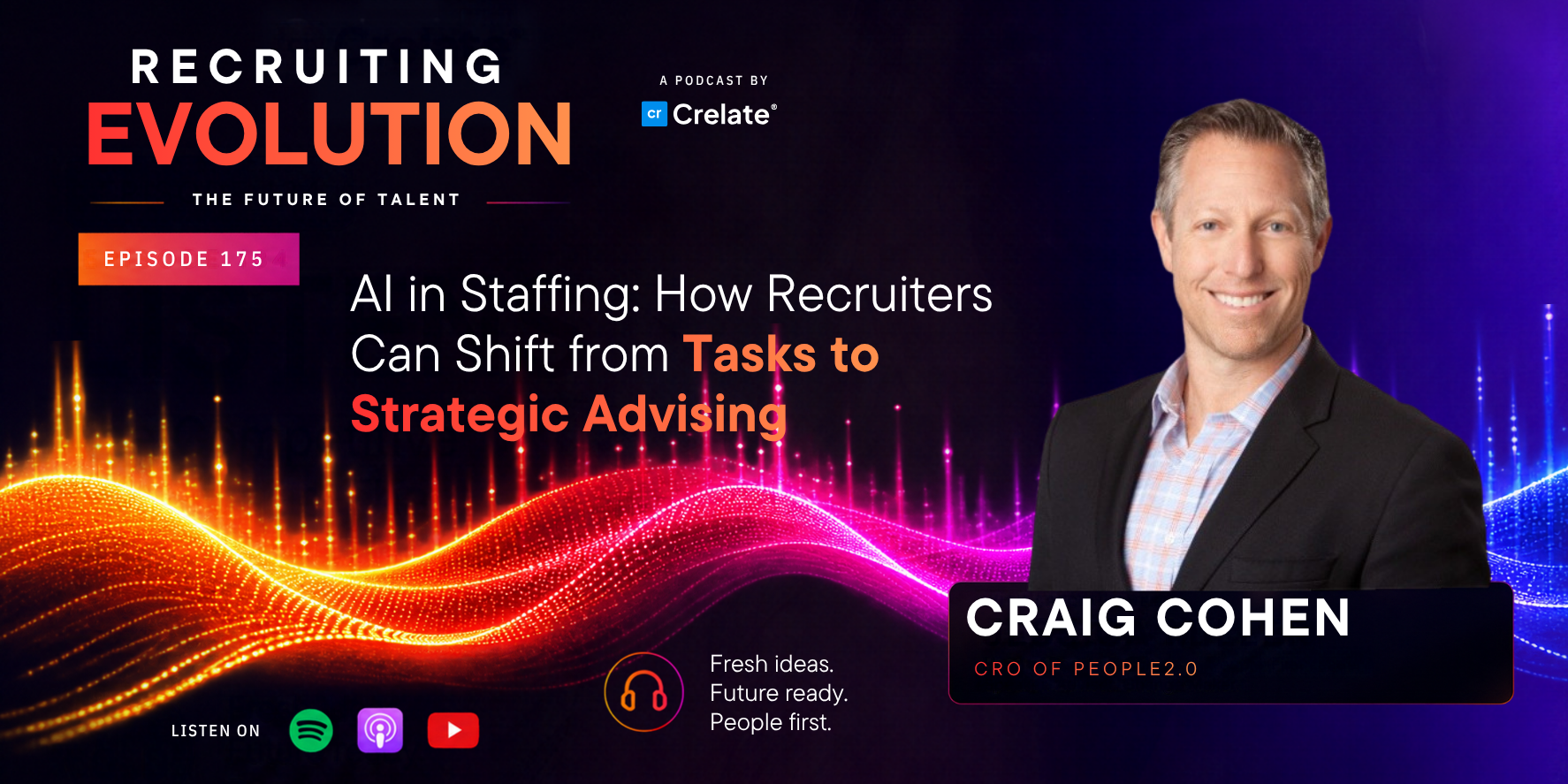
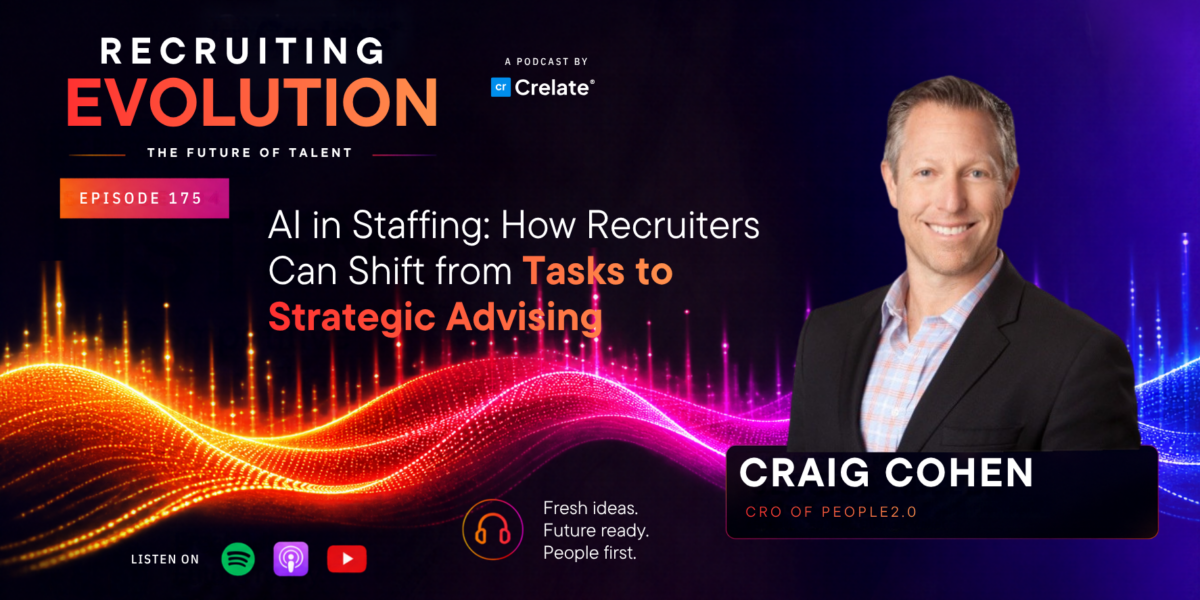
Craig Cohen, Global Chief Revenue Officer at People2.0, joins Kortney Harmon to discuss how AI is changing the recruiter’s role and how staffing agencies can adopt it with purpose. He explains how automation can free recruiters to focus on market insight, client advising, candidate relationships, and business development.
Follow Craig Cohen on LinkedIn: LinkedIn | Craig
Transcription:
Craig Cohen [00:00:00]:
It’s trust is earned. It’s not just given. And so it’s options earned, not announced, right? And I think you need everybody’s buy-in. You need to have everybody, and this goes, if you’re one person to a multiple person kind of agency or recruiting firm, you need to make sure that everybody gives their feedback.
Kortney Harmon [00:00:18]:
Welcome back to a special episode of Recruiting Evolution. If that name sounds new, that’s because it is. The Full Desk experience is evolving, and as our audience, our conversations, and and the recruiting industry have continued to grow, we knew it was time for the brand to grow with it. So welcome Recruiting Evolution, our new name and new brand built for the next chapter of conversations that you already know and trust. And while you see the new look and hear the new name, you can expect the same impactful topics, candid conversations, industry voices, and really practical insights designed to help you stay ahead of what’s coming next in recruiting. The session you’re about to hear was originally recorded as a part of the FDE+, our original event series under the Full Desk Experience. Going forward, those conversations will be live within the Recruiting Evolution brand. New name, new brand, same commitment to moving the industry forward.
Kortney Harmon [00:01:19]:
I’m your host, Kortney Harmon. Let’s jump in with some fresh new ideas, future ready, and creating relationships that fuel growth. Our next session is one that probably hits a little bit closer for us at home here at Crelate, because this guest is not just a speaker. They’re a partner and someone who truly gets where the industry is headed. Craig is the Global Chief Revenue Officer at People 2.0. They’re a global leader and employer of record in agent of record services. And with 30 years in HR tech space and experience building partnerships with companies like Apple, Microsoft, Slack, ADP, Craig brings perspective, both strategic and deeply practical. So in today’s session, he is going to be talking about evolution or evolving recruiter role and what it actually looks like in today’s world.
Kortney Harmon [00:02:15]:
And trust me, this is a conversation that our industry needs to be having more right now because all of our roles are changing and moving and altering with everything that’s happening with AI and all the stuff that’s going on in our industry. So Craig, welcome to FDE Plus. I’m so glad to have you here. I am going to go ahead, I’m going to throw your screen up here. If you need me, the running joke for the entire session was just holler my name 3 times and I’ll be like a bad genie and I’ll come back out from backstage. So you holler for me if you need me. Otherwise, the floor is all yours, sir.
Craig Cohen [00:02:48]:
So, hey everybody. Thank you all for having me. Really excited to speak today. This This is a topic that’s near and dear to my heart, not only because we work with agencies and recruiters, but my wife is actually a recruiter. So all the things I’m gonna talk about today are all the things that I’ve talked with her about, you know, over dinner and while watching, uh, her Real Housewives shows or whatever she watches. And so hope to give you guys some interesting pieces of information, some things you can take away. And hopefully, even though I don’t see any of you or hear any of you, Please put in the chat, however the Q&A works, Kortney. I’m ready and willing.
Craig Cohen [00:03:24]:
I don’t even mind doing it in the middle. So what we’re seeing in this space, just so you all understand what People 2.0, like Kortney said, is we are a global talent company. And what that means is we work with agencies and enterprises all around the world to place people and basically become the employer of record. So we’re kind of hand in hand with staffing agencies. Sometimes we’re confused. We don’t think that we’re A staffing agency, but we’re not. And we have about 1,700+ partners around the world. So I always say we’re one of the biggest companies nobody’s ever heard of.
Craig Cohen [00:03:55]:
We operate in over 130 countries. A lot of those are entities, meaning that we actually have boots on the ground in those countries. And like when we talk to agencies, I’ve got agencies that are single shingle recruiters all the way up to agencies that do $100, $120 million a year in billings. So we’re working with everybody. So where, what are we seeing right now? And I’ve been to a couple shows lately and spoken on numerous clients and prospects. Things that you hear, you all, that’s everybody talking about AI. It’s all you hear is AI. And I think the thing that’s coming out of all this is we’re not quite sure how we’re going to use AI.
Craig Cohen [00:04:35]:
Like we know there’s some certain things that we can, but one, like I guarantee you all, it’s It’s already started happening in Europe. It will start happening in North America. There’s a lot of legalities that will come into play around what you can do with AI, especially with that information and how your customers feel about that. We’ve known, we’ve heard that people are trying things and they’re doing the fail fast forward thing where they’re basically trying things. It doesn’t quite meet the needs. So then they’re tweaking it and they’re trying other things, but everybody’s trying to get a clear plan. And that’s what the point that I really want to get across as I talk about some of these things today. So the recruiter role, like it says here, is being redefined.
Craig Cohen [00:05:13]:
And what that means is recruiters today, the way it used to be is, okay, I’m going to go out, I’m just going to look for a bunch of people. I’m going to bring them in, the best quality people, and hand them over to my client so they can fill their people as quickly as possible. And the one thing that I want to make sure that everybody knows, no matter what all the stuff around AI, The recruiter role is not going away. It’s just going to shift. And what I mean by that is going from like sourcing today, which is going out and emailing LinkedIn, calling, doing all the things you’re doing, what used to be spending a lot of time doing that. Now it’s going to be more about advising about what the talent is that’s going on in the market, right? So the recruiter, instead of spending all that time finding people, AI can do some of that transactional work for you. Instead, now you can go out and become the advisor to the client and basically talk about like what you’re seeing in the market, what the ranges of the pay are, where the talent can be. Like people are starting to really think about talent globally now and not just like, oh, I’m a Nebraska company and I want to hire people in Midwest.
Craig Cohen [00:06:20]:
You can probably find fantastic people around the globe and it’s your job to really now advise them on that type of thing. The other piece then is also the screening, right? Usually, And I can hear it every day with my wife in the other room talking to, she’s talking to people, she’s screening them, she’s finding out as much information about them to really help determine which is the perfect candidate to send over to the client. And now it’s more about, you could do some of the screening through AI and through some of the tools that are out there, but now they’re just spending their time really, I would say, being more of the, like trying to get the candidate through. the process quicker because time loses, right? Like you find a candidate, they’re probably talking to 6 other companies and you’re trying to get them into your company that you’re selling to or put them into place. And it’s your job to really make sure that you’re like the, you know, the conductor that’s bringing them through into the right process and into getting them into your client as quick as possible. And then finally, I think the key is, is after you submit and you get the hire, The companies that are struggling, the agencies that are struggling are the ones that are like stuck waiting for people to come to them for new business. And I think what you could spend time now doing instead of spending time doing the old traditional stuff is really building those relationships and doing more of the follow-up on how the candidates are doing, what’s good, what’s bad, maybe even ask them for references, things like that that are going to help you build relationships and find new businesses. So I think if you just take some of your time that you would do the old school way of doing it and putting that to the AI and taking more of your stuff to the strategic side, you’ll be able to really grow the business.
Craig Cohen [00:08:01]:
So we have a bunch of data. We get it from SIA, we get it from Bullhorn, we get it from a bunch of different sources. We have our own data too. So we know that a lot of companies are spending a lot of time using AI in their ATS. Now, the only thing that I will say when you talk about AI and ATS is just be careful on some of the things around, like when you’re using AI, we’re seeing more and more candidates, especially people around the globe who are pretending they’re the person and they’re applying to a bunch of jobs. And then when they get a bunch of different jobs, they’re actually putting, redeploying other people into that. So I would say just make sure when you’re using the AI and the ATS, That you’re actually doing the right thing and understanding where they are and who they really are and they are who they say they are. But through that, we’re also seeing that because AI is doing some of this stuff in ATS, you’re getting some of your time back.
Craig Cohen [00:08:53]:
And I think that I talk about this in sales all the time. Being a sales guy is what can you be spending on your time that’s most important to you? And I think for all of you, the most important thing for all of everybody on this call and to all my clients is Getting more clients, right? Like, how do we grow? How do we, and not only get new clients, but how do I get more placements within the clients that I actually have? And so reallocation of time is really important. And by doing so, you’re going to grow revenue. And then we also noticed that you’ll be able to fill some of these top performers in a much quicker time fashion. So like I said, if you’re using AI in some ways, And then you’re using your strategic advisory to really coach them and have those great conversations and communication with your clients that the job feels quicker, which when the job feels quicker, it’s good for the client because they’re getting that person the job, it’s helping them do whatever they need to do, but it’s also helping you get paid faster. So all those things put together mold into one great big puzzle. So where are the barriers? And I would say it’s not the options because there are ton and ton and tons of options out there in the market. The barrier’s not the, like what it is.
Craig Cohen [00:10:08]:
I think the number one blocker for everybody is what should I do? How do I prioritize? How do I focus and put these tools in place and put my processes in place to really get to where I need to be? And so my advice to all of you is to sit down. I know it’s hard to do this. Sit down with your team, sit down with yourselves and really put together what the client experience is. So the person you’re selling to and putting people in for, what the worker experience is, and then what your experience is. And having those 3 layers all lined up next to each other, see where the common threads are, and then really decide on what you can automate versus what you need to spend time really how you do it today and maybe a little bit better without the tool. So we keep talking about AI, I keep talking about efforts, I keep talking about the recruiting business and how it’s evolving. Why do they stall? And so I just mentioned this, but what happens is we get all excited in the AI thing. And it’s funny, I had this great conversation with somebody at a conference a couple, probably 3 weeks ago, and they were talking about, we put this in place and nobody’s using it.
Craig Cohen [00:11:22]:
And I questioned this, that instead where I’m like, well, did you put it in place without even talking to your team and talking to the people that are, you know, that this is communicating with, that they’re going to use it and how it’s going to help them? And she said, no, because I know it’s going to help them. And so what I would tell all of you is if you’ve got a team or even for yourself, be patient on what you buy and how you do it. Know what you want to know Know what you want and how it’s going to impact. And by doing that and get buy-in from yourself and from the team that you’re going to use it and commit to it, that’s the first step you got to do. You got to do the process before the tools, always. The second process that we talked about was also like, she was kind of all over the place. She was talking about like, oh, I want to put this in for my ATS. And then she was talking about something about billing.
Craig Cohen [00:12:12]:
And I said, well, what about all the stuff in between? Right? Like, where does that fit in? So, well, what I told her was, you need to map it out. And from there, you need to say, like, how does A affect B to C to D? Because if you’re putting all the people in the ATS and it’s helping you source and find people better, which is fantastic, and you get to the invoicing part, well, what about the middle part with, like, how about communication with the client and that if you’re putting the right people in place, that you’re giving them the right candidates, that they’re doing those things. There are tools in place that you can do to document and communicate better in between that. So I would say keep that process in place. Also, I would say narrow the application, right? And what I mean by that is there’s a lot of things that we can make AI to make it much easier for our people that we’re recruiting. And also for our workers, but a lot of the back office stuff that happens behind the scenes that you got to make sure you’re doing properly, that’s going to still stay manual. There’s a lot of, there’s not a lot of options to yet for that to really change. So I would say narrow your application and stick with the front-facing right now and make sure that it’s not one-person adoption.
Craig Cohen [00:13:33]:
You know, I would say You start with a power user, you get them really, and you get them to buy in. And then hopefully that person then provides you case studies and recommendations. And once they start seeing value from it, then the whole rest of the team will get value from it too. And then finally is it stalls also because there’s no change management. What I mean by that is you put something out there, you say, here’s what we’re doing, everybody, here’s what’s going to happen. And even when you communicate with the clients, Here’s what we’re doing, but you really don’t do it. And especially with salespeople, I have faced this. It takes like 7 times for people to really process things and get it through.
Craig Cohen [00:14:10]:
And so you need to have a change management process in place, meaning like, what do I do? How do I roll this out? How do I make sure they communicate it? How do I make sure they understand they’re using it? How do I inspect that they’re really using it right? And then how do I check the ROI of it at the end of it? And then from there, that will tell you, where you need to keep fixing and making it better so you don’t stall out. Because the worst thing you can do is keep putting tools in and things in place and your business is staying flat and not growing, but you’re spending more money on AI. And you also have unhappy people that are doing things. You don’t want that to happen. What should happen is as you add tools and processes in place, the business should always go up along with it. All right. So I’ve been talking a lot. It’s hard with no questions.
Craig Cohen [00:14:52]:
Classic thing from people. So what do top performers do differently? And so the first is, once again, they start with the work, not the tool. They pick the right starting points and they prove it before they scale it. So once again, I would not roll out something new to all of your clients at once. I would not roll something out if you’ve got a larger staffing agency or a larger recruiting firm. I wouldn’t roll it out to like everybody all at once. You do it in chunks. To iron out.
Craig Cohen [00:15:20]:
It’s kind of like rolling out a new product. You don’t roll it out to everybody because then you get more headaches with people complaining. You roll it out, you get like an MVP or a beta with certain groups, and then you continue to do it. And then you make sure that you go back to those top performers and those people that are using it to be your advocates for the team. Once again, start with the work, not the tool. So if you all haven’t documented how work actually gets done today, The good thing about AI is you can actually like use ChatGPT or Anthropic or any of those tools today to like even say like, what’s the best process possible for my firm? Like, this is who we are, this is who we sell to. And that gives you a starting point. And then you can document how work actually gets done today.
Craig Cohen [00:16:06]:
And I would hit every nitty-gritty from finding to offboarding to everything in between. And then you find out where your biggest time is lost and your quality varies. And then make sure you identify all the frictions of people aren’t going to like this because they’ve got to use this tool and this tool to do the same thing. Well, that’s probably not going to work for you. So find all the frictions, find where all your team is spending all their time, and then try to just hammer on those things. And picking the right starting point. So I mentioned the woman I had a conversation with about hers, like she went from The ATS, AI to invoicing. And then, so we sat down for another like 30 minutes.
Craig Cohen [00:16:45]:
And really what was interesting was her number one pain out of everything was actually collecting the time for the billing. That was, believe it or not, like it was crazy because a lot of her workers, she was doing light industrial, was, was working with people that like do hourly and she’s got to bill the hourly rate. So. She didn’t have a great tool or a good way to manage that. And so she probably had 3 or 4 people that were literally going out and collecting timesheets from people and then following up with them and then following up again and doing all those things. And I told her, well, that seems like to be your number one pain. Like, you should start with that. And it doesn’t always have to start today.
Craig Cohen [00:17:30]:
Start with your number one priority. And then from there, then you start to work your way through. So, and I told her, like, you know, everybody talks about SMART goals, but what I told her is you just need to make sure it doesn’t have to be a total SMART goal, but you really should have like measurable results at the end of the day to go like, okay, we didn’t need 4 people collecting time anymore. I can reallocate 2 or 3 of those people to actually collecting the money, the billings, right? Instead of collecting time. And see where you reallocated and what you did before to make sure it’s all measurable. And then make sure that your risk, that there isn’t a break in the system. So if you have manual timesheets that people are doing, or they’re sending you them via Excel or whatever it is, and now you’re putting a new process in place, you have to make sure that there is no dropping the ball in between. So you might have to do both for the first couple of weeks with a small sample group to make sure that you get, that you implement it correctly.
Craig Cohen [00:18:34]:
And then once again, prove it before you scale it. So it’s kind of like trust, trust and adoption to me are the same thing. It’s trust is earned. It’s not just given. And so adoption is earned, not announced, right? And I think you need everybody’s buy-in. You need to have everybody. And this goes, if you’re one person to a multiple person kind of agency or recruiting firm, you need to make sure that everybody gives their feedback. You come back to them with what you found and then it, how it really impacts their day to day and give them real life wins instead of just like, hey, this is what we’re doing because this is what everybody else is doing.
Craig Cohen [00:19:11]:
So sourcing the submission before and after. So this is some things that we’ve done and we’ve been helping Putting people actually put this into action. So before, usually what happens is when you’re getting the job from the client, you do the rec intake and you do the role definition, and usually it takes a good hour to really dig in and find out what that is. Where now you’ve got tools in place that you can use to gather what the company culture is. You can gather certain things that you can’t get from AI, but the rest of it you can gather like What the comps look like in the market and some role definitions of other companies, what they’re doing with it and some of those things. So you can cut that time down by managing that correctly. Outreach is always a nightmare for all sourcing, right? There are many tools that allow you to contact multiple people through either LinkedIn or even I would call them like AI SDRs for you. That do the outreach, that they’re calling candidates.
Craig Cohen [00:20:14]:
They’re— and by the way, that always is the best feeling for the candidate, just so you know. The candidate knows it’s an AI and they don’t have that personal touch. And so you want to make sure. But what I mean by the outreach messaging is it’s not the how many people are calling or what you’re doing, but it’s the talk tracks you have behind to give yourself a very strong value point of why they should come work for the company that you’re recruiting for. Resume screening, that’s a simple one, right? Now with AI, it’s much easier to do validation, background checks, make sure even on the resume, you hear from your person that you talk to, I don’t want a person that job hops. I don’t want a person that’s been at a job every 20 minutes. You know, they change every year, every 6 months. Don’t do that.
Craig Cohen [00:20:58]:
A lot of the AI tools and ATS tools these days can pull it in, say this doesn’t fit within the ICP of the client. And weed them out. And then finally, the submission write-ups. This is probably my weakest point, period. And my wife will tell you this always is like, I’m a terrible writer. And, but you want to make sure that you have, when you give a write-up to the client about the person that you’re submitting to them, you want it to be valuable and to the point. And we used to spend a lot of time, we’re trying to cover 42 different things with bullet points and You’re really trying to sell them on that write-up where now you can, with AI and other tools, you can really take that and give them what’s most important to them. You just, by making sure you understand from them what’s important, and then from your, from your information, from your interviews, from your screening, which you’re recording, it can actually record, sum up, put it into a nice summary, and actually put it into the write-up to the client without you having to do much in between.
Craig Cohen [00:21:57]:
More of a checkup. So there’s a lot of things you can do to really help speed up your and expedite those processes that are really transactional today. And then finally, this is, you know, I would tell you, I’ll give a little bit of a shameless plug here, but, you know, the back office has to be a part of the equation, right? So like you’re out there selling, you’re out there talking to clients, you’re out there sourcing, you’re out there doing all these great things that you want to do it, but dealing with the backend of collections and making sure the billing is right and making sure that you’re compliant, especially if you’re, you know, you’re in a company that’s placing people in Texas, but now you have a company that wants to place people in Illinois and New York/New Jersey/California where they all have different things. You want to make sure that you have a back office that keeps you in compliance on all those things. And that’s where People 2.0 is, we kind of fit into that. So we have our own tools that we use and AI to help manage all this, but we have a lot of human touch that comes in with that to help you do all this without you having to worry about it. And so for you right now, it takes a long time to get paid by your clients. We know it, we see it, we collect for a lot of our agencies.
Craig Cohen [00:23:12]:
And so if we can get that down, From, you know, a certain amount of days for you to actually getting you paid sooner, that means a lot for you all. And that’s our job is to try to help you all focus on that and take that so that way you get paid quicker to do it, to either reinvest it or to put more money back into the profits of the company. So I think I’m at 30 minutes. I went quick, so hopefully at least time for questions. I’m usually, it’s usually back and forth, but 3 things, take you with you. The role’s changing. It’s not disappearing. Recruiters and agencies, they are going to be here.
Craig Cohen [00:23:48]:
It’s all about adaptation and making sure that you are keeping up with the times, um, having great talk tracks around that. The other thing I didn’t mention in any of this, by the way, is the vertical recruiters and the vertical agencies are having more success than the general recruiters and agencies. So I apologize if any of you are in the general sense, but what we’ve seen in the market is, I mean, if you’re a recruiter and you recruit for anything from tech to light industrial to, it’s very hard because you become a, it’s more of a generalist. We’re seeing the companies that are very specific into a specific industry, like in healthcare, for example, like they only focus on traveling nurses or in light industrial, which is Very, very big right now. If you’re really focused on people that can do electrical for these data warehouses and things like that, those type of agencies are crushing it. And so I would say, like, you know, if you, if you’re really generalist, find a couple of niches, you know, niches in there and then kind of maybe focus on one or two of those too. The barrier is the approach, not the technology. So Don’t do AI just to do AI.
Craig Cohen [00:25:00]:
Don’t put tools in just to put tools in. Make sure that you’re, you know, you’re doing it right and that you, that you have a great process with that. And then finally, last but not least is start small, prove it, and build from there. Don’t do anything massive because it will cause confusion in your company. It will cause confusion with your clients. It’ll cause confusion with the people that you’re recruiting and just make sure you have things really clean before you go out there. So I’m gonna stop sharing and open it up to questions.
Kortney Harmon [00:25:32]:
Anybody have any questions? Craig, do you wanna tell us a little bit more about People 2.0 and anything that you guys are offering or where you’re going right now based on how you’re integrating with everyone with AI, anything else? Because I know obviously our partnership is newer, but just for those people who are like, Is it my time? Do I need something? Uh, let’s plug that while we’re waiting to see if there’s any questions.
Craig Cohen [00:25:58]:
Cool. Yeah, sure. I love that. Thanks, Kortney. So People 2.0 is the way People 2.0 to look at us, these, there’s different aspects of in the, in our business, right? There’s MSPs, there’s staffing agencies, there’s freelance management systems like Uplift and Indeed and like those things, right? There’s all these different. What I’d say about us, and there’s also, by the way, there’s also the people like Crelate that are doing a lot of the front end stuff. And then you’ve got, what I say is we’re kind of the behind the scenes type organization. So whatever tools you’re using on the front end from the ATSs to the communication with the clients to whatever it is, we’re the back office where we just onboard and make sure that we’re collecting all that information.
Craig Cohen [00:26:44]:
And making sure that people get paid right. And we’re keeping you in compliance in the state or the country that you’re in. Like I mentioned, we’re seeing a ton of companies that are like, okay, I’ve run out of opportunities in the U.S. I’m moving up to Canada now. And I don’t have an entity in Canada. What do I do? Well, we’ll be your Canadian entity. You go source it, find the people, the customers, and do all that. And then you send them our way.
Craig Cohen [00:27:08]:
And then we take all, we take all the liability off of you and we take full liability. And it’s like that around the globe. Like we’re seeing a number of UK agencies that are trying to penetrate in the US, but they don’t want to create an entity here. So what they do is they use us as the back office for them and those workers sit under our entity and then we do all the invoicing and then they get their cut on the back end. So that, that’s where I’d say we fit into all of it.
Kortney Harmon [00:27:33]:
I love that. And what a nice thing not to have that hassle. I remember those days. That was wonderful using you guys. So.
Craig Cohen [00:27:40]:
Yeah, thank you. Yeah, we’re, like I said, we’re pretty, it’s surprising because we have 2 sides to the business. If anybody doesn’t know, well, we really have 3. We have one side where we sell to agencies, staffing agencies and recruiters, single-channel recruiters. And that’s where we started. That was our original business. And with that is we’re doing the funding, we’re doing, you know, all the back office. everything.
Craig Cohen [00:28:04]:
But then we went out and we bought the other side of our business, which is we sell directly to enterprises. And we’re selling directly to like Nike and to Warner Brothers and those, and they’re using us for their contingent. We’re not going to compete against like the Deals and the Papayas and those people. They’re spending millions and millions of marketing because they’re looking for more of the perm employees. We focus on the contingent. independent contractor freelancers. And that business is the other side of our business. What our goal is to eventually is to merge the two where then we can take all the agencies that we work with and introduce them as a supplier to the enterprise companies that we work with.
Craig Cohen [00:28:47]:
So I really look at us as like eventually becoming this great bridge for, puts the two worlds together instead of having to always go through, um, an MSP or going through Another source where you get introduced through.
Kortney Harmon [00:29:00]:
Amazing. I love it. And yeah, the enterprise piece. How long ago was the enterprise piece that you guys added that on?
Craig Cohen [00:29:07]:
Uh, we bought Talent Wave, I don’t want to say like 9 years ago, 8 years ago.
Kortney Harmon [00:29:13]:
That sounds about right. That was about the time that I was exiting MRI. So that’s, that I remember. I don’t remember that piece whenever we worked with you guys then. So that makes sense. So.
Craig Cohen [00:29:23]:
We’ve done, I think in the last, where we’ve been in business almost for, I think we just hit 30 years or something like that. Uh, but we, we’ve done in the last like 7 or 8 years, I think 20-something acquisitions globally. So yeah, we are doing about $3 billion a year in billings.
Kortney Harmon [00:29:38]:
That’s amazing. Well, I love it. I think you guys are such a wonderful solution. I know we have mutual clients, so I can’t recommend you guys enough and all the value that you guys bring. So thank you for everything. Thank you. There is no questions as of right now.
Craig Cohen [00:29:55]:
Well, I did my job then.
Kortney Harmon [00:29:57]:
You explained everything thoroughly and wonderfully. I did add Craig’s LinkedIn profile, connect with him. If you need a, would like a direct email or an intro to Craig, feel free to send me a message. I will be happy to connect the two of you as well if there’s any questions there. But Craig, thank you so much for joining us today and talking and talking us through that and giving us insight on people 2.0. Is there anything else that you want to say that I didn’t give you a chance to say?
Craig Cohen [00:30:24]:
No, I appreciate being here. Like Kortney said, we’re— we partnership integration between the two, and we look forward to bigger and better things with the Crelate team and all their clients. So thank you all for having me.
Kortney Harmon [00:30:37]:
Thanks for joining us for this special Recruiting Evolution episode. As you heard, this session was originally recorded as a part of the FDE+ series. But going forward, you’ll find these conversations under the new Recruiting Evolution brand. Make sure you’re subscribed so you don’t miss what’s next, including new episodes, live sessions, industry spotlights, and Recruiting Evolution Express. I’m your host, Kortney Harmon. Thanks for being a part of this next chapter with us. Fresh ideas, future-ready, and creating relationships that fuel growth.