Show Notes
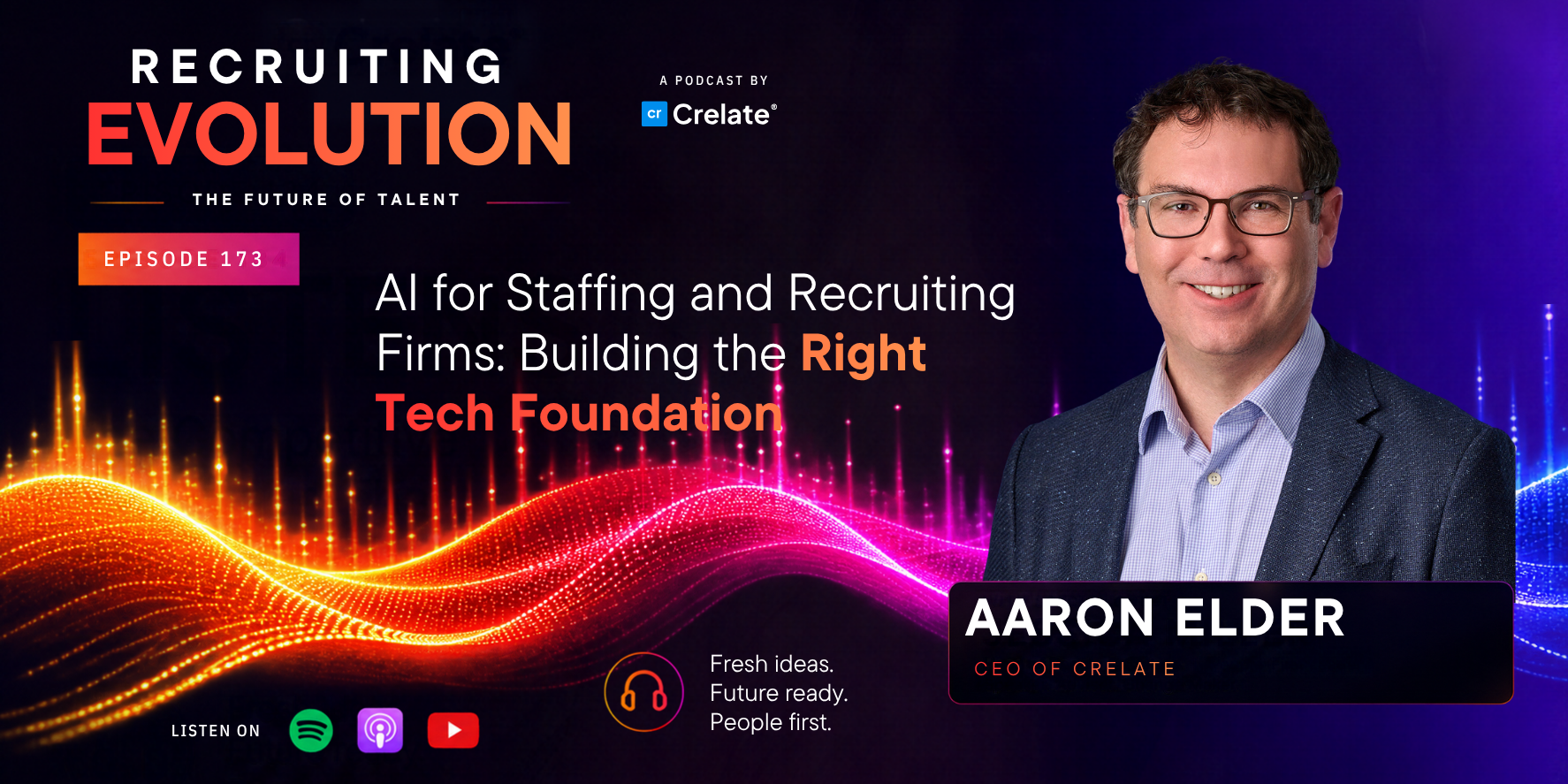
In this special episode of Recruiting Evolution, host Kortney Harmon talks with Aaron Elder, CEO and co-founder of Crelate, about the technology foundations behind AI in recruiting.
Aaron explains the roles of systems of record and systems of action, and how APIs, webhooks, and MCPs let AI agents work with recruiting platforms. They also discuss token costs, agent sprawl, credential security, and why some tasks are better handled by reliable, rules-based workflows than by AI.
Follow Aaron Elder on LinkedIn: LinkedIn | Aaron
Transcription:
Aaron Elder [00:00:00]:
We have deployed Claude internally, and I think our uptake was pretty fast and aggressive. What I have observed is people who were already really successful have become way more successful. So your 10x people are now 30x, right? Like, there are others who have only become 20% more effective.
Kortney Harmon [00:00:17]:
Welcome back to a special episode of Recruiting Evolution. If that name sounds new, that’s because it is. The Full Desk experience is evolving, and as our audience, our conversations, and the recruiting industry have continued to grow, we knew it was time for the brand to grow with it. So welcome Recruiting Evolution, our new name and new brand built for the next chapter of conversations that you already know and trust. And while you see the new look and hear the new name, you can expect the same impactful topics, candid conversations, industry voices, and really practical insights designed to help you stay ahead of what’s coming next in recruiting. The session you’re about to hear was originally recorded as a part of FDE+, our original event series under the Full Desk Experience. Going forward, those conversations will be live within the Recruiting Evolution brand. New name, new brand, same commitment to moving the industry forward.
Kortney Harmon [00:01:18]:
I’m your host, Kortney Harmon. Let’s jump in with some fresh new ideas, future ready, and creating relationships that fuel growth.
Kortney Harmon [00:01:27]:
For everyone else, This is one that I’m looking forward to. You see Crelate, you see it in the corner. I’ve been talking about free trials and all the things that this entire session and the entire event, but I’ve definitely been looking forward to this.
Kortney Harmon [00:01:48]:
So our next session is really inside of Crelate, the AI innovation and the road ahead. And joining us is someone that I now get to work alongside every single day more frequently, Aaron Elder. He is our CEO of Crelate. And honestly, everything that you’ve heard over the past 2 days, the AI workflows, the BD systems, the lean agency models, the candidate marketing engines. All of it runs better when your platform is built for what’s coming.
Kortney Harmon [00:02:13]:
And Aaron is ready to pull back the curtain and show you exactly where Crelate is headed, what’s already in motion, and how AI is shaping the future of this technology in a very real way. So Aaron, with that being said, I am going to hop off. Everyone know that the chat is still open. If you have questions, I’ll jump on to help ask those throughout this presentation. But Aaron. Here is your deck and I’m going to jump off. Do you need anything before I disappear?
Aaron Elder [00:02:39]:
Don’t think so. Thank you so much for the warm intro. So, um, I’m Aaron Elder, CEO, co-founder of Crelate, and I wanted to basically do a brain dump on sort of foundational concepts of how I think about AI in recruiting platforms, which is very much informing how we’re building for the future. And I think it would be useful to all of you as you think about building AI into your businesses going forward. A little bit about me. I’m a serial entrepreneur. I’m actually an art school dropout. I taught myself how to code when the web was taking off.
Aaron Elder [00:03:10]:
I’ve been working for Fortune 100 companies, the NSA, cleared work, you know, since I was 18 or 19 years old. My first startup, which I co-founded, got sold to Microsoft, where I became the lead architect for Microsoft Dynamics CRM, the lead application architect for that. Shipped 3 versions of that. Left to co-found a consultancy, grew that, ultimately sold that, and then went to go build Crelate. And the big idea behind Crelate was a CRM for recruiting a little over 10 years ago. I think you’ll see a lot of enterprise CRM thinking in the foundations of what we do, but always refresh and updated for the latest. And AI is now the latest. So I want to sort of talk a little bit about, well, like, just how we think about AI.
Aaron Elder [00:03:54]:
And so I don’t have a demo here. This is meant to be more educational and foundational and sort of the core thinking. Which I hope helps mature your thinking as everyone’s moving fast on different tools and different agents and kind of slopping it all together. So the first is, is to think about the 2 jobs that, that at the core have to be done well and done right. And so, so there’s 2. There’s one, there’s a system of record. And right now, despite the SaaSpocalypse, Claude and Anthropic and OpenAI, they don’t actually want to be a system of record. There are open source frameworks on the periphery and lots of ways of doing this, but But at the end of the day, they want to be sort of the glue between these 2 things and all the, and all the other things.
Aaron Elder [00:04:36]:
And so, you know, the first thing is your system of record, and this is really your guys’ moat. This is your pile of context, to use an AI term, that is really only the thing that’s you. Like, at the end of the day, everyone has the same database of public records. LinkedIn has, you know, the LinkedIn data. Et cetera, but only you have your collection of candidates and your conversations and your history. And that’s important. And if you make it available to everyone, then, then that’s, that’s your secret sauce. So think candidates, contacts, activities, the history of what’s going on.
Aaron Elder [00:05:08]:
That’s sort of your system of record and ideally your source of truth within your business. The next is your system or systems of action. And this is the reliable way that things get done. A mail gets sent, a series of steps get done. statuses get updated, tasks get created. These are sort of the 2 foundational rocks that you want to get right as you think about all your agents and all your people working with your agents dancing all over, you know, these sort of bottom line things. The thing about this is that in the world of AI, both humans and robots or AI are actually interacting with these things. The underlying system doesn’t actually change, just the interface and the actors in the system change and they got to work together.
Aaron Elder [00:05:53]:
So I’m not sure if any of you have heard this term headless, but this is the direction in which software is going. And no one has this quite figured out yet, but this is also a big part of the SaaSpocalypse is the fact that the sort of traditional old way of software is where you have like your data layer, your business logic and your UI, and the humans talk to the UI and the UI talks to the data and everyone does their little thing. What the headless world does is it fully recognizes that the UI is really just one of many clients sitting on top of the platform. And that can be a mobile client, it can be a web client. That’s also how it’s architected today. But in the future, that client could be an agent and you might interact with that agent via voice, via chat, asynchronously via ideas, but you’re never actually gonna log into the app. But you do need to trust that behind the curtain, the actions are happening reliably, safely, you know, et cetera. And the data is being logged and stored in a truthful way that you can access later.
Aaron Elder [00:06:54]:
I hope that makes sense, is that this headless world is, you might be talking to your recruiting platform via Microsoft Teams or via voice. Your candidates might be doing the same thing. It removes the UI out of the equation or certainly reduces the The, the importance of the UI on a long timeline. One of the challenges with this, or challenges, or one of the things that people who wanna make a lot of money in AI are, are betting on, is that when you replace the UI, which honestly has a pretty static cost structure to it, with this headless approach, you’re consuming tokens at every step in the process. You’re consuming tokens to translate your voice into prompts. You’re consuming tokens for the agent to look at those prompts and make a call. You’re consuming tokens for the call to be executed. You’re consuming tokens for the platform to take the call and convert it into API calls, process that and return it to you and go all the way through.
Aaron Elder [00:07:46]:
It’s a token economy when you’re in this world. And I think everyone’s going to see this as recruiting platforms. And then I bet all CRM systems recognize this and shift towards a consumption-based, token-based recognition of what happens in the cost structure. And so as I think about this from our platform standpoint, we did just launch a new UI. And UI is still important and we want to reduce clicks and all the things. I’m really thinking about the next couple of years and the need for us to get ready for a headless experience. And so with that, the sort of 3 big building blocks that your platform needs to have in order to enable this headless experience in the future will be one, the API. And this is standard table stakes.
Aaron Elder [00:08:28]:
Not every platform publishes these things. I know some platforms are very tight-knit about their API. We’ve always had an open API, but the API is the, is the sort of a doorway in and out for all software to communicate. And I don’t wanna drain the slide cuz I got more slides on each. The next is a webhook. And, and a webhook is also like an API, but it allows a system to proactively push things to other software. Hey, something has happened. You need to respond to that.
Aaron Elder [00:08:56]:
Now, the thing that responds to it might be AI. And then the last thing is MCP, which is basically the AI-friendly doorway. that agents can talk to interact with these 2 things. So for those that don’t know, I’ll just walk through the sort of the building blocks. So the API is the Application Programming Interface, been around since software has been around. It’s basically this contract that the platform agrees to and agrees to not break, you know, over a period of time that other applications can rely on to exchange data. The little analogy that I have going here is it’s like, like the menu at a restaurant. It’s got a predefined set of things you can order.
Aaron Elder [00:09:33]:
And you know that when you order it, you’re going to get exactly what you need on the other side. I want a list of the last 5 activities for this candidate. Here they are. And the whole thing’s built on what’s called REST, and it usually interacts with a syntax called JSON. And at the end of the day, it’s just these JSON blobs going back and forth. The systems talk to each other. In your platform, you want the API to cover a wide set of surface area. of all the things, because in many applications, not everything you can do via the UI, you can do via the API.
Aaron Elder [00:10:06]:
And there’s often very good reasons for that. And partly because when the internal API is only bound to the internal UI, there’s not a lot of stress of maintaining the contract. As soon as you make the API available publicly, you now have to support that contract on an ongoing basis, which can be very challenging once thousands or millions of consumers start hitting that API, if that makes sense. And so companies generally have a sort of a layer cake of what they expose. We try to expose as much as we can, and directionally we wanna expose even more because the more we expose, the more it becomes available to AI to interact with the system without a UI. The next core concept is a webhook, and with an API world, it’s inherently a pull-based world. So you have to write code or have your AI agent write code that at the end of the day is calling into your platform and saying, hey, do this thing or give me this thing. And if you wanna figure out if anything’s changed, you’ve just gotta say, has anything changed? Has anything changed? How about now? How about now? And you just gotta do that every minute or 10 minutes or whatever you choose to pull.
Aaron Elder [00:11:17]:
And that can create Wasted effort in that, but it has pros and cons. There’s advantages to that to that too. But essentially APIs are a pull-based thing. You or your code or your agents will reach out and do something. Webhooks flip the script, and they are a push. And so your agent or you can register with your platform and say, “Hey, when this thing happens, tell me about it.” Now that might sound easier said than done because. The internet’s not always reliable. And so let’s say I try to tell you about it, but your MCP server or your AI is not working today, or it’s backed up, or you’re out of tokens or whatever.
Aaron Elder [00:11:56]:
Then what? You missed the event. And if you missed the event and your entire workflow is based on never missing an event, now you’ve lost data in the flow, right? And so when the platform owns webhooks, it has to have like a retry mechanism with a backoff so we don’t overload your servers and you don’t overload our servers. But then at the end of the day, you might then just go and pull anyway to help refresh anything that you missed in the interim. This is pretty standard tech that’s been around for a long time. When a webhook pushes you an event, it might push you the full payload of what happened, or it might only push you the deltas, the changes that, what happened, or it might just push you an ID, which then you then use to go pull the latest information. And there’s pros and cons to each of those approaches. But that’s just sort of about the overall architecture of how a webhook works and how an API works. The last thing is then what the heck is an MCP, right? So if the API is like the menu at the restaurant, the webhook is like the restaurant texting you to say, hey, your order’s ready.
Aaron Elder [00:12:54]:
Does that make sense? Right? So if I call them, I place an order, and then they text me when it’s ready. Cool. Then I can go to the restaurant and pick it up. Well, an MCP is kind of like a maître d’ at the restaurant, and it acts as like a translator. MCP is basically a standard developed by Anthropic to wrap APIs. So at the end of the day, an MCP is really just wrapping APIs, and it’s doing it in a way that makes the API more discoverable to AI agents. And so it exposes 3 major things: tools, which are callable functions; resources, which are read-only data that you can query; and prompts, which are basically reusable templates. The advantage here, and, and today you can get Claude or, or, or an AI agent to talk to any API.
Aaron Elder [00:13:42]:
It can go read the API docs, it can go generate a JSON call, it can do that. MCP standardizes that process and drastically simplifies it. It also allows for an opportunity for platforms like, like Crelate to optimize the calls to be more efficient for AI. Today, I’ve noticed when Claude wants to make API calls, it’s often definitely not optimized for maximum, you know, for best token usage. It just slams the API and starts calling things like crazy. You see your sessions burn down or your tokens burn down pretty freaking quick. We see a ton of load on the servers because it’s pretty inefficient. When we wrap that in an MCP, we can sort of dictate the language and the tools and the ways in which we want the AI to interact.
Aaron Elder [00:14:27]:
And so we can then guide it to be more efficient. So it’s kind of like having, like, a standard outlet, right? Like, all the different agents can plug into the standard outlet. They can discover all the things they can do. They can agree on the voltage. They can agree on the wattage, and they can go party and be happy. That’s— so those are the 3 big buckets. And so when you think about this and you think about this as your platform, you need a platform that has these 3 things if you’re gonna go build your enterprise or, you know, agentically going forward. It’s just a minimum.
Aaron Elder [00:14:54]:
I don’t think most people want to be in the business of maintaining system of records and system of actions, although there is a belief system in that, and we’ll talk about this in a little bit. But ideally, you want to pay someone else to go maintain all those things and make sure it’s up and make sure it’s fast and make sure it does all the things. And then you want to be able to interact with it because ultimately it’s your data and your secret sauce however you want with your agents. So the main point of this slide is to say MCPs do not replace APIs or webhooks. They are just a wrapper that AI uses to sit on top of them. And so without having a good API, you can’t have a good MCP. And without having a good platform, you can’t have a good API. So the whole stack kind of builds upon itself.
Aaron Elder [00:15:34]:
Now, an MCP is really just a little mini web server that has one endpoint for AI to talk to and one endpoint to listen to webhooks and, and to talk to APIs. You can host it yourself. In fact, today you can, you can have Claude build you a little MCP server. But now you got this MCP server you’re hosting, and there is a very real problem that, that businesses are facing. We at Crelate also seen this problem as we deploy Claude. You’ve got 50 different people with their own little servers running on all their desktops or their own little personal instances of Claude, and it creates this spider web of data and support. And you start thinking to yourself, well, okay, my integration between system A and system B only works because Sally’s computer is plugged into Claude and burns sessions every night at midnight. And what happens if Sally wins the lottery? Is this even documented? Does my whole, does my whole company grind to a halt? And you times that by 50 Sallys, and it’s, it’s kind of crazy and actually should be quite stressful to anyone who has to Manage a business or certainly an IT department on top of this.
Aaron Elder [00:16:43]:
But today you or your provider can, can host the MCP. I think ideally you want to be in the business of not hosting MCPs and you want to push that to your provider so they can at least manage that one layer. Doesn’t mean you still have to deal with all the AI agent slop sort of on top of that. I hope this is making sense to people. Please jump in if you have questions along the way. And of course, in this whole equation, you’re burning tokens at every single step. And I bring this up because today, right now, tokens are heavily subsidized as lots of money flows into AI and et cetera. There’s a very real world in the future where tokens are not so subsidized and the price skyrockets.
Aaron Elder [00:17:21]:
And so as we think about building software, we don’t feel that we need to bring tokens to every single step in the equation. Although that is certainly what, you know, the people at Claude would tell you, AI all the time for everything. I don’t think that’s wise on a long timeline. I think it’s AI in the right spots at the right time. And we’ll talk about that in a second. So reiterating why MCP matters, APIs are built for developers. That developer could be Claude. And MCPs are built for agents.
Aaron Elder [00:17:48]:
MCPs are ultimately a wrapper around the API. They work hand in glove on a go-forward basis. And all of that is built on your system of record and system of actions on which to keep it all safe and keep it all yours. Okay, let’s talk about tokens for a second. I don’t know how many times this has hit yet, but I guarantee you we’re going to see headlines of companies that went bankrupt because of uncontrolled token usage. I’ve seen some, some incredible horror stories. There was a startup where the AI agent blew away their entire production database, like all of it and the backups. I don’t know if anyone saw that about 6 weeks ago.
Aaron Elder [00:18:21]:
There was that one company that got a surprise half-million-dollar bill from their Claude usage. That was a couple of weeks ago. This stuff’s not free. And you really need to be thinking about this as you design your AI enterprise on a go-forward basis. You also need to think about the controls and, and how you’re going to sustain whatever you guys build, right? It is super awesome that your VP of finance was able to like knock out some cool tool or that your head of IT can knock out a tool. But what happens if they win the lottery and now this thing is just, no one even knows. It’s some undocumented magic that was just running in the background in some cloud instance. You really got to sort of think about that.
Aaron Elder [00:18:58]:
I think 2 ways to think about that are, one, how much can you push into platforms? And 2, there are products out there that are designed to centralize the management of these, these sort of Claude ongoing tasks and things. You should look into those as well to sort of centralize them off people’s individual instances. Ultimately though, good design means fewer tokens and less latency and, you know, and all the various things that you want to have. So be thoughtful as you move forward into this bold future. Some things, and this is true all the way down the stack, only asking for the fields you need. So if you ask it for every single contact and your contact has 500 fields and the AI is only going to use 5 of them, you’re paying for the token processing of all the fields. Right? Like, it has to look at every single thing all the way down in order to suss out your thing. If you can be more narrow in what you give it, you’re way more efficient.
Kortney Harmon [00:19:56]:
Surprise! There’s a question from Kurt. I don’t know if you saw it. It says, companies are trying to determine what the new normal is. Does a 10-time SW engineer who blew through $40K in a week mean that that’s the new normal? And how do you control and measure it?
Aaron Elder [00:20:11]:
That is a good question. We have deployed Claude internally, and I think our uptake was pretty fast and aggressive. What I have observed is people who were already really successful have become way more successful. So your 10x people are now 30x, right? Like there are others who have only become 20% more effective. An interesting conversation, and I’ve seen this out of the business too. And I actually, I was part of a panel discussion a couple of months back where this topic really came up is that I think what holds people back is that they need to reinvent how they approach the problems. I’m a lifelong developer. I’ve, I’ve written code almost every day, right? But I haven’t written a line of code since I set that deployed Claude.
Aaron Elder [00:20:50]:
My job’s changed, right? I’m now using Claude like a, like a junior man, you know, as a junior dev, and I’m passing it out really fast to go do various things. So does a 10x software engineer who blew through 40,000 credits a week mean that’s what’s normal? I don’t know. We currently use session-based plans, not, not actual token-based, based, based plans. Um, so, so I, I don’t have a direct thing. What I have found though is that inefficient people are able to be inefficient at scale with AI very quickly. And I somehow have been able to literally 3 to 5x my, my throughput and not hit the limits within my session variables. And so I think there’s something there. There’s something to the fact that being efficient with tokens and being efficient with the tasking.
Aaron Elder [00:21:36]:
is an actual skill in and of itself. It’s beyond prompt engineering. I might call it project management and project architecting, breaking projects down into smaller discrete chunks that don’t require massive context windows to go through each iteration. I’ve also, as a developer, not been afraid to just take the wheel when— how do I say this? I’ve seen people just literally fight with Claude all day, which is basically just burning tokens. It’s like, dude, just jump in there and debug it. And then you give Claude a hint, and suddenly you’re back on track. Or I gotta open up, you know, dev tools and highlight some class, because at the end of the day, I can recognize, because I’ve been managing devs my whole life, when Claude is just guessing, and guessing is just burning tokens. And so I’ve gotta break the guess loop, And so then I will just give it a hint.
Aaron Elder [00:22:31]:
Hey, look, we’re looking for this class or this variable or look in this file, and it’s back on track. So I think there really— I hope that answers your question, Kurt. There’s definitely something to being efficient with AI on a go-forward basis, both as you use it and as you architect an ongoing solution. Cool. Great question. Summarization, another big thing. Actually, something that I do all the time. I will often compact or reset my context window.
Aaron Elder [00:22:54]:
To narrow it. People have a bad habit of leaving these mega chats open. The same can be true with, with MCP and agents. You don’t need a mega chat every single time you want to answer the next question. And then lastly, being very sort of clear at SMMA is that sort of break it down into smaller discrete things so that you don’t require massive context windows to achieve the task. There’s been this a lot of talk about like, what, what is an AI-native platform? Like, And I kind of think it’s almost like kind of BS, like AI native just means that you have this toolchain mindset applied to your problem space. You still need a traditional data storage API layer platform, but alongside it, you need an actual agentic platform, which is basically just a connection of really small tools, breaking things down into small steps. With checks at each level so that you can efficiently at scale handle these things.
Aaron Elder [00:23:52]:
Lastly, and we’ll talk about this in a second, not every single thing needs AI. And that’s a pretty important thing that I would love to plan with y’all. AI with free rein, got to be careful. There are horror stories where this happens. And the thing about it, it can do it at the speed of machines. Humans can only click so fast and hurt the data so fast. The AI can fly right through it. Mass delete records, mass delete people in your database, mass, you know, exfiltrate the data, like a lot of things there.
Aaron Elder [00:24:23]:
And so some best practices around this is credentialing. And so right now we’re doing major upgrades to our API, and, and a big part of that lift is around credentialing. Right now, the state of the art is that you just go into your system like HubSpot or whatever, and, and you just create a key. And that key is you. And then you say, hey AI, use this key to connect to HubSpot and do your thing. As far as HubSpot is concerned, that’s you doing it. There’s no difference. And it has every right that you have.
Aaron Elder [00:24:55]:
A lot of people on this call are probably owners and operators, and that means you’re probably admins, which means that when you give Claude access to your HubSpot or your Crelate, you’re running as an admin. Right? Which means that if the wrong thing happens, it’s happening as you, the admin, and you can do anything because you’re the admin. Right? And so in the future world, you want to think about an architecture that allows you to create keys for specific purposes and have more narrowed scope and availability. And so our next version of credentials will allow you to do, like, read-only keys, for example, and specific keys for individual agents. Right? So, hey, this key is only used by my Claude finance agent, and it can only read data because its job is to pull reports. Make sense? And then when the system audits the access and, and looks at all the things, you know that that traffic and those things were happening from that. And you also know that worst case, it only ever read data and only for these purposes. And so basically what I said right here.
Aaron Elder [00:25:52]:
So you, you wanna have a, a system that allows you to create more granular keys and control access to those keys to help you contain the blast radius. Keep track of what’s actually happening and, and to control the future. If something’s going wrong, you can just turn off that one key without having to turn off your entire API. General best practices, you wanna have your keys have limited rights and, and something to get limited rights, you know, etcetera. Let’s see here. Trust but constrain, get the upside of it. I’m basically gonna reiterate. So I hope this makes sense to everyone.
Aaron Elder [00:26:21]:
Like, like, I would imagine from a show of hands, people that are connecting Claude to your systems right now, you’re probably doing it with your credentials. or your keys and just understand that, that, that there’s risk in that, right? It’s running as you and the audit logs will show that it came from you. So you really can’t differentiate as to what, what, what, what went on. In the future, you’re gonna wanna have dedicated keys with least privileges and audits and the ability to revoke, right, on a per-agent basis, you know, in your platform. Shadow IT or AI slop are 2 words that I’m seeing thrown around a lot as people worry and think about their AI architecture. So the problem statement is, is, and I, and Kortney, I do see a question. I’ll, I’ll come back to that in one second. Is this sort of AI agent sprawl, which I talked about before, but I wanted to give you a few more points on that.
Aaron Elder [00:27:06]:
Sort of ungoverned use of agent where each person is wiring up their own thing their own way. And it’s just on their desktop. Like, it’s actually pretty crazy if you actually build your, your enterprise operating system on this patchwork of things. We actually had a job running where it was a synchronization between something and something. I forget what it was, but then the developer who was supposed to run it, you know, was sick for a week and he just didn’t run it. And like, like all the wheels, it’s like, wait, what’s going on here? And that was just for someone who was like sick for a few days. Things didn’t get run at the right time and no one could access his machine. And so it’s like, is that how you want to build your business? And I think the answer is no.
Aaron Elder [00:27:44]:
So you really got to think about centralizing these things, at least things that are mission critical. For you. When they’re all decentralized, you also have no visibility into what’s going on. You don’t really have a good understanding of token usage or what they’re actually doing. Credentials are all over the place. If someone gets locked out, if someone gets hacked, right, that becomes very dangerous too, because now they’re logged in as this person and it’s sort of sprawling throughout your system, and it can be a lot of duplication of work. In the future, you know, I think it’s really important to let people experiment and play around and try things. But you’re going to want to have mission critical processes get centralized.
Aaron Elder [00:28:21]:
You’ve got to talk with your team, bring these things together, and figure out how to centrally manage them for things that are mission critical to your business. Absolutely. They can be centralized in your recruiting platform. They can be centralized in third-party platforms. They can be centralized with your IT department if you’ve got that level of people, but you just want to really think about this on a go-forward basis. I guess another sort of nightmare scenario you can envision a year from now about how whole businesses crawl to a halt because so-and-so left and they had all the keys to all the things and no one knows how it works and, and you’re kind of just dead in the water. Not everything needs to be AI. And before I said that, let me reply to the question.
Aaron Elder [00:28:59]:
Kurt said a rules-based engine based on profile function, much like an ERP. Oh yes. Thanks, Kurt. Totally. Not everything needs to be AI. Sometimes when all you have is a hammer, everything looks like a nail. You know, I think we’re very much in that, that, that euphoria right now with AI. A few things.
Aaron Elder [00:29:16]:
It’s funny, it’s kind of catch-22. AI is really good at automating very deterministic tasks because they’re deterministic, but also deterministic tasks need to stay deterministic. And what that means is that like, you need to know that when A happens, B happens every time. You’re not interested in hallucinations or interpretations. or frankly burning tokens for A to always result in B. And so you don’t always wanna bring AI to every single scenario. And if you think about it, like, if your only goal is to bring data from Crelate into HubSpot, you’re not really interested in AI’s opinion on the way through. You just want the data to always go from field A to field B.
Aaron Elder [00:30:03]:
Now, you can use AI to sort of help you build the infrastructure, but ultimately behind the scenes, you wanna result in a kind of an old-school way of doing it, kind of boring sort of way of doing it. And that still has a place in the future. And so just think about that as you think about architecting AI solutions. Throwing an LLM at every problem adds cost, 100%. And by the way, not every task needs to use a frontier model. And I guarantee all of you over the next couple of years, AI caching layers and AI waterfalls will be real big problem spaces that people do. The initial problem goes to a frontier model at $50 per million tokens, but then it is only used to summarize the problem into smaller problems, which go to a, a lower-end reasoning model or a non-reasoning model entirely. And then it gets passed down to, you know, a purpose-built model.
Aaron Elder [00:30:56]:
Makes sense? And then you cache results at each layer to minimize token usage and to use the right model at the right time. AI-native architecture inherently adds latency to the overall process. That’s not always a problem in all things, but I have found that it is a mindset shift that people need to get used to. I’ll give you an example. As we think about AI search, there is this perpetual desire to always have all the results of like your data and external data all come into one single sheet of glass that a recruiter can look at. But if you think about it, that’s really based on this sort of like Google search, LinkedIn search mindset. It’s not based on an agentic mindset, where an agentic mindset, what you wanna do is give it a criteria and have an agent asynchronously work through and do a reasoning step at each evaluation point, and then bring you a curated set of things. That entire process is inherently asynchronous, and all agentic architecture is inherently asynchronous.
Aaron Elder [00:31:56]:
Toolchains are slower. And they’re designed that way. And so then you wait a little bit and then the results come back, if that makes sense. That may not be what you want. You might just want to copy 10,000 records from point A to point B. And if you want to do that with no latency, old school is the way to go. And then lastly, predictability. Again, where do you want LLM, the potential for hallucination or interpretation and non-determinism to hit? And if none of those things provide any benefit, don’t use AI.
Aaron Elder [00:32:24]:
Use something else. So there’s still a place for the traditional toolbox in all these things. And this is where the market hasn’t quite figured out what’s going on with this, with this SaaSpocalypse. Like, there is a place for traditional. It is definitely wrapped in a blanket of AI, and it definitely has AI internally, but you still need deterministic API calls, polling for guaranteed data syncs, like zero loss, no, you know, internet hiccups from webhooks, and frameworks and things to make all these happen. So choosing the right tool, I think ultimately comes down to what kind of tasks you’re trying to do and how much tolerance for latency, cost, and non-determinism you can take within it. I think ultimately they’re going to work together and that any business is going to need a platform that is forward-thinking on these things and enabling you guys to sort of AI on top of it, you know, all day long. Like that’s the future of software.
Aaron Elder [00:33:14]:
In closing, just want to make sure everyone’s building the right engine for their business and that you think about it that way. So you want a solid system of record and system of actions where you’re going to store your context, store your data, store your secret sauce. You’re going to want a forward-thinking platform that exposes everything that you’ve stored as an AI-first, webhook-first, MCP-first, headless mindset so that you guys can bring agents, either your agents, third-party agents, to do the work in and on the system of action. You want to be very thoughtful about optimizing token usage and bringing the right tool to the job. You wanna be very thoughtful about security and creating a sort of an AI shadow AI infrastructure for yourself. And then you wanna use AI where it makes the right, the right, like, use AI wherever it’s earned its place, not everywhere. You gotta use your judgment. With that, I will open up the questions.
Aaron Elder [00:34:05]:
We’re almost right at the 40-minute mark, which is what I scheduled.
Kortney Harmon [00:34:09]:
We were betting, people, that we would have been right on it. I love it. Does anyone else have any questions for Aaron? This actually has been a question as we kind of talk through this. Yesterday it was a concept of asking about Crelate’s MCPs and those kinds of things, I guess. So do you want to talk about that at all? And like the capacity of our roadmap, because I know that was a question yesterday by Chris. I don’t know if he’s even— or she’s on here right now, but it was just asking the question about our MCPs and what we’re developing with those connectors. Can you talk about that at all?
Aaron Elder [00:34:43]:
100%. So, I mean, what I just laid out in this presentation is our roadmap. Like, I intend to be a part of the future of software and to survive the SaaSpocalypse. And in my, my mind, it is a foregone conclusion that we need to be prepared for a headless architecture world. And so we need to be a really awesome system of record that is safe and yours and you’re in control, that then fully exposes it to you. We need to be a really awesome system of action that lets you do all the things you want to do. Or if you do them outside the system, though, you can still log them, but then again exposes them in a way that your AI agents can go party on. So this is our roadmap.
Aaron Elder [00:35:21]:
We have always had an open API. We perpetually work on performance and trying to make it faster and better for people. We, we sort of try to have a pretty wide scope of what people can do with the API. And that’s probably one of the most common things that we’re always adding is more ways to interact with it. We just did a big UI refresh. We built a new UI, or at least big parts of it, on Unified API. which has a whole new system for us to more easily expose things to the customers. We are actively building our MCP servers right now.
Aaron Elder [00:35:49]:
I mean, customers have already built their own. I don’t think they want to be in the business of hosting these things. It’s just one more piece of plumbing you got to have on some guy’s desk somewhere. So we’re going to offer a first-party MCP server, and then we’re going to update our API to be optimized for the calls that are going through it. We should have an alpha of it in the next month or so. We’ll be betaing it later in the quarter. So that’s happening right now. Our Webhooks V2 is in development right now, again, with a more AI thought process on it.
Aaron Elder [00:36:18]:
Credential V3 is coming out. All this is happening right now. This is our active roadmap.
Kortney Harmon [00:36:23]:
I love it. Kurt asked the question, and I know the story, but I’m gonna let you tell the story. How did you come up with the name Crelate?
Aaron Elder [00:36:29]:
Funny thing is I didn’t come up with the name Crelate. Mark Bear, my, my, my co-founder did. And I don’t know what— he’s like, I was on the Metro in DC, and it just came to me. I, I think it was his short story. But the word comes from create relationships. So at the end of the day, that is the heart of talent and the heart of recruiting is creating relationships. And then the entire goal of the platform is to enable that throughout society. Because ultimately, I believe that when people in business align for mutual benefit, great things happen.
Kortney Harmon [00:36:57]:
I love it. Any other questions? I know Aaron has it up here, but I’m also putting it in the chat. You can start your free trial of Crelate. There’s a link there. So feel free to do that. And then if you haven’t, connect with Aaron. I included his LinkedIn profile here. I’m sure he would love to connect with you and hear from you.
Kortney Harmon [00:37:15]:
So please connect with him as well.
Aaron Elder [00:37:18]:
Pleasure. Thank you so much. I hope this was educational, informative. I wasn’t trying to do a sales pitch. I’m trying to sort of educate everyone on sort of the foundational building blocks to think about as you guys move forward with AI in your businesses.
Kortney Harmon [00:37:30]:
I think it was wonderful. Aaron, I appreciate you. And then for everyone here, I will go ahead, if there’s any other questions, we’ll be here, but then I’m gonna leave you guys and then we’ll start again at the top of the hour. So, go grab some lunch, go grab some caffeine, whatever you need, and we will start again here in a few.
Aaron Elder [00:37:48]:
Cool. Thank you, everyone.
Kortney Harmon [00:37:52]:
Thanks for joining us for this special Recruiting Evolution episode. As you heard, this session was originally recorded recorded as a part of the FDE+ series. But going forward, you’ll find these conversations under the new Recruiting Evolution brand. Make sure you’re subscribed so you don’t miss what’s next, including new episodes, live sessions, industry spotlights, and Recruiting Evolution Expresses. I’m your host, Kortney Harmon. Thanks for being a part of this next chapter with us. Fresh ideas, future ready, and creating relationships that fuel growth.