
Show Notes
Transcription:
Greg Fischer [00:00:00]:
So when you’re sitting down and saying hiring people are the bottleneck in my business, I don’t have the bandwidth, my team doesn’t have the bandwidth. This is where I like to start. Is it a recruitment issue and I need to add more recruitment capacity? Am I doing too much recruitment and I need to hand that off? And then where is that? Is it just simply sourcing? We’re not touching people, or do I actually need somebody on the phones? The biggest recommendation I have is don’t take one of these functions, a sourcer, researcher, appointment setter, and try to combine it with an admin assistant. You’re going to end up with somebody who’s not very good at anything. They can check off the boxes, but they’re not going to be a high performer.
Kortney Harmon [00:00:35]:
Welcome back to a special episode of Recruiting Evolution. If that name sounds new, that’s because it is. The Full Desk Experience is evolving. And as our audience, our conversations, and the recruiting industry have continued to grow, we knew it was time for the brand to grow with it. So, welcome Recruiting Evolution, our new name and new brand built for the next chapter of conversations. That you already know and trust. And while you see the new look and hear the new name, you can expect the same impactful topics, candid conversations, industry voices, and really practical insights designed to help you stay ahead of what’s coming next in recruiting. The session you’re about to hear was originally recorded as a part of the FDE+, our original event series under the Full Desk Experience.
Kortney Harmon [00:01:26]:
Going forward, those conversations will be live within the Recruiting Evolution brand. New name, new brand, same commitment to moving the industry forward. I’m your host, Kortney Harmon. Let’s jump in with some fresh new ideas, future ready, and creating relationships that fuel growth.
Kortney Harmon [00:01:52]:
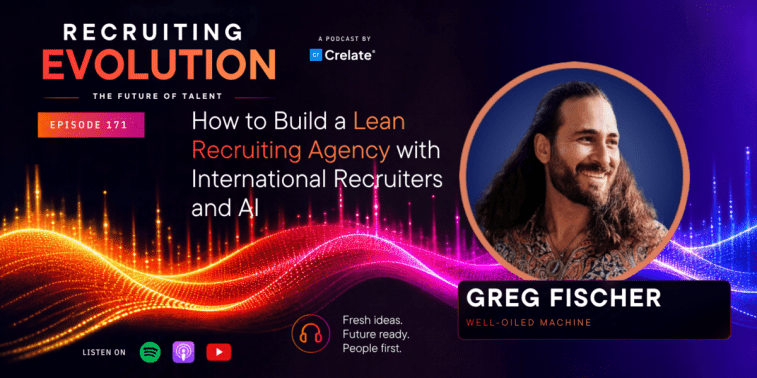
We are obviously going to close out day 1 with a bang, and I could not be more excited about this session. Greg is the founder of The Well-Oiled Machine, which is an agency that helps recruiting firms hire top talent across Latin America, Africa, Asia. His session, the title says it all. It’s The Lean Agency: International Recruiters+ AI+ Onshore, 130% Increase in Profit. Let that sink in, uh, 130%. So Greg’s gonna break down exactly how to combine US rainmakers, AI, international recruiters to a model that really works. Super excited. This is a main conversation that I’m hearing across many organizations and agencies.
Kortney Harmon [00:02:37]:
So, Greg, thank you so much for taking your time to spend with us this afternoon, and I’m gonna leave. The floor is yours. I’m gonna jump off. If you need me, holler for me. Uh, the running joke this today has been, if you say my name 3 times, I’m like a bad genie. I’ll just pop up outta nowhere and I’ll come and say hi and help you in any way that I can.
Greg Fischer [00:02:55]:
Okay, fantastic.
Kortney Harmon [00:02:56]:
All right. Have a great session. Thank you so much. Cool.
Greg Fischer [00:02:59]:
Thank you. Okay. So to give a little context on who I am before we go into this. So prior to launching Well Oil Machine, I was the first recruiter hired at AMI Network. We were a direct hire healthcare recruitment firm. I think our first year together, we did a quarter million dollars, itty bitty bitty little agency. Over the course of 10 years, we built something that I’m incredibly proud of. In our best year, we did $4.2 million in revenue.
Greg Fischer [00:03:26]:
$1.4 million in profit. I became a minority owner in the agency. And a big part of how we were able to scale and scale very profitably was the combination of onshore team technology and 18 international team members in Latin America and Asia. So I have firsthand experience building some of this out. I eventually ended up leaving to launch my own agency, Well-Oiled Machine. Really to help other agencies replicate that magic. Our expertise is on helping agencies hire international recruiters, admins, salespeople, et cetera. I’d like to think I know a thing or two about AI.
Greg Fischer [00:04:06]:
And so we’ll talk about that a little bit, but we’re going to be geared a bit more on the building your team internationally and what that looks like as we get into this. So let’s start things off. And by the way, There will probably be a ton of questions that come up. Drop those in the comments. I definitely want to save some time in the end to be able to go into that and no questions off limits. I know some of these can be pretty hot topics. So I want to start with the legacy agency model. This is what agencies have more or less looked like for 20, 30 years or so.
Greg Fischer [00:04:40]:
So historically, legacy-based agency is entirely US-based. Everybody from the owner the recruiters, et cetera. There’s some big pros to this. Even today, you can have in-person client relationships, which is huge, including going to conferences is very easy. You can be in office together, which creates really great team building and learning opportunities. English is never a question. You have also great cultural alignment. Everybody’s going to be speaking the same language and have a lot more in common.
Greg Fischer [00:05:09]:
Now, some big downsides with purely international teams, you’re not using a ton of AI, you don’t have international colleagues, are the cost. So today more than ever, US-based employees cost a lot, and retention. The reality is, is that if you have a 180 recruiter, this is a B job. They’re not going to be making several hundreds of thousands of dollars a year in income. And on the flip side, if you have an A+ 360 recruiter, They’ll often question, why am I staying here? Why not go on my own? So, um, it becomes very difficult to retain great employees in the US. And these are some of the problems that we see today. When we see the way this shakes out, I wanted to give the example of a $3 million agency where the owner has removed themselves from the day-to-day business, which is not the dream of every owner, but it’s the dream of a lot of owners. This is taken from live examples that I’ve seen with a lot of agencies.
Greg Fischer [00:06:05]:
So in this case, the owner has removed themselves. They even have an admin to help out with the not so fun stuff. They have 4 Rainmaker 360 recruiters who are bringing in the business, and then a team of 180 recruiters underneath them. These are using industry standards when it comes to revenue, and we’ll unpack what that looks like. But this is a very successful agency. Probably top 0.5% of agencies can get to this level where the owner removes themselves and they’re bringing in that kind of revenue. So it takes a lot of work to get there. What does the owner get for that work? So let’s break it down.
Greg Fischer [00:06:39]:
Each of those pods of 4 is doing $750K in placements to be able to get to that $3 million. There are agencies out there that do higher than that. Some of you are like, oh, I have a pod that should be doing $1.5 million. That’s great. That does exist. There are also a lot of teams that do far less than this. This is in line with the standards that most agencies aim for. Now, when it comes to Some of the costs we can see right here, your admin, it’s going to cost about $75K.
Greg Fischer [00:07:07]:
Your 360 recruiters are going to be around $200K, 180 recruiters closer to $100K. You’re going to have some tech costs here, usually about $10K per recruiter per year. Throw in a little bit of miscellaneous. And then because these are all US-based employees, add in a nice 33% burden when it comes to Taxes, benefits, workers’ comp, all that good stuff. So that owner has spent years building a very successful agency that more or less runs itself. What do they get for that? $600,000 a year in revenue, which, hey, if you’ve removed yourself from a business and it can bring in $600K, that is a really good— it is very, very good thing. Now, what I also want to share is what it can look like with What I would call the lean agency model. So what the lean agency does, instead of saying we are going to be very labor focused, we’re not going to be super tech forward, we’re all in the US.
Greg Fischer [00:08:02]:
It has 3 pillars. So you still have your onshore team. These are the ones where they’re owning client relationships. Again, it’s going to be AI certainly can’t own a client relationship and your international team is often going to struggle owning client relationships. I have seen it work in select situations. AI is going to be doing a lot of the heavy lifting with sourcing, research, even outreach. Claude, Pin, and CoRecruit are all good examples of these, but there are many more. And then you have an international team that handles the delivery side, the recruitment side, doing the research.
Greg Fischer [00:08:38]:
LATAM, Africa, and Asia, specifically the Philippines, are great for those functions, which we’ll continue to dive into more. So what does the lean team look like? So we still have that owner sitting at the top. They’ve removed themselves from the day-to-day business. Now they’ve upgraded from an admin to a chief of staff. A lot of people ask me, well, what is a chief of staff? A chief of staff is a second brain. Whereas an EA, you might say, hey, I need you to send out these invoices. A chief of staff, you would say, I feel like we have a lot of accounts receivable that are late. I want you to come up with a new process To reduce our time to collect money from our clients.
Greg Fischer [00:09:18]:
So we have a higher level talent. You’ll see what the cost looks like later. They’re based in the Philippines as an example, 3 360 recruiters. And you’re going to ask, well, how are we getting to that? And we’ve been able to beef them up. So we still have those 2 180 recruiters. They’re going to be based in Latin America. We’ve now added a researcher behind them. So somebody to do sourcing, somebody to do business development research.
Greg Fischer [00:09:41]:
So those 180 recruiters and 360s have a bit more research. And then we’ve added various AI tools. Again, you’ve heard a lot about AI today. I’m not going to be going super in depth into what those tools are and how to maximize them, but this is where you’re bringing in your pin.coms, you’re using Claude Cowork. There’s a million and one ways that you can get more out of your team if you’re investing in those tools. And with that, and again, these are actual numbers that I’ve started to see from agencies. We’re now able to bump up 25% increase in productivity. By the way, for context, at my last agency, when we added an offshore recruiter to support our US-based recruiters, and we did 1 offshore recruiter per 2 US-based recruiters, we were able to increase their production 25%.
Greg Fischer [00:10:27]:
So you might say, oh, like these are just kind of pie in the sky numbers. I’ve actually seen it happen firsthand. The costs are going to be very, very different here. So. Our chief of staff is $25K versus a $75K EA. So we’re spending less and getting more. Our 360 recruiters, we’re actually going to be paying more for here because they’re going to be producing more revenue overall. We have our LATAM-based 180 recruiters.
Greg Fischer [00:10:53]:
In this case, we dropped that cost from $100K to $60K. And by the way, we need less because we’re getting more out of our team. Great researcher in the Philippines will cost you $20K. You can do less, but it’s pretty easy. I’d rather spoil a team and overpay them. You know, we’re adding in some additional cost here on the tech side between the different tools that you might bring in. You are going to add, call it another $10K per team. We still have our, our other recruitment technology, our ATSs, our LinkedIn seats, and our miscellaneous costs stay the same.
Greg Fischer [00:11:26]:
Our employer burden goes down. Because that only applies to our US-based team. We don’t have to pay taxes, workers’ comp, benefits for the most part for international staff. And so when you break it all down, the profit margins are wildly different. So we go from a $600,000 profit to a $1.3 million profit, hence the 130% increase. What does that mean? Well, if your goal is to have a business generating $1.3 million in profit that runs more or less without you, that’s what you’re aiming for. If maybe your goal is less, you can stop at a smaller agency now and it takes a lot less work to get there and it’s a lot easier to get there. So this sounds great in principle, but why aren’t all agencies on this model? There’s a lot that goes wrong, which we’re going to dive into.
Greg Fischer [00:12:16]:
A big one that I see with AI is automating work that requires human touch. I remember very early on when I launched Well-Oiled Machine, I had a lot of folks say, hey, we’re going to use these AI sourcing tools to handle all of our sourcing. We don’t need to hire a sourcer. And then 6 months later, they came back and said, hey, these tools are pretty good, but it turns out I can’t just set it and forget it. I do need a human guiding them. And so figuring out what you can automate and what still requires human touch is a big one. Hiring a generalist instead of a specialist. This is Probably the most common mistake, especially for smaller agencies.
Greg Fischer [00:12:51]:
So it’s quite common where I see an owner who’s really tied down to the business. They’re doing everything. They say, oh my gosh, I’m so busy. I need somebody. I need to hand off all of these different things. I need to hand off managing my inbox, managing my LinkedIn, doing a bit of sourcing, doing a bit of outreach. And what tends to happen is you end up with a jack of all trades who’s not great at anything. Setting a low bar.
Greg Fischer [00:13:13]:
So one of the most common questions I get is if I hire a Latin American-based 180 recruiter, if I hire a Filipino-based sourcer, what should I expect? My answer is the same as a US-based employee. Set the same standard for your team. It is possible to be able to get that level of productivity. However, what most agency owners do is say, well, I can hire a Filipino sourcer for $1,000 a month. Instead of a US-based sourcer for, I don’t know, $5,000 a month. So I’m going to, you know, it’s 1/5 the cost. I’m going to reduce my expectations by 5x or maybe by half. And I think the result is we get really low talent.
Greg Fischer [00:13:53]:
That’s very frustrating to work with. Set that high bar. Choosing the wrong country. So choosing the region of the world where you think about time zone, you think about language, you think about where the talent is going to be. for instance, somewhere like Latin America, you can go after a Robert Half, a Korn Ferry, a Michael Page. That level of talent doesn’t exist in the Philippines. So, being intentional about the region of the world that you’re targeting. Treating them like an outsider is a really big one.
Greg Fischer [00:14:19]:
So, I remember talking to a really talented international recruiter once, and I said, why are you looking for something new? And she said, I’m actually paid really well, but I feel like a second-tier citizen. All of The regular employees in the US have paid vacation. I have a surgery coming up. I have to deduct pay out of my paycheck to take time off. And so I’m probably going to go back to work earlier than the doctor told me because I don’t have paid vacation. This person, they’re going to lose a really good recruiter now because they didn’t treat them equally as the rest of the team. And it would have been very easy to just offer PTO in that case. And offering the wrong comp plan.
Greg Fischer [00:14:57]:
And we’ll talk a little bit more about comp later. But if you pay hourly, if you pay part-time, just like in the US, you’re probably going to get less reliable employees. Offering a stable monthly salary with some commission, even for something like a sourcer or an admin role, can pay dividends. So how to get it right? There’s a few steps in the process, and this is a lot of what we’re going to go through today. So define a clear function rather than having a generalist. Get very specific on what you need within your agency, and we’re going to be going through all these in detail. Determine the geography. So what part of the world is going to be best for the function that you need? Hire a high performer.
Greg Fischer [00:15:33]:
So just like in US, I would say the average recruiter isn’t very good. The same applies internationally. So how do you go out and find a high performing international recruiter? Set up a contract, which is super simple to be able to do, and then treat them the same as your onshore team. And if you can do all these things, you can get that puzzle piece right in lean agency model. So what does work across these 3? So I like to break down a recruitment business into 3 parts. We’ll talk about the first, which is actually recruiting for candidates. So sourcing, onshore team can source just as well as anybody else. International team can source.
Greg Fischer [00:16:12]:
And in some cases, I’ve even seen international sourcers be better at it. I once had a conversation with our head of our research team in the Philippines. His name was Claude, and I asked Claude, I said, hey, how do you feel about doing this work? Do you get bored? It seems really repetitive to just be sourcing 40 hours a week. And he said, you know, Greg, I could see why you would think that, but I love the work. To me, the only path to perfection is through repetition. And he actually found an immense amount of fulfillment in every day coming back and trying to be a little bit better, a little bit better at the same tasks. Whereas in the US, it tends to be hard to find somebody who’s going to be satisfied doing nothing but sourcing. You can certainly use AI to source tools like Juicebox or Pin are very well known in this space, but there’s still going to need to be a human directing them.
Greg Fischer [00:17:03]:
Outreach. So, you know, emails, LinkedIn messages, cold calls, texts to be able to get a candidate on the phone. Your onshore team is going to be a yes for all of these. International team absolutely can. I’ve seen some incredible appointment setters on the recruitment side who book calls with US-based recruiters. AI can, I would add the caveat that you’re probably not going to have AI make a cold call, but I certainly seen it help. I was really impressed when I popped into Hinz platform or a tool like Source Whale to see the way that it can help you compose messages, but it’s probably not going to go start to finish here. Candidate relationships, international recruiters can Typically I see Latin America radically outperforming Asia when it comes to actually getting on the phone with candidates, but I have seen some Filipino and Indian recruiters perform well, but probably 80, 90% of our clients choose to hire in LATAM if you want somebody actually on the phone owning a candidate relationship.
Greg Fischer [00:18:00]:
And yeah, good luck getting Claude to actually run a recruitment call. Client communication, onshore team absolutely can own that. International team has as well can. One of our clients today, he is an international recruiter who’s doing SaaS startups, a lot of Series A, a lot of Series B, working with C-suite of $50 million, $100 million companies, owning the relationship start to finish. I think in her first month she made 2 $30,000 placements. It can happen. You just have to be very intentional about finding the right person. AI is not going to able to do that for you.
Greg Fischer [00:18:36]:
Now, when we look at the second part of the business, sales, going out, getting new clients, your sales research, you’re building client lists, you’re finding contacts. This is a great use case for international researchers. AI can do a lot of work too. I’ve had AI, for instance, go look up job openings. There are some really cool tools out there that can go find job openings of competitors. Usually it’ll need a little bit of handholding by a researcher in the US or international. But there are some pretty cool tools out there that can go and identify sales prospects. Appointment setting, of course, onshore can do well with that.
Greg Fischer [00:19:10]:
I’ve seen some phenomenal BDRs. We had 2 based in Latin America who averaged 3 appointments a month, which when you’re in the retained search business, if you can get 3 sales calls, that generates 1 client. That is a lot of value to get 12 more clients a year. I would add the caveat that it takes a lot of training to develop a great appointment setter. There are certainly some AI appointment setting tools out there. These I’ve found only work in very select instances. In most cases these days, I’m seeing agencies needing a human steering the ship when it comes to lead gen. And your closing calls, usually international salespeople struggle.
Greg Fischer [00:19:45]:
I’ve met a couple who have built large books of business in the US, but generally I’m expecting the sales closing to be in the US. And account management of relationships. Usually it’ll be US-based. Again, I know I mentioned an exception where I’ve seen client relations held internationally, but it tends to be more successful in the US. And then lastly, the third party, your agency, your admin. So database management is a great one to give to your international team or AI. On the AI side, the tool like Woo that sits on top of your ATS and can keep it updated is great. Having a researcher go through Update your ATS continually is great.
Greg Fischer [00:20:24]:
Building out reports can also be done. I think Claude’s starting to get to the point where you can say, hey, go through my ATS, pull this data, put it into an Excel spreadsheet. You can certainly have international employees do it, and then data entry can be done as well. So long list of how you might start to think about dividing this out. Now we’re going to take a deeper dive into what it means to define the function. So. Specifically in recruitment, I like to hire international sourcers and 180 recruiters. Works very, very, very well.
Greg Fischer [00:20:56]:
In business development, researchers and BDRs. 360 recruiters, I rarely see succeed. I wouldn’t advise starting there. And in operations, admin assistants, if you can truly make that a full-time job. If you’re on the staffing side, back office admins can work really well. We actually just placed an AP specialist. Who’s also handling some HR functions and the chief of staff to serve as your second brain. So when you’re sitting down and saying hiring people are the bottleneck in my business, I don’t have the bandwidth, my team doesn’t have the bandwidth.
Greg Fischer [00:21:27]:
This is where I like to start. Is it a recruitment issue and I need to add more recruitment capacity? Am I doing too much recruitment and I need to hand that off? And then where is that? Is it just simply sourcing? We’re not touching people, or do I actually need somebody on the phones? And then rinse and repeat that with business development as well. Is it just simply like, we don’t have enough time to build the list to do the market research, or do I need somebody doing outreach? And then within operations, it can get a bit trickier. The biggest recommendation I have is don’t take one of these functions, a sourcer, researcher, appointment setter, and try to combine it with an admin assistant. You’re going to end up with somebody who’s not very good at anything. They can check off the boxes, but they’re not going to be a high performer. Okay. Geography.
Greg Fischer [00:22:09]:
So this is one of the most common questions I get is where in the world should I think about hiring? This is by no means a rule that these are all the best places, but if you were to ask me, where am I going to have the highest odds of getting a great hire, a good value hire, this is what I generally aim for. So in Southeast Asia, Philippines and India are the biggest 2 countries. That provide recruitment talent. They have very large recruitment industries, even though they’re in a completely different part of the world. There’s a huge culture supporting US working hours, and it is very, very normal to require US working hours. I have a Filipino colleague now. It’s not uncommon for her to be able to order DoorDash at 2:00 AM, and a lot of her friends work the night shift too. And so even like socially, they’ll get together at unusual times of day.
Greg Fischer [00:22:58]:
India has a lot of that too. Pakistan is probably a third one to look at also. I think the recruitment business is a little bit behind these countries, so I tend to prioritize these 2. In terms of cost, so I actually have on my LinkedIn profile a very detailed cost guide of hiring for different roles in different regions. This gives you a general overview. The price of a sourcer starts very low. In my mind, they should be incentivized a base salary in this range. Plus some commission if one of the candidates they source becomes a placement.
Greg Fischer [00:23:31]:
You can hire 180 recruiters in this part of the world. It’s very rare to find high performers, but for certain searches, maybe higher volume, more transactional recruitment, you can have success. And I have even found some great executive recruiters internationally. Communication-wise, you will get flawless formal English, but they struggle with informal English. And that’s why this part of the world tends to perform much lower on actual recruitment calls is because we speak very casual, informal English. We’re throwing the likes and the wells and the idioms in there. And that’s just not what’s taught in school in Asia. And so it tends to feel a bit more rigid and uncomfortable.
Greg Fischer [00:24:08]:
You can find it. You just have to do a lot of work to find somebody who speaks more Americanized English in that part of the world. In Latin America, Brazil and Mexico comprise 55% of Latin America’s population. And I would say probably 65% of recruiters because their economies are more mature than most of the others. Throw in Colombia and you’ve probably found 75% of the recruiters in Latin America, certainly the ones who speak English. Argentina is the next. You see it crossed off here in red because salaries are about 30% higher to deal with a higher cost of living. You don’t necessarily get anything extra there.
Greg Fischer [00:24:41]:
You just get higher costs. I’ve worked with some great Argentinian recruiters. You just have to know if you’re going there, you’re probably going to need to pay a bit more for what you get. Costs will be a bit higher here, but what you end up getting, if you know where to look, is great formal English, but you can also get informal fluency. And I’ve introduced a lot of Latin American recruiters to agency owners who said, wow, they speak English better than half my friends. So is the average person going to speak Americanized English that sounds really natural to a candidate or a client? No, but it’s far, far more common in Latin America. In Africa, country everybody talks about is South Africa because they have a very big industry that supports the Western world. Nigeria is probably the next country that I would look at.
Greg Fischer [00:25:29]:
Very, very, very driven culture there. I’ve met some of the most exceptionally driven people I’ve met internationally are based in Nigeria. The downside with South Africa is there’s not as large of a concentration of big name recruitment firms. So whereas in Latin America, I could go target a recruiter who works at Robert Half or Michael Page or Korn Ferry, those big names don’t exist there. And so the level of quality, level of training on average is a bit lower, but you do get lower costs than Latin America. The other big struggle here is because the English is very similar to UK English patterns and it’s aligned time zone-wise with Europe. You have a lot fewer people who are going to happily work US hours for a long time. You might get somebody who does it for 6 months, but then eventually they get an opportunity with a European-based agency and can work European hours.
Greg Fischer [00:26:20]:
And so I tend not to prioritize Africa unless you’re doing business in Europe, but there can be some really good talent out there. The other thing is there are going to be a bit more gaps in communication patterns. They speak more formal. English there. It’s a very charming accent to Americans, but I find sometimes small little gaps when it comes to connecting. So one of the most common questions I get is, yeah, like this all sounds great, but like, are there people who are really sharp? Are there high performers? Obviously the answer is yes. I wanted to give you all some idea of what that can look like. So these are candidates that we have worked with in the past.
Greg Fischer [00:26:56]:
Denley is a great example. 3 years of recruitment experience. Worked across several major niches. So she’s going to be familiar with a lot of different types of searches. She’s also accustomed to having to learn new niches. She currently works for a boutique US agency doing full cycle recruitment, like from sourcing all the way through to speaking candidates based in the Philippines. Cost is exceptionally, exceptionally low. And what I want to show you all is what I would look for for communication.
Greg Fischer [00:27:27]:
Greg, I’ve been in the recruitment for about 3 years now, mainly focusing on technical level 1 to 3 technical roles. Currently, I am a technical recruiter with OS Technical. They are a small staffing— they’re a boutique firm in Newport Beach, California. So I was connected through HiConnect, and I handle mostly full-cycle recruiting IT. Positions from sourcing, onboarding, but before that, I also worked.
Greg Fischer [00:28:00]:
So speaks great English. One of the things that I really like is that she’s going to understand feedback that I give, direction I give on searches. Now, there were some small grammatical mistakes that she made when we were talking that a lot of candidates, not all candidates, but a lot of candidates might trust her at a different level and say, this person communicates a bit different. I’m not sure if they’re fully grasping what I’m saying. So somebody like Venli maybe could do full cycle recruitment for certain roles. I would probably bring her in as a sourcer. What I love though, is that she’s gone start to finish. And so she understands it’s not about going through 100 pages on LinkedIn, but actually finding people who ultimately become placements.
Greg Fischer [00:28:41]:
Now, looking to Latin America, Jose is a great example. So a lot of his experience is in supply chain and manufacturing, done a bit more in healthcare. He comes from a big name US executive search firm. They do over $10 million in revenue, very, very high expectations for performance. He’s in what I would call a 270 seat where he manages client relationships. He’s actually responsible for doing the intake calls with clients and then running the search start to finish from sourcing all the way through to extending offers. Based in Mexico, which is really great. The client who ended up hiring him will actually be flying him out to the U.S.
Greg Fischer [00:29:18]:
to do some in-person training for a company retreat. Cost is quite a bit higher here. Now, he did $500,000 in placements in 2024. So if you look at a U.S.-based recruiter and what you’re going to be paying, it’s a lot more than that. But the reality is, is like great labor is not going to be cheap in Latin America, but it will be very cost effective. And to give you an idea, this is how a candidate like Jose presents.
Greg Fischer [00:29:43]:
I’ve had plant manager roles in my last job, but we had a big project with Kraft Heinz in my last job, and I filled like 12 plant managers across the US, which were very tough searches because they had to relocate people and like in these very remote places, right? But it was a good challenge, and it was fun. I learned a lot about manufacturing and whatnot, right? I did.
Greg Fischer [00:30:11]:
So very, he goes into some different pharmaceutical searches he does after that. And if anybody’s curious to get like full overviews of these profiles, I’m happy to share them. So he very, very, very different level of English. I mean, being able to do relocation searches for plant managers in rural parts of the US, that is tough for a company like Kraft Heinz. So that talent isn’t easy to find in Latin America, but it does exist. Now, what does it actually take to go out and find somebody like a Jose or a Venli? I’ll tell you from my experience, the first 4 hires I made went horribly wrong. It’s not easy to do it. And unfortunately, I think a lot of the general recommendations point us towards lower tier talent.
Greg Fischer [00:30:53]:
So where did I start? Upwork. Figured, hey, this can connect me with international talent. I’ve heard that they can be hit or miss. I just want to try it out with a freelancer. It’s very low commitment. The problem is like you get that same type of candidate where they’re going to go work for 5 different companies. There can be some really talented people. I’ve made some amazing hires on there, but I find the success rate is probably 1 in 4 end up working out in the long run because they’re splitting their time across multiple jobs.
Greg Fischer [00:31:21]:
And the highest level of talent typically aren’t freelancers internationally, just like they’re not in the US. BPOs and RPOs are also very, very, very common. You probably get a couple emails from them every single week. They say, give us your searches. We have a team of sourcers who knows your niche. We will handle them. I’ve seen a small percentage of these work. However, what you have to recognize is that a BPO or RPO is typically going to be paying them somewhere between a quarter and a third of what you pay the BPO and RPO.
Greg Fischer [00:31:51]:
The result is that you’re typically getting the lowest tier of talent in that model, and you’re paying them to manage the employee, which on paper sounds great, but now you’re relying on their quality of managers, which also tend to not be great. And the managers aren’t on the calls with your clients. They’re not living in your world. And so I typically tend to find that the level of talent is lowest, and there’s a lot of layers to work through. If you don’t like the candidates they’re producing, you have to tell their manager, their manager has to tell it to them, and there’s usually a lot lost in conversation. Turnover is also very high because these tend to be more entry-level recruiters. Are there exceptions to this? Yes, but I rarely find BPOs and RPOs working out in the long run. Staffing agencies.
Greg Fischer [00:32:32]:
So you heard Denley earlier mention HiConnects. They’re a very well-known staffing agency for recruiters. So in this model, they are the employee of the staffing agency staffed with you. You’re typically paying the staffing agency about 50%. Or the agency is paying the recruiter about 50% of what you pay them. So you can have some turnover costs because this individual is not earning a huge amount of money. Also, you don’t have control over this individual. So it’s not unusual for the staffing agency to assign them to multiple clients at once, and they’re determining what the priorities are, not you.
Greg Fischer [00:33:08]:
And I typically find the highest performers, like if you wanted to go approach Jose, he would never work through a staffing agency. He’s going to want to be a direct employee. I have seen more success through staffing agencies, but typically not the highest performers. And then job boards are probably your best bet. A lot of people talk about onlinejobs.ph in the Philippines. It’s not bad. I find Indeed and LinkedIn work better in the Philippines and in South Africa and in Latin America. And this would probably be, if I were to pick any of these, it would be posting a job ad.
Greg Fischer [00:33:41]:
Through one of those platforms in those regions. However, just like you would tell your clients, posting and praying usually isn’t a way to guarantee success. You can get lucky with it though. So what does work? LinkedIn. If you want a good place to start, look for people at established agencies. Korn Ferry has offices in Latin America and in the Philippines. If somebody’s been a recruiter at Korn Ferry for 3 or 4 years, are they world-class? Impossible to say on paper, but they’ve probably had to be pretty good to make it that long. So these are all big names that have international presences.
Greg Fischer [00:34:15]:
There are a lot more out there, but that’s typically what I like to look for is somebody who’s at an established agency that’s been around for a while and has enough people around where they probably have some relatively high performance standards. And it’s as simple as recruiting for the rest of your clients. Go on there, source through these agencies. And do cold hard outreach. You’ll have a huge advantage because there’s, you can offer above market pay. It’s a fully remote job, which is hard to find internationally. And there’s a lot of prestige actually working for a US-based company if you’re not based in the US. Or option B, you can use an agency, Sagan and Somewhere, a couple of the really big ones.
Greg Fischer [00:34:54]:
We can always recruit recruiters for you too, but those are typically the best options if you want to go out and find Somebody like a Venli or Jose in another country. Now we’re getting to the end here. So treating offshore like onshore, few things. And like some of these might seem like no-brainers to many of you. However, it’s actually quite rare for me to see all of these executed well. So it starts with training and like actually, again, treating them like a US-based employee who you’re going to heavily invest in. So that means actually having a plan, map out what does the first month look like? To me, the first 2 weeks, it should be touching base with them daily to be able to give them some sort of coaching or feedback or demonstration. You are a member of your team.
Greg Fischer [00:35:35]:
Actually having defined processes. If you want them building a report, if you want them sourcing, if you want them on a call with a candidate, what you expect should be in writing. Unclear expectations is one of the biggest reasons why employees ultimately don’t deliver. They didn’t know what you expected from them in the first place. And then put in the reps. It does take, just like in the US, if you say, you know, here’s what a good call looks like. Okay, go for it. I’ll talk to you in a month.
Greg Fischer [00:35:58]:
You’re probably not going to get great results. The process of, I’m going to demonstrate what good looks like. I’m going to have you do it. I’m going to observe and I’m going to give you feedback needs to be repeated often. Somebody should be able to get on sourcing or on calls within their first week, but you’re going to have to continue to put in a lot of reps to be able to progress them. Manage diligently. So setting expectations. I’m a big fan of mapping out the first 6 months and saying, by day 30, here’s where I expect you to be.
Greg Fischer [00:36:27]:
By day 90, here’s where I expect you to be. By day 180, here’s where I expect you to be. Measuring results. So even if it’s a sourcer, how do you want to define success? If it’s a recruiter, how am I going to define success? There should always be something measurable here. I ultimately want for my investment of money and time. I need to see an extra 1 placement a month out of this person, whatever it is. But it’s important to come back to some sort of defined goal that, you know, you’re getting a good ROI and they know they’re doing a good job and that they’re contributing to the business. And you could also have subjective.
Greg Fischer [00:37:02]:
I should be able to trust you blindly to go create Boolean for a search. 8 out of 10 candidates that you submit should be a yes that I pass along to the client. So I’m a fan of objective. And subjective. And then coaching regularly. So whether it’s a sourcer, a full-cycle recruiter, an admin, having weekly, monthly, and quarterly meetings to discuss challenges, performance, feedback, et cetera, are a big one too. And then lastly, include them in everything. Anything that you’d include a US-based employee in, include them.
Greg Fischer [00:37:34]:
I’m a big believer in even flying your teams out to meet in person if you can on an annual basis. That’s the one where it sometimes doesn’t make sense. But team meetings, like for instance, at my last agency, every single quarter we would do a big business review where we would walk through our financial results as a company, our goals, our business objectives, our international team was on that. Having performance reviews with them, whether it’s a monthly or quarterly performance review is a big one. And then feedback too. So we would do biannual engagement surveys with our staff asking how we could be better. Our US-based team was on that. Our international team was on that.
Greg Fischer [00:38:10]:
And that is it, everybody. I know it probably seems like a lot of big steps to be able to put this together. And it certainly can be, but if you’re willing to put in the time to be intentional about how these pieces fit in, to go out and find the talent or to find the tools and to integrate them into your agency, it can be a game changer.
Kortney Harmon [00:38:31]:
Greg, there was a question. Are they splitting their time across multiple jobs if you give them a full-time role?
Greg Fischer [00:38:37]:
Yes. Yes, I absolutely would. Again, just like a US-based recruiter, I think it depends a lot on the agency. I see agencies probably giving a recruiter anywhere between 3 and 12 searches, depending on what your business model looks like. I would look to do the same thing. Now I’d add a caveat. One thing I see a lot of agencies doing with sourcers is they have one sourcer assigned to say support 3 recruiters. If you’re going to do that, you need to have a system of prioritization.
Greg Fischer [00:39:05]:
So I’ve seen, say, like a spreadsheet where it’s like, we’re going to assign you searches. You take your top 3 searches. When you finish one, cross that off, move on to the next. So it can take a little bit of work to organize it if they’re supporting multiple people.
Kortney Harmon [00:39:18]:
I love it. There is another question though, so hopefully we can answer that. If you hired directly, what has been your experience with background checks in Africa?
Greg Fischer [00:39:26]:
Wow.
Greg Fischer [00:39:26]:
Very specific question. So I actually, have yet to see a client want to do like a formal background check like you would in the US. So I don’t have an answer to that, but doing reference checks absolutely can be a great idea to do. And I would conduct those pretty similar. It’s very common, you know, when you’re at the offer stage to ask for a few references.
Kortney Harmon [00:39:48]:
Kurt. I love it.
Greg Fischer [00:39:50]:
What cities do you focus on in Colombia? So I would say this, I generally don’t target Colombia unless there is a very specific region. Like every now and then, like we had a client whose like wife was Colombian and they spent a lot of time in Colombia and like really wanted to hire somebody from there. The main reason being that probably 80% of your talent, 90% of your talent’s going to be outside of Colombia. So I’ll start with that. That said, if you’re hiring internationally, it probably should be a fully remote role. And so I would just be selecting the whole country. I wouldn’t necessarily target a specific city. It’s worth noting, if you want to have somebody in office internationally, you’re going to be losing out on a lot of good talent because one of your biggest value propositions is being able to offer fully remote work.
Kortney Harmon [00:40:36]:
All right. My computer is telling me that it is time. That’s what it’s telling me. I do have another thing to get to. This is last call for any questions before Kortney’s computer crashes. Remote is attractive. You are absolutely correct.
Greg Fischer [00:40:50]:
Yep.
Greg Fischer [00:40:50]:
Very much so. And I always love to be able to be a resource for this. So I’m also happy to like to continue the conversation on LinkedIn. Is it possible to build a fully remote team recruiting in an entirely different continent? 100%. So at my last agency, we were 45% international, or we were 100% remote company with our US-based employees. We had always said if we were going to rebuild the agency, we would have been about 80% international. The only roles we would have kept in the US. would’ve been our account managers and salespeople.
Greg Fischer [00:41:22]:
And I’m seeing agencies do it today. I have a client who should do about $2 million in permanent placements. He doesn’t have a single American employee and he’s doing like, I think his average placement fee is like $30K working with SaaS companies, like not necessarily easy searches.
Kortney Harmon [00:41:38]:
Amazing. It’s definitely a different world in which than when I recruited. So here we are. I love it. Greg, thank you so much for your time. I want to give you a breather before your next session whenever you go. So, thank you, thank you, thank you for your insights. Definitely a different twist, a different lens on the same industry that we all know and love.
Kortney Harmon [00:41:57]:
So, thank you for your time today, and I greatly appreciate that.
Kortney Harmon [00:42:04]:
Thanks for joining us for this special Recruiting Evolution episode. As you heard, this session was originally recorded as a part of the FDE+ series, but Going forward, you’ll find these conversations under the new Recruiting Evolution brand. Make sure you’re subscribed so you don’t miss what’s next, including new episodes, live sessions, industry spotlights, and Recruiting Evolution Expresses. I’m your host, Kortney Harmon. Thanks for being a part of this next chapter with us. Fresh ideas, future ready, and creating relationships that fuel growth.


